
Can you take tirzepatide with birth control?
Can you take tirzepatide with birth control? Yes, with precautions for oral pills. Learn the 4-week backup rule, nonoral options, and when to seek help.

Yes, you can take tirzepatide with birth control, but oral birth control pills need extra protection. FDA prescribing information for tirzepatide advises switching to a nonoral contraceptive or adding a barrier method for 4 weeks after starting treatment and for 4 weeks after every dose increase. Nonoral hormonal contraception is not expected to be affected by tirzepatide’s effect on stomach emptying.
- Can you take tirzepatide with birth control? Yes, but oral contraceptive pills need additional protection during specific treatment windows.
- Zepbound and Mounjaro prescribing information advises backup contraception for 4 weeks after starting tirzepatide and after each dose increase.
- Nonoral hormonal contraception is not expected to be affected by tirzepatide’s delayed stomach emptying.
- Vomiting, diarrhea, missed pills, and unprotected sex need separate advice from a pharmacist or prescribing clinician.
Can you take tirzepatide with birth control?
You can use contraception during tirzepatide treatment; the precaution depends on whether you swallow it. Tirzepatide delays gastric emptying, which can reduce the effectiveness of oral hormonal contraceptives. The FDA-approved prescribing information for Zepbound and Mounjaro gives the same backup-contraception instruction.
Do not assume another weight-loss medication has identical instructions. The separate question of taking semaglutide with birth control requires medication-specific guidance.
| Birth control method | Tirzepatide-specific instruction | Practical benefit | Limitation |
|---|---|---|---|
| Combined oral pill | Add a barrier method or switch to nonoral contraception during the specified windows | Keeps an established pill routine | Requires daily use and temporary extra protection |
| Progestin-only pill | Follow the same oral-contraceptive precaution | An oral option without estrogen | Still swallowed; timing instructions depend on the pill |
| Vaginal ring or skin patch | Not expected to be affected by delayed stomach emptying | Avoids gastrointestinal absorption | Estrogen-containing methods are not suitable for everyone |
| Contraceptive implant or injection | Not expected to be affected by delayed stomach emptying | Does not require swallowing contraception | Requires clinician-guided initiation and method-specific follow-up |
| Hormonal or copper IUD | No gastrointestinal absorption concern from tirzepatide | Avoids a daily contraceptive task | Requires placement by a clinician |
| External condom | Can serve as the added barrier method | Also reduces the risk of many sexually transmitted infections | Must be used correctly every time |
These are interaction considerations, not a ranking of contraceptive effectiveness or a personalized prescription. Your medical history still determines which methods fit.
Curious whether you qualify? A licensed provider makes the final call.
Start My Pre-AssessmentWhy this matters
The interaction is easy to miss because tirzepatide is injected, not swallowed. The injection still slows how quickly your stomach empties, which affects how some oral medicines are absorbed.
Having no nausea does not remove the birth control precaution. For a treatment plan in 2026, contraception belongs in the conversation before your first injection—not only after side effects develop or a period is late.
The label gives a prevention strategy, not a prediction that your pill will fail. Follow the protection window rather than trying to judge contraceptive effectiveness from appetite changes, bleeding patterns, or how you feel.
Oral birth control: 4 weeks of additional protection
If you take a birth control pill, use a barrier method or switch to nonoral contraception for 4 weeks after the first tirzepatide dose. Repeat that protection window after every dose increase, including increases made later in treatment.
Four weeks equals 28 days. If you increase the dose when the first protection window ends, the next window starts immediately; do not leave a gap between them.
You do not have to stop your pill simply because you start tirzepatide. If you choose to keep taking it, continue according to its instructions and add the recommended barrier method. A clinician should direct any switch to a different contraceptive.
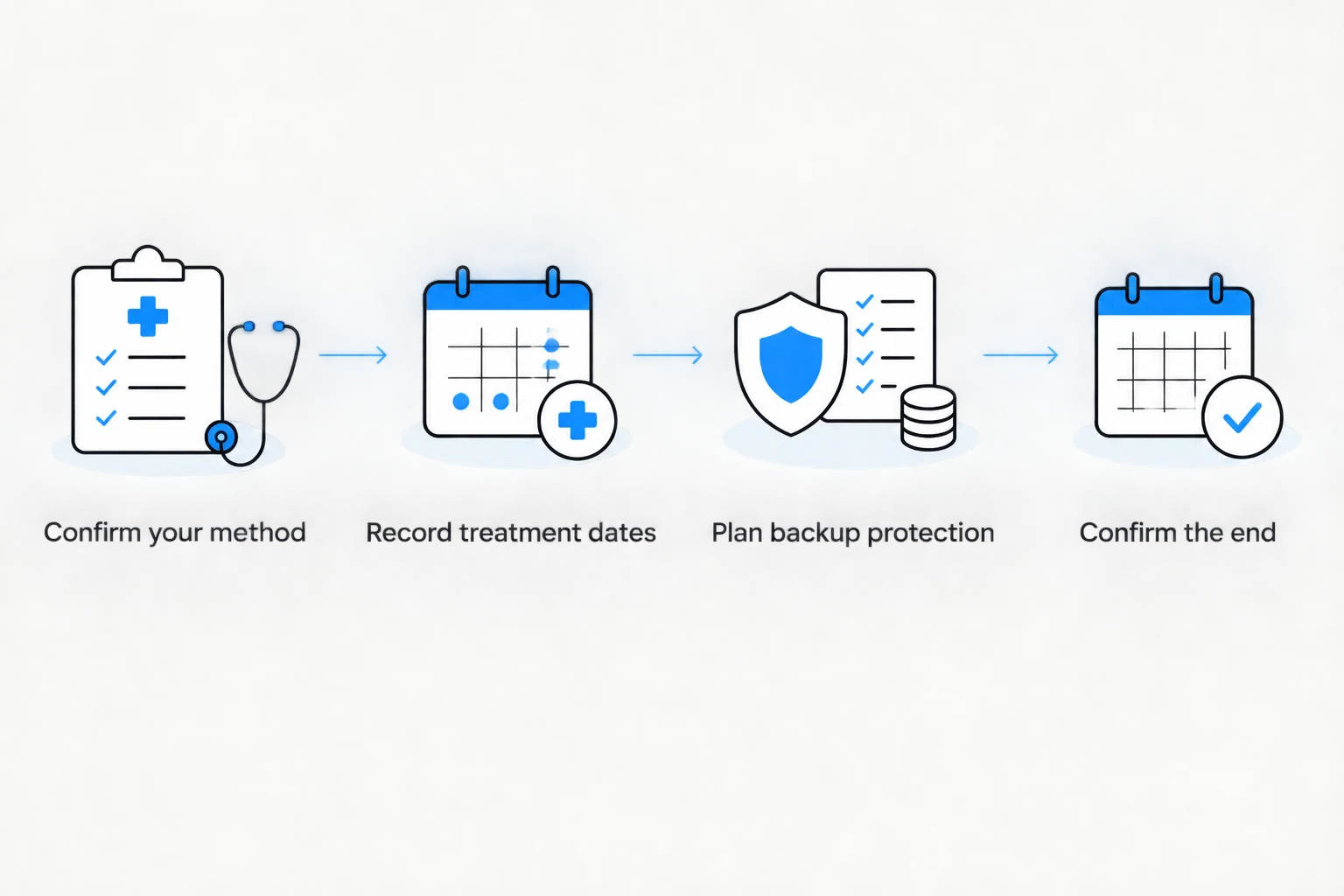
A practical way to track the window
- Confirm your method. Write down the exact contraceptive name and whether it is oral or nonoral.
- Record treatment dates. Note your first injection and every prescribed dose increase.
- Plan backup protection. Arrange the barrier method before the relevant injection, not afterward.
- Confirm the end date. Ask your clinician or pharmacist when extra protection can stop, especially after a dose change or missed pill.
Taking your pill in the morning and injecting tirzepatide at night does not replace this advice. The prescribing information does not offer dose spacing as an alternative to backup or nonoral contraception.
Nonoral birth control: no stomach-absorption precaution
Nonoral hormonal contraception is not expected to be affected by tirzepatide’s delayed gastric emptying. That includes methods such as the vaginal ring, patch, implant, and contraceptive injection. An IUD also avoids the gastrointestinal absorption issue.
Best fit for avoiding this specific interaction: a medically appropriate nonoral contraceptive. That does not make every nonoral method appropriate for every person; estrogen eligibility, bleeding preferences, future pregnancy plans, and other medicines still matter.
Starting a new method also has its own instructions about when pregnancy protection begins. Do not stop an existing method or assume a newly placed or started method works immediately without confirming the transition plan.
VEVArx is best suited to US adults seeking online, medically supervised weight loss. Its telehealth weight-loss offering includes doctor-prescribed tirzepatide, but choosing contraception still requires an individualized clinical discussion—not a general article alone.
For a 2026 treatment review, bring the contraceptive’s exact name rather than saying only that you take birth control. At VEVArx, the relevant starting point is a discussion of your medication history and pregnancy plans, not a self-directed change to either prescription.
Why your contraception plan varies
The backup instruction is specific, but your overall plan depends on more than the tirzepatide prescription. These factors determine what you need to discuss:
- Route of contraception. Oral pills face the stomach-emptying precaution; nonoral methods do not depend on gastrointestinal absorption.
- Treatment stage. Starting tirzepatide and increasing its dose each trigger the label’s temporary protection window.
- Contraceptive adherence. A missed or late pill adds a separate issue, with instructions that depend on your pill type.
- Vomiting or severe diarrhea. Gastrointestinal illness can interfere with oral contraception independently of the tirzepatide precaution.
- Other medicines. Some medicines interact with hormonal contraception through mechanisms unrelated to stomach emptying.
- Pregnancy intentions and medical history. These guide contraceptive suitability and whether weight-loss treatment should continue.
Do not use breakthrough bleeding as a home test of whether contraception is working. Bleeding changes have several causes, and neither spotting nor its absence establishes protection against pregnancy.
What should you do before a tirzepatide dose increase?
Restart the 4-week protection window after each dose increase if you use oral hormonal contraception. Review that instruction even if you tolerated the previous dose and have taken every pill correctly.
A practical 2026 medication checklist should record the prescribed dose, the date it changes, your contraceptive method, and the backup end date. Keep those details together so the contraception plan does not become disconnected from the injection schedule.
Clinical review of tirzepatide dose adjustments should include more than weight and side effects: each increase also restarts the oral-contraceptive precaution. Laboratory results do not replace this instruction, and feeling well does not cancel it.
Do not increase, delay, or reduce tirzepatide on your own to manage contraception. Ask the prescriber to coordinate treatment with a pregnancy-prevention plan you can follow consistently.
Does vomiting change what you should do with your pill?
The 4-week tirzepatide precaution does not replace your pill’s vomiting, diarrhea, or missed-dose instructions. If you vomit after taking a pill or develop severe diarrhea, check the leaflet for that exact contraceptive and contact a pharmacist when the next step is unclear.
Different pills have different rules. Do not borrow instructions from a friend’s prescription or take extra contraceptive doses simply because you feel nauseated.
Seek prompt medical care if vomiting prevents you from keeping fluids down or you develop signs of dehydration. Severe or persistent abdominal pain also needs urgent assessment during tirzepatide treatment, rather than being dismissed as an expected adjustment.
Find out if GLP-1 treatment may be right for you.
Start My Pre-AssessmentWhat if you had sex without the recommended backup?
Emergency contraception is time-sensitive, with some options used up to 5 days after unprotected sex. Contact a pharmacist, sexual-health clinic, or prescribing clinician promptly if you relied on an oral contraceptive alone during the tirzepatide protection window.
Tell them when sex occurred, which pill you use, any missed pills, your tirzepatide start or increase date, and whether you have been vomiting. These details affect the advice; taking your regular pill perfectly does not erase the tirzepatide-specific precaution.
An emergency copper IUD avoids gastrointestinal absorption. Oral emergency contraception requires individualized advice about the appropriate option, timing, and when to continue or restart regular hormonal contraception.
Do not assume tirzepatide makes every emergency contraceptive ineffective, and do not delay seeking help while trying to choose alone. If pregnancy remains possible, take a pregnancy test 3 weeks after the last unprotected sex, or follow the testing schedule your clinician provides.
What if you want to become pregnant?
Tirzepatide is not a weight-loss treatment for pregnancy. Discuss stopping treatment before trying to conceive, and ask for a plan that accounts for the medicine remaining in your body after the final injection.
If you discover a pregnancy while taking tirzepatide for weight loss, stop the weight-loss medication and contact your prescriber promptly. If tirzepatide also treats diabetes, arrange timely medical guidance for blood-glucose management rather than leaving diabetes untreated.
When discussing VEVArx telehealth weight-loss care in 2026, disclose a current pregnancy, plans to conceive, or any uncertainty about contraceptive coverage. Weight loss is not contraception, and irregular periods do not rule out pregnancy.
Have questions about your options? Start with a quick online assessment.
Start My Pre-AssessmentFAQ
Can you take tirzepatide with birth control pills in 2026?
Yes, but use a barrier method or switch to nonoral contraception for 4 weeks after starting tirzepatide and for 4 weeks after every dose increase. Continue your pill according to its instructions unless your clinician directs a change.
Does tirzepatide make every type of birth control less effective?
No. The prescribing-information precaution concerns oral hormonal contraception because tirzepatide delays stomach emptying. Nonoral hormonal contraception is not expected to be affected by that mechanism.
Do I need backup birth control after every tirzepatide injection?
No, the label specifies 4 weeks after starting treatment and 4 weeks after each dose increase, not a new window after every unchanged weekly dose. Missed pills, vomiting, or diarrhea can create separate reasons for backup.
Can I take my birth control pill at a different time from tirzepatide?
Separating the timing does not replace the recommended protection window. Tirzepatide’s prescribing information advises a barrier method or nonoral contraception rather than spacing the medicines apart.
Do I need extra contraception with an IUD while taking tirzepatide?
An IUD does not depend on stomach absorption, so the tirzepatide oral-contraceptive precaution does not apply to it. Confirm that the IUD is correctly in place and within its approved duration of use.
What if I had unprotected sex after increasing tirzepatide?
Contact a pharmacist or clinician promptly about emergency contraception if you relied on an oral contraceptive without the recommended backup. Some emergency options can be used up to 5 days after sex, and the right choice depends on your circumstances.
Should I stop birth control when I start tirzepatide?
Do not stop contraception simply because you start tirzepatide. Keep taking your pill as directed and add the recommended barrier method, or arrange a clinician-guided transition to nonoral contraception.
One last thing
The dose-increase date matters as much as the first-injection date. Before your next prescription change, put the contraception review on the same calendar entry. That small step addresses the easily overlooked part of the label: backup protection restarts after every increase, not just when treatment begins.
Related guides
Ready to get started?
See if doctor-prescribed GLP-1 treatment may be right for you. It only takes a few minutes, 100% online.
Start My Pre-AssessmentThis article is for informational purposes only and is not medical advice. Compounded medications are not approved by the FDA and have not been reviewed for safety, effectiveness, or quality. Prescription products require an online consultation with a licensed healthcare provider who will determine if a prescription is appropriate. Individual results vary.