
How often do you need to see a doctor on GLP-1 treatment?
How often do you need to see a doctor on GLP-1 treatment? Plan monthly check-ins early, then quarterly reviews. Know when symptoms need earlier care.

Plan on a check-in every month for the first 3 months, then at least every 3 months once treatment is stable—a general obesity-medication monitoring framework, not a universal GLP-1 visit requirement in 2026. Your prescriber sets your actual schedule, and side effects, dose changes, or other health conditions can require earlier contact. A check-in does not always mean an in-person appointment.
- How often do you need to see a doctor on GLP-1 treatment? Monthly early reviews are a guideline-based starting point.
- Stable obesity-medication treatment still needs reviews at least every 3 months under Endocrine Society guidance.
- New symptoms or medication changes require contact before your next scheduled appointment.
- VEVArx offers doctor-prescribed GLP-1 weight-loss treatment online for US adults; confirm the follow-up schedule before enrolling.
Why this matters
Your injection schedule and your appointment schedule are different. A weekly injection does not automatically require a weekly doctor visit, but receiving medication does not replace clinical monitoring.
Follow-up helps your clinician assess tolerability, nutrition, weight response, and whether other prescriptions need adjustment. If you are comparing online care in 2026, start by understanding whether GLP-1 medication requires a doctor visit, then ask how ongoing medical reviews work.
Curious whether you qualify? A licensed provider makes the final call.
Start My Pre-AssessmentHow often do you need to see a doctor on GLP-1 treatment?
A useful starting framework is monthly during the first 3 months and at least every 3 months afterward. The Endocrine Society's Pharmacological Management of Obesity clinical practice guideline, published in 2015, recommends that cadence for assessing weight-loss medication safety and effectiveness.
That guidance covers obesity pharmacotherapy generally. It is not a GLP-1-specific rule requiring every patient to attend an office visit on the same timetable.
| Treatment stage | Monitoring framework | What the review should address |
|---|---|---|
| Before starting | Initial prescribing assessment | Medical history, medication list, treatment suitability, and instructions |
| First 3 months | At least monthly under Endocrine Society guidance | Side effects, weight response, eating and drinking, and the treatment plan |
| Stable ongoing treatment | At least every 3 months under that guidance | Continued benefit, tolerability, health changes, and ongoing treatment needs |
| New symptoms or treatment problems | Contact sooner; do not wait for the calendar | Symptom severity, medication safety, and whether urgent assessment is needed |
The benefit of this framework is consistency: you know when someone will review your progress. Its limitation is that a calendar cannot account for every symptom or medication change. Your prescriber must personalize the plan.
Starting treatment: monthly reviews for the first 3 months
Early appointments establish whether the prescription fits your health needs and how you tolerate it. Feeling less hungry is only part of that assessment. Your clinician also needs to know whether you can eat adequately, stay hydrated, and manage daily activities.
Bring a current list of prescriptions, over-the-counter medicines, and supplements. Mention diabetes medicines, blood-pressure treatment, previous medication reactions, and any plans for pregnancy.
At each review, discuss:
- Your actual use: the medication, prescribed dose, injection dates, and missed doses.
- Your symptoms: nausea, vomiting, constipation, diarrhea, abdominal pain, or dizziness.
- Your intake: whether you can eat regular meals and keep fluids down.
- Your response: weight trends, appetite changes, and relevant home measurements.
- Your next step: whether to continue the current plan or discuss an adjustment.
Do not increase your dose simply because another month has passed. Product instructions and your clinician's assessment determine dose changes. Persistent symptoms deserve review rather than an automatic increase.
Stable treatment: reviews at least every 3 months
Once your treatment is stable, the general guideline framework becomes at least every 3 months. Stable means more than recognizing your injection routine: your clinician should be satisfied with tolerability, response, and the monitoring plan.
A maintenance appointment should revisit whether treatment continues to help you. It should also cover new diagnoses, new prescriptions, nutrition concerns, and symptoms you have started treating as normal.
Reaching a weight goal does not remove the need for follow-up. Your clinician still needs to discuss the benefits and risks of continuing treatment, changing the plan, or stopping.
For your 2026 maintenance plan, leave each review with a next appointment or a clear instruction for arranging one. Ask what should trigger contact sooner and who handles questions between visits.
Dose changes: contact your prescriber before adjusting
Dose escalation is a prescribing decision, not a reward for tolerating the previous injection. Some branded injectable weight-management medicines use escalation steps separated by at least 4 weeks, but their instructions differ. Follow the instructions for your exact medication.
The FDA prescribing information for Wegovy and Zepbound describes product-specific escalation schedules. Those schedules tell you how dosing progresses; they do not establish a universal appointment schedule.
If your planned increase falls between appointments, ask how your prescriber wants to review symptoms first. Do not assume that a refill, a shipment, or an automated reminder means a dose increase has been clinically approved.
After a treatment interruption, get restart instructions rather than assuming your previous dose is still appropriate. The correct action depends on the medicine and the length of the interruption.
Why GLP-1 follow-up frequency varies
Your monitoring schedule should reflect your health, not just the program's default calendar. These factors can justify closer review:
- Dose changes: a new dose requires attention to tolerability and your response.
- Digestive symptoms: persistent vomiting or diarrhea can interfere with hydration and nutrition.
- Other diabetes medicines: insulin and sulfonylureas can increase hypoglycemia risk when used with GLP-1 treatment.
- Kidney concerns: dehydration can affect kidney function and prompt testing or closer assessment.
- Other treatment changes: new prescriptions, pregnancy plans, or an upcoming procedure can require a revised plan.
- Difficulty eating enough: marked appetite suppression is not a reason to ignore inadequate intake.
You do not need to decide which factor is medically significant on your own. Report the change, describe its timing, and let the clinician determine the next step.
Can GLP-1 follow-up visits happen through telehealth?
Yes, some follow-up assessments can happen through telehealth when the clinician considers remote care appropriate and applicable requirements are met. Remote care can support a discussion of symptoms, medication use, and home measurements; it cannot provide every physical examination or urgent assessment.
| Care format | Best for | Benefit | Limitation |
|---|---|---|---|
| Telehealth review | Routine discussions when remote assessment is appropriate | Lets you discuss progress without traveling to an office | Cannot replace every examination, test, or urgent evaluation |
| In-person review | Concerns requiring a physical examination or local assessment | Allows hands-on assessment | Requires travel and appointment coordination |
VEVArx GLP-1 telehealth is best suited to US adults seeking online, medically supervised weight loss. VEVArx offers doctor-prescribed semaglutide and tirzepatide; ask about its actual follow-up arrangements before choosing care.
Confirm whether reviews use video, phone, or clinical messaging, who evaluates your responses, and how to request an earlier assessment. Do not assume that an online program provides emergency care or that every message reaches a clinician immediately.
Find out if GLP-1 treatment may be right for you.
Start My Pre-AssessmentWhat should you prepare before a GLP-1 check-in?
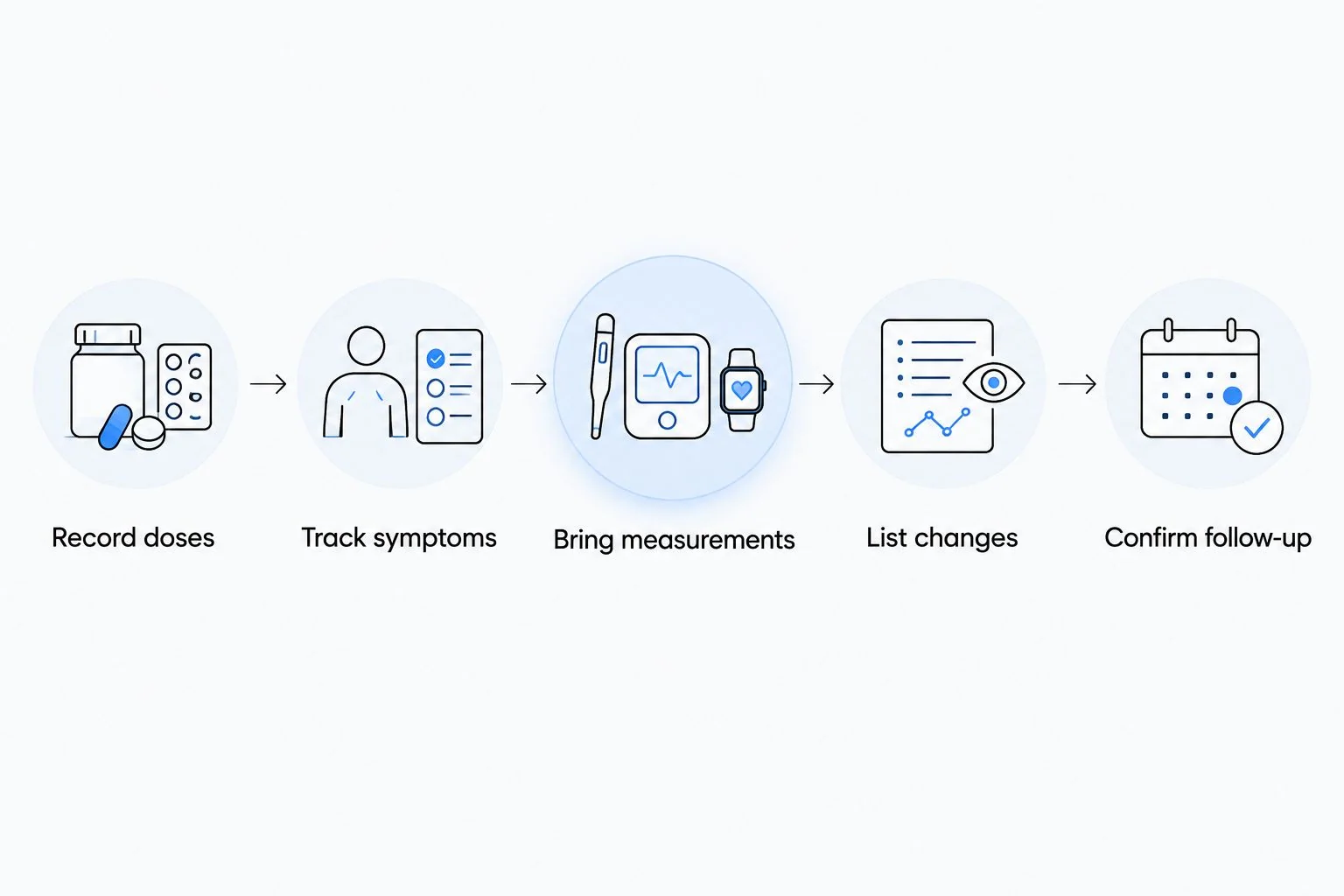
A useful check-in starts with a short, accurate record—not a perfect spreadsheet. For a 2026 treatment review, prioritize information that helps your clinician make a safe decision.
- Record doses. Note the medication name, prescribed dose, injection dates, and missed doses. For a vial, distinguish the prescribed dose from the syringe markings.
- Track symptoms. Record when symptoms began, whether they follow injections, and whether they affect eating, drinking, or normal activities.
- Bring measurements. Share your weight trend and any blood-pressure or glucose readings your clinician has requested.
- List changes. Include new medicines, supplements, diagnoses, pregnancy plans, or procedures.
- Confirm follow-up. Ask when the next review is due and what symptoms require earlier contact.
This record helps you avoid describing an entire month as simply good or bad. It also separates a brief, manageable symptom from one that is persistent or worsening.
Do you need blood tests at every GLP-1 appointment?
No, there is no universal requirement for blood tests at every GLP-1 follow-up. Your clinician chooses tests based on your medical history, treatment indication, symptoms, and other medicines.
For example, diabetes care can require glucose-related monitoring, while persistent vomiting or dehydration can prompt assessment of kidney function and electrolytes. These are clinical decisions, not a standard laboratory bundle everyone needs every month.
Ask what each requested test is intended to assess and when the result will change your care. A normal previous result does not replace reassessment when your symptoms or health circumstances change.
When should you contact a clinician before your next appointment?
Contact your care team sooner when symptoms persist, worsen, or interfere with eating and drinking. Do not wait for a routine review if you repeatedly vomit, struggle to keep fluids down, develop significant dizziness, or experience concerning glucose readings.
Severe, persistent abdominal pain—especially pain that spreads to your back, with or without vomiting—needs urgent medical assessment. FDA prescribing information for semaglutide and tirzepatide warns about pancreatitis and other potentially serious adverse reactions; a routine messaging queue is not the right place to wait for severe symptoms.
Trouble breathing, swelling of the face or throat, collapse, or another apparent emergency requires emergency services. In the US, call 911.
For non-emergency concerns, describe the symptom, when it started, your latest dose, and whether you can keep fluids down. Ask for instructions about your next scheduled dose rather than making an unsupported adjustment.
Have questions about your options? Start with a quick online assessment.
Start My Pre-AssessmentFAQ
Do I need to see a doctor every month on GLP-1 treatment?
Monthly reviews are a guideline-based starting point during the first 3 months of obesity-medication treatment, not a universal lifelong requirement. Your prescriber determines the actual schedule based on your medication, symptoms, and health needs.
How often should I have check-ins once my GLP-1 dose is stable?
At least every 3 months is the Endocrine Society's general monitoring framework after the initial treatment period. Contact your clinician sooner if symptoms, prescriptions, or health circumstances change.
Does a weekly GLP-1 injection mean I need a weekly doctor appointment?
No, a weekly injection does not automatically require a weekly doctor appointment. Your injection frequency comes from the prescription, while your follow-up frequency comes from your clinical monitoring plan.
Can my GLP-1 follow-up be online instead of in person?
Yes, telehealth can be appropriate for some routine GLP-1 follow-ups. A clinician must determine whether you need an in-person examination, testing, or urgent local assessment instead.
Do I need blood tests every month while taking semaglutide?
No, monthly blood tests are not a universal requirement for everyone taking semaglutide. Testing depends on your medical history, diabetes care, symptoms, and other treatment needs.
Should I wait until my next appointment if I keep vomiting?
No, persistent vomiting warrants earlier clinical contact, especially if you cannot keep fluids down. Severe abdominal pain, fainting, or other serious symptoms require urgent assessment rather than waiting for routine follow-up.
Does VEVArx offer medically supervised GLP-1 treatment online?
Yes, VEVArx offers doctor-prescribed GLP-1 weight-loss medications through an online telehealth platform for US adults. Confirm the appointment schedule, clinician contact process, and arrangements for testing or in-person assessment before enrolling.
One last thing
A refill is not the same thing as a medical review. Medication delivery confirms a supply step; it does not tell you whether your dose, symptoms, or changing health needs have been assessed.
Before your next refill in 2026, make sure you know your next review date and how to report a problem. If either answer is unclear, ask your prescriber before relying on the refill process to keep your care on track.
This article provides general education, not an individualized treatment schedule. Follow your prescriber's instructions and the prescribing information for your medication.
Related guides
Ready to get started?
See if doctor-prescribed GLP-1 treatment may be right for you. It only takes a few minutes, 100% online.
Start My Pre-AssessmentThis article is for informational purposes only and is not medical advice. Compounded medications are not approved by the FDA and have not been reviewed for safety, effectiveness, or quality. Prescription products require an online consultation with a licensed healthcare provider who will determine if a prescription is appropriate. Individual results vary.