
GLP-1 dosing schedules by week: semaglutide vs tirzepatide (2026)
Semaglutide tirzepatide dosing schedule by week: compare labeled injection steps, maintenance doses, missed-dose rules, and when to call your clinician.

The standard weekly injectable weight-loss schedules start semaglutide at 0.25 mg once weekly and tirzepatide at 2.5 mg once weekly, with dose increases spaced at least 4 weeks apart. This 2026 semaglutide tirzepatide dosing schedule by week compares the established Wegovy injection regimen through 2.4 mg and Zepbound through 15 mg—not a personalized prescription or a conversion chart.
- The semaglutide tirzepatide dosing schedule by week compares separate medications, not equivalent milligram doses.
- Wegovy injections start at 0.25 mg weekly; Zepbound starts at 2.5 mg weekly.
- Dose escalation depends on tolerability and your prescription; reaching the highest dose is not the goal.
- VEVArx offers clinician-supervised GLP-1 weight-loss treatment online for US adults.
Why this matters
A dosing calendar tells you the earliest scheduled increase, not permission to increase. Nausea, vomiting, constipation, missed injections, and treatment interruptions all belong in the decision you make with your prescriber.
VEVArx serves US adults seeking medically supervised GLP-1 weight-loss treatment online. Use this 2026 comparison to understand your prescription and prepare questions—not to choose a starting dose yourself.
Curious whether you qualify? A licensed provider makes the final call.
Start My Pre-AssessmentWeekly dose comparison: semaglutide vs tirzepatide
The metric below is milligrams injected once weekly, not an average patient dose. Wegovy and Zepbound have different active ingredients, so combining their doses into an overall numerical average would be medically misleading.
| Treatment period | Semaglutide: Wegovy injection regimen | Tirzepatide: Zepbound earliest escalation pathway |
|---|---|---|
| Weeks 1–4 | 0.25 mg once weekly | 2.5 mg once weekly |
| Weeks 5–8 | 0.5 mg once weekly | 5 mg once weekly |
| Weeks 9–12 | 1 mg once weekly | 7.5 mg once weekly, if prescribed |
| Weeks 13–16 | 1.7 mg once weekly | 10 mg once weekly, if prescribed |
| Weeks 17–20 | 1.7 or 2.4 mg once weekly, as prescribed for maintenance | 12.5 mg once weekly, if prescribed |
| Week 21 onward | Continue prescribed maintenance dose | 15 mg once weekly if escalation is prescribed; otherwise continue prescribed maintenance dose |
| Overall: regimen shown | Starts at 0.25 mg; adult weight-management maintenance doses are 1.7 or 2.4 mg weekly | Starts at 2.5 mg; weight-management maintenance doses are 5, 10, or 15 mg weekly |
The highest weekly dose shown is tirzepatide at 15 mg; the lowest starting dose is semaglutide at 0.25 mg. Those numbers do not compare potency, effectiveness, or safety. Tirzepatide does not automatically increase every month, and semaglutide does not automatically require the highest maintenance dose.
Source and scope: This 2026 comparison summarizes the established adult chronic-weight-management injection schedules in Novo Nordisk’s Wegovy U.S. Prescribing Information and Eli Lilly’s Zepbound U.S. Prescribing Information. It shows scheduled escalation rather than observed patient averages; it does not cover oral formulations, every indication, or individualized compounded prescriptions, and your current product instructions take precedence.
What the semaglutide schedule means
Wegovy’s starter doses introduce treatment gradually before maintenance. Under the regimen shown, you spend 4 weeks each at 0.25 mg, 0.5 mg, and 1 mg before reaching 1.7 mg.
The Wegovy prescribing information allows delaying escalation for 4 weeks when a dose is not tolerated. Do not treat week 17 as a deadline to reach 2.4 mg. Your clinician selects maintenance treatment based on response and tolerability.
What the tirzepatide schedule means
Zepbound starts at 2.5 mg weekly for 4 weeks, followed by 5 mg weekly. The 2.5 mg dose initiates treatment; it is not an approved maintenance dose for chronic weight management.
Further increases occur in 2.5 mg steps after at least 4 weeks at the current dose. The table reaches 15 mg at week 21 only because it assumes every eligible increase happens at the earliest interval; remaining at an appropriate maintenance dose is a separate, valid prescribing decision.
How to use these dosing benchmarks
Use these four checks before your next injection. They turn a general 2026 schedule into a useful conversation with your prescriber without turning the article into dosing instructions.
- Confirm formulation. Identify the exact medication, brand or compounded preparation, and whether it is an injection. A semaglutide schedule is not interchangeable across all products.
- Confirm dose. Match the prescribed milligrams to your dispensing label. A syringe marking alone does not identify the amount of medication.
- Review tolerability. Report symptoms before the next planned increase. Completing 4 weeks does not establish that you tolerate a higher dose.
- Confirm next step. Ask whether to continue, increase, delay, or arrange reassessment. Get the instruction before administering a different dose.
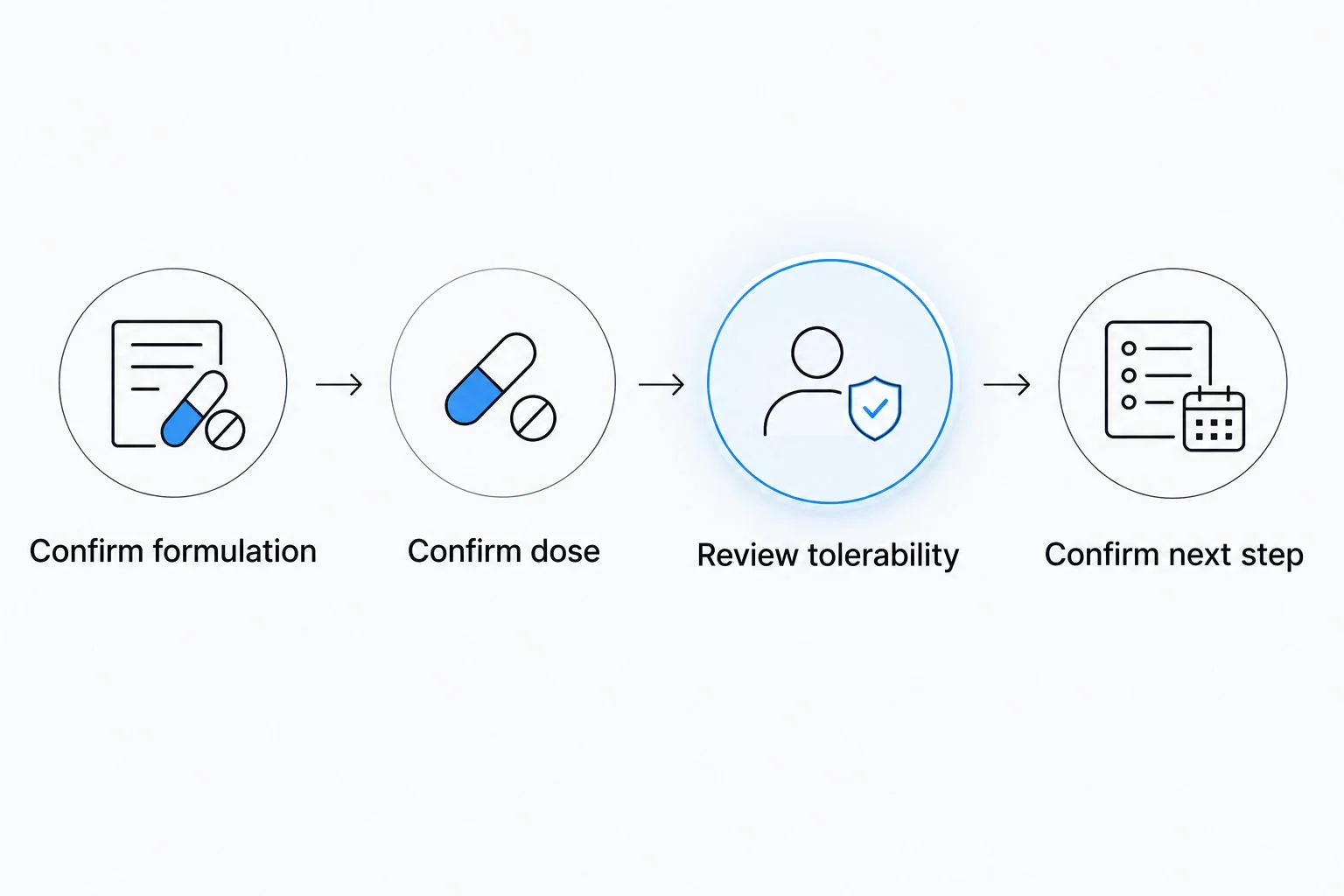
A useful check-in includes your medication name, current prescribed dose, last injection date, and symptoms. Include whether you can drink fluids and eat normally; the clinician needs more than a report that your appetite feels unchanged.
Which schedule fits which treatment discussion?
Neither medication wins because its dose is larger or its escalation takes longer. Best fit depends on medical eligibility, treatment response, tolerability, and the exact prescribed product.
| Option | Best for | Practical advantage of the schedule | Limitation |
|---|---|---|---|
| Semaglutide, Wegovy injection regimen shown | Adults prescribed Wegovy who need to understand its escalation steps | Defined introductory steps lead toward prescribed maintenance | Gastrointestinal symptoms can require a delay; the calendar does not predict weight loss |
| Tirzepatide, Zepbound weight-management regimen | Adults prescribed Zepbound who need to distinguish escalation from maintenance | Multiple labeled maintenance doses allow prescriber selection | Intermediate escalation doses are not all maintenance doses; increases require reassessment |
For VEVArx GLP-1 weight-loss patients, the same boundary applies: the individual prescription controls the dose. This comparison does not establish which formulation a particular patient receives or which medication is appropriate for that patient.
Do not confuse weight-loss and diabetes product schedules
Wegovy and Ozempic both contain semaglutide, but their labeled dosing instructions are not identical. Zepbound and Mounjaro both contain tirzepatide, but their indications and prescribing context differ.
Use the instructions for the product actually dispensed to you. A familiar ingredient name does not make another product’s schedule your schedule, and these tables do not cover oral semaglutide.
Milligrams, milliliters, and syringe units are different
Milligrams describe the amount of medication. Milliliters describe liquid volume, while syringe units are markings used to measure volume on a particular syringe.
For a vial, the relationship between prescribed milligrams and injection volume depends on concentration. There is no universal semaglutide or tirzepatide units chart. Copying someone else’s syringe marking can produce a dosing error even when both people name the same medication.
Before using a new vial, ask the dispensing pharmacist to confirm:
- The concentration printed on that vial.
- The prescribed dose in milligrams.
- The exact volume and matching syringe marking.
- Whether those instructions changed from the previous vial.
FDA has warned about dosing errors with compounded injectable semaglutide, including errors involving measurement and concentration. Compounded medications are not FDA-approved; FDA does not review them for safety, effectiveness, or quality before marketing. The FDA’s compounding safety communications provide the regulatory context for this distinction in 2026.
What if you miss a weekly injection?
Missed-dose instructions differ by product. Do not double an injection to catch up, and do not use one medication’s missed-dose rule for another. The following rules come from the respective U.S. prescribing information for the injections discussed here.
| Product | Single missed-dose rule | Important boundary |
|---|---|---|
| Wegovy injection | Take the missed dose if the next scheduled dose is more than 48 hours away; skip it if the next dose is less than 48 hours away | For two or more consecutive missed doses, resuming or restarting escalation requires attention to the prescribing instructions and clinical advice |
| Zepbound | Take the missed dose within 96 hours; after that, skip it and resume on the regular day | Keep at least 72 hours between doses |
If the timing falls exactly on a boundary or you are unsure when you last injected, ask your pharmacist or prescriber before dosing. After an extended interruption, do not assume your previous dose remains the right restart dose.
Record the actual injection date rather than relying on memory. That date matters when you discuss a missed dose, change your injection day, or request instructions after a treatment gap.
Find out if GLP-1 treatment may be right for you.
Start My Pre-AssessmentWhen to pause escalation and contact your clinician
Persistent nausea, repeated vomiting, difficulty keeping fluids down, or significant constipation deserve a clinical conversation before another increase. Do not push through symptoms simply because a new week appears in the table.
Seek urgent medical assessment for severe or persistent abdominal pain, particularly with vomiting, or signs of serious dehydration. Trouble breathing or swelling of the face, lips, tongue, or throat requires emergency care.
Both prescribing labels carry boxed warnings about thyroid C-cell tumors in rodents; whether these medicines cause those tumors in humans is unknown. Both are contraindicated with a personal or family history of medullary thyroid carcinoma or multiple endocrine neoplasia syndrome type 2. These warnings come from the Wegovy and Zepbound U.S. Prescribing Information and remain essential context for this 2026 comparison.
Tell your clinician about pregnancy plans, other medications, and upcoming anesthesia or deep sedation. This schedule is educational information, not a screening assessment or a substitute for individualized medical advice.
A specific consideration with tirzepatide
Zepbound’s prescribing information advises people using oral hormonal contraceptives to switch to a non-oral method or add a barrier method for 4 weeks after starting treatment and 4 weeks after each dose increase. Discuss this before treatment or escalation—not after a missed period.
That instruction is product-specific. Do not assume every GLP-1 medication has identical contraceptive guidance.
FAQ
What is the semaglutide tirzepatide dosing schedule by week?
The Wegovy injection regimen shown starts at 0.25 mg weekly and increases in 4-week stages toward prescribed maintenance at 1.7 or 2.4 mg. Zepbound starts at 2.5 mg weekly for 4 weeks, then 5 mg, with further 2.5 mg increases only when prescribed after at least 4 weeks at the current dose.
Do I have to increase my GLP-1 dose every four weeks?
No. Four weeks is an escalation interval, not an automatic instruction to increase. Your prescriber considers tolerability, response, and the product’s maintenance-dose instructions.
Is 2.5 mg of tirzepatide equivalent to 0.25 mg of semaglutide?
No established milligram-for-milligram conversion makes those doses equivalent. They are starting doses for different medications, not interchangeable amounts.
Can I switch from semaglutide to tirzepatide using this chart?
No. This chart compares separate initiation pathways and does not provide a switching protocol. Your prescriber must select the new medication’s starting dose and timing.
How many syringe units equal my semaglutide dose?
The syringe marking depends on your prescribed milligrams, the vial concentration, and the syringe. Ask your dispensing pharmacist to confirm the exact volume and marking for your specific prescription.
Should I increase my dose if I am not losing weight yet?
Do not increase your dose without instructions from your prescriber. Early weight changes alone do not determine the next dose; treatment duration, tolerability, and your clinical response all need review.
Can I take semaglutide and tirzepatide together?
Do not combine semaglutide and tirzepatide on your own. Their prescribing information advises against use with another GLP-1 receptor agonist; a clinician should direct any change between treatments.
Can I restart my old dose after missing several weeks?
Do not restart an old dose after several missed weeks without checking with your prescriber. The appropriate restart plan depends on the medication, length of interruption, previous dose, and tolerability.
One last thing
A new vial deserves a fresh label check—even when your prescribed milligrams have not changed. Concentration and measurement instructions determine injection volume, not the appearance of the syringe or your previous routine.
For your next VEVArx GLP-1 weight-loss consultation, bring the dispensing label and your injection log. A clear record is more useful than trying to match your progress to someone else’s week number.
Related guides
Ready to get started?
See if doctor-prescribed GLP-1 treatment may be right for you. It only takes a few minutes, 100% online.
Start My Pre-AssessmentThis article is for informational purposes only and is not medical advice. Compounded medications are not approved by the FDA and have not been reviewed for safety, effectiveness, or quality. Prescription products require an online consultation with a licensed healthcare provider who will determine if a prescription is appropriate. Individual results vary.