
Can you take tirzepatide with high blood pressure medication?
Can you take tirzepatide with high blood pressure medication? Often yes, with monitoring. Learn the risks, warning signs, and questions for your doctor.

Yes, you can often take tirzepatide with high blood pressure medication when your prescriber reviews the combination and monitors your blood pressure. The main concern is blood pressure dropping too low as weight, food intake, or hydration changes—not a blanket ban on combining these treatments.
- Can you take tirzepatide with high blood pressure medication? Often yes, with prescriber review and blood-pressure monitoring.
- Tirzepatide-related vomiting or diarrhea can cause dehydration, making low blood pressure and kidney problems more concerning.
- Never stop or reduce blood pressure medication without instructions from the clinician managing it.
- VEVArx offers doctor-prescribed telehealth weight-loss treatment for US adults; medication suitability requires individual assessment.
Can you take tirzepatide with high blood pressure medication?
High blood pressure medication does not automatically rule out tirzepatide. FDA prescribing information for Mounjaro and Zepbound does not list treatment with antihypertensive medication itself as a contraindication. The Zepbound label does identify hypotension as an adverse reaction, including in people taking antihypertensive treatment.
For your 2026 treatment discussion, bring the exact medication names, doses, and reasons you take them. A drug prescribed for blood pressure can also treat heart failure, an abnormal heart rhythm, or kidney disease; that changes how your clinician approaches adjustments.
| Blood pressure medication class | Examples | What matters alongside tirzepatide |
|---|---|---|
| ACE inhibitors | Lisinopril, enalapril | Dehydration makes kidney function and low blood pressure important concerns. |
| Angiotensin receptor blockers | Losartan, valsartan | Review blood pressure, kidney function, and potassium when clinically indicated. |
| Diuretics | Hydrochlorothiazide, furosemide | Fluid loss from vomiting or diarrhea adds to dehydration concerns. |
| Calcium channel blockers | Amlodipine, diltiazem | Review dizziness, blood pressure, and the reason for treatment. |
| Beta blockers | Metoprolol, carvedilol | Review pulse and blood pressure; do not stop abruptly without medical direction. |
This table flags monitoring issues, not preferred combinations. No medication class is automatically the best choice for everyone taking tirzepatide, and a pharmacist should check your full medication list.
Curious whether you qualify? A licensed provider makes the final call.
Start My Pre-AssessmentWhy this matters
The goal is to treat weight-related health needs without losing control of your blood pressure. Weight loss can improve blood pressure, but vomiting, diarrhea, or reduced fluid intake can also lower readings for an unhealthy reason.
A lower reading is not automatically a better reading. Symptoms, hydration, kidney function, and your usual blood pressure help your clinician interpret the change.
Keep blood-pressure readings alongside medication dates and symptoms. This guide to tracking your GLP-1 doses covers the medication-log side; your clinician should set the blood-pressure targets and follow-up plan.
Why your blood pressure response varies
Your blood pressure response depends on more than which injection you take. These factors deserve attention during a 2026 medication review:
- Your starting blood pressure: Someone with readings already near their lower limit needs a different monitoring plan from someone with persistently elevated readings.
- Your medication combination: Taking several blood-pressure-lowering medicines changes the review, especially when a diuretic is involved.
- Fluid loss: Vomiting and diarrhea can reduce circulating fluid volume and contribute to low blood pressure or kidney injury.
- Changes in weight and intake: Weight loss and changes in eating patterns can alter blood pressure and treatment needs over time.
- Kidney and heart conditions: Kidney disease and heart failure affect medication decisions, fluid advice, and whether laboratory monitoring is needed.
- Recent treatment changes: A new prescription, dose increase, or illness makes fresh readings more useful than an old baseline.
Do not assume that dizziness proves your blood pressure medicine is too strong. Low blood sugar, dehydration, and other conditions can cause similar symptoms, so report what happened rather than choosing the explanation yourself.
How should you monitor blood pressure when starting tirzepatide?
Use a validated automatic upper-arm monitor with the correct cuff size. American Heart Association home-monitoring guidance recommends avoiding exercise, smoking, and caffeine for 30 minutes beforehand, resting quietly for 5 minutes, and taking readings 1 minute apart.
These measurement basics apply in 2026 whether you receive care online or in person. Ask your clinician how often to measure and which readings or symptoms should trigger a call.
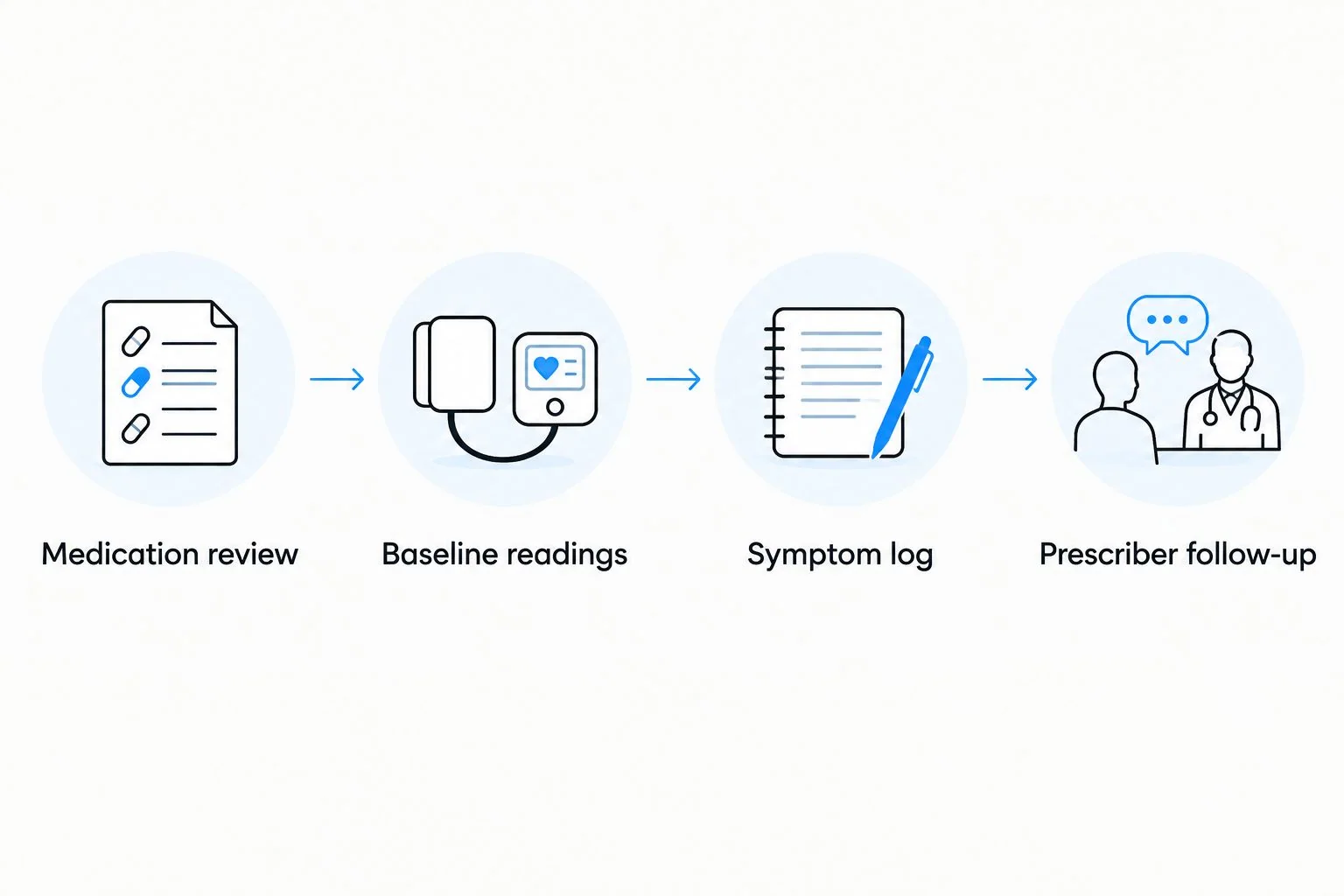
- Medication review: Share prescriptions, over-the-counter medicines, supplements, and the actual doses you take. Include medicines you use only occasionally.
- Baseline readings: Record readings before starting or changing treatment when practical. Sit with your back supported, feet flat, and arm supported at heart level.
- Symptom log: Note dizziness, faintness, weakness, vomiting, diarrhea, and reduced fluid intake. Record whether symptoms happen after standing or around medication time.
- Prescriber follow-up: Send the readings and symptoms to the clinician managing your blood pressure. Ask who will coordinate decisions if different clinicians prescribe the two treatments.
The sequence matters: establish what you take, measure consistently, document symptoms, and share the pattern. An isolated measurement without context gives your clinician less to work with.
Bring your home monitor to an appointment if you question its accuracy. A clinician can check your technique and compare the device with office equipment before treatment decisions depend on its readings.
What symptoms mean you should get help?
New dizziness, faintness, or marked weakness deserves attention, especially with vomiting or diarrhea. Sit or lie down to reduce the chance of falling, and check your blood pressure if you can do so safely. Contact your clinician promptly for instructions.
Seek urgent assessment for repeated vomiting, inability to keep fluids down, very little urine, or symptoms that persist or worsen. Do not drive yourself if you feel faint or unsafe.
When is high blood pressure an emergency?
A blood pressure reading above 180/120 mm Hg with chest pain, shortness of breath, weakness, numbness, vision changes, or difficulty speaking requires emergency help. Call 911 rather than waiting for a telehealth message or your next scheduled appointment.
If your reading is above 180/120 mm Hg without those symptoms, wait at least 1 minute, measure again, and contact a healthcare professional immediately if it remains that high. American Heart Association guidance distinguishes this situation from a high reading accompanied by emergency symptoms.
What if your blood pressure seems too low?
There is no single home reading that tells every person to stop a medication. Your usual readings, symptoms, and medical conditions determine the response; ask for an individualized low-reading action plan.
Loss of consciousness, chest pain, severe breathing difficulty, or signs of stroke require emergency help regardless of the blood-pressure number. Do not spend time taking repeated measurements before calling.
Should you take tirzepatide and blood pressure pills at different times?
There is no universal requirement to separate tirzepatide from blood pressure pills by a set number of hours. Follow the instructions for each prescription rather than creating your own schedule.
Tirzepatide delays gastric emptying and can affect absorption of oral medications. FDA prescribing information advises caution with oral medicines that depend on threshold concentrations for effectiveness or have a narrow therapeutic index; your pharmacist can identify whether that concern applies to your prescriptions.
Spacing a pill away from an injection is not a substitute for checking an interaction. Keep your prescribed schedule unless your clinician or pharmacist changes it, and ask what to do if you vomit after taking an oral medicine rather than automatically repeating the dose.
Find out if GLP-1 treatment may be right for you.
Start My Pre-AssessmentCan weight loss mean you need less blood pressure medication?
Weight loss can reduce blood pressure, but it does not automatically eliminate the need for medication. Your clinician should base any adjustment on repeated readings, symptoms, and the reason each medicine was prescribed.
A medicine supporting heart failure or kidney care has a purpose beyond the number on your cuff. That is why a lower reading does not always mean the right move is to remove a prescription.
For your 2026 follow-up, bring a readable log rather than relying on memory. Include measurement times, medication changes, symptoms, and periods of poor intake; your clinician can then distinguish a lasting trend from an illness-related dip.
Do not stop a beta blocker abruptly. Sudden discontinuation can be dangerous, and any reduction needs instructions from the prescribing clinician.
What should you ask before getting an online prescription?
An online weight-loss consultation still needs a full medication history. Tell the prescriber about kidney disease, heart failure, fainting, previous dehydration, diabetes treatment, and any recent blood-pressure changes.
Ask these questions before starting:
- Who will manage changes to my blood pressure prescriptions?
- What home readings should make me call, and which symptoms require urgent care?
- Do my medicines or medical conditions require kidney-function or electrolyte testing?
- What should I do if vomiting or diarrhea prevents normal eating, drinking, or medication use?
- When should I follow up after starting treatment or increasing a dose?
VEVArx is best for US adults seeking doctor-prescribed telehealth weight-loss treatment. VEVArx offers that care model, but an online platform does not replace emergency assessment or establish that tirzepatide is suitable for your individual medication combination.
The advantage is access to a prescribing consultation online. The limitation is that symptoms requiring an examination or urgent testing still need the appropriate in-person setting.
Have questions about your options? Start with a quick online assessment.
Start My Pre-AssessmentFAQ
Can I take tirzepatide if I already take lisinopril?
Taking lisinopril does not automatically rule out tirzepatide. Your prescriber should review blood pressure, kidney health, and dehydration risk, especially if vomiting or diarrhea develops.
Can I take tirzepatide with losartan or amlodipine?
Losartan or amlodipine use does not automatically prevent tirzepatide treatment. Your clinician should check the full medication list and monitor for low blood pressure or symptoms that require an adjustment.
Is tirzepatide safe with a water pill?
A diuretic requires particular attention to hydration when taken alongside tirzepatide. Vomiting or diarrhea can add to fluid loss, so ask your clinician for instructions before illness occurs rather than stopping the diuretic yourself.
Will tirzepatide let me stop my blood pressure medicine?
Tirzepatide does not guarantee that you can stop blood pressure medication. Weight loss can lower blood pressure, but your clinician must consider repeated readings and any other reason you take the medicine.
Should I skip my blood pressure pill if tirzepatide makes me dizzy?
Do not make a routine medication change on your own because of dizziness. Sit or lie down, check your pressure if safe, and contact your clinician promptly; fainting or severe symptoms require urgent assessment.
How long should I rest before checking blood pressure at home?
Rest quietly for 5 minutes before checking your blood pressure. American Heart Association guidance also recommends avoiding smoking, caffeine, and exercise for 30 minutes beforehand and taking readings 1 minute apart.
Can VEVArx decide whether my medicines work with tirzepatide?
VEVArx offers doctor-prescribed telehealth weight-loss treatment, which requires an individual prescribing assessment. Share your complete medication list and coordinate blood-pressure changes with the clinician managing that treatment.
One last thing
The most useful question is not just whether the medicines can be combined—it is who will adjust them if your readings change. Before starting tirzepatide in 2026, identify that clinician and get clear instructions for low readings, persistent vomiting, and urgent symptoms.
Also ask about fluid intake rather than assuming that drinking more is always appropriate. If you have heart failure, kidney disease, or a prescribed fluid restriction, hydration advice needs to fit that condition.
This article provides general education, not a personal prescribing or medication-adjustment plan. FDA prescribing information for Mounjaro and Zepbound and American Heart Association home-monitoring and hypertensive-crisis guidance provide the clinical basis for the precautions above.
Related guides
Ready to get started?
See if doctor-prescribed GLP-1 treatment may be right for you. It only takes a few minutes, 100% online.
Start My Pre-AssessmentThis article is for informational purposes only and is not medical advice. Compounded medications are not approved by the FDA and have not been reviewed for safety, effectiveness, or quality. Prescription products require an online consultation with a licensed healthcare provider who will determine if a prescription is appropriate. Individual results vary.