
From at-home lab test to GLP-1 prescription: complete 2026 workflow
Your at home lab test glp-1 prescription workflow starts with a clinician, not a kit. Learn what to prepare, how to share results, and when to seek follow-up.

Instead of arranging an at-home lab test and then chasing a GLP-1 prescription, start with a clinician-directed workflow: confirm which tests are needed, collect the requested sample, share the complete report, and review treatment eligibility. Lab results inform the prescribing decision; they do not replace a medical consultation or guarantee medication.
- Your at home lab test glp-1 prescription workflow starts with clinical review, not an independently chosen kit.
- VevaRX offers doctor-prescribed GLP-1 weight-loss care for adults seeking medical supervision online.
- Confirm the required tests and acceptable collection method before collecting a sample.
- A complete lab report supports eligibility review; normal results do not guarantee a prescription.
Why this matters
An at-home test answers a specific laboratory question. A prescribing consultation answers a different question: whether a particular treatment fits your health history, current medications, goals, and risks. Combining those decisions without checking the requirements first creates avoidable repeat testing.
VevaRX is best suited to adults seeking doctor-prescribed GLP-1 weight-loss care through an online telehealth platform. VevaRX offers semaglutide and tirzepatide through medically supervised care. That describes its treatment model, not a promise that a particular home test will be accepted.
Online care makes the consultation remote, but it does not make every clinical task remote. Its limitation is practical: specimen collection, a physical examination, or urgent assessment can require in-person care. Use this 2026 workflow to organize the handoff between testing and prescribing, without assuming that the platform supplies a kit or accepts an outside report.
Before you start
- Prepare your clinical information. Gather your current medication and supplement list, relevant diagnoses, allergies, recent height and weight, previous weight-loss treatments, and any existing laboratory reports. Include pregnancy, breastfeeding, or pregnancy plans when relevant.
- Confirm access and responsibility. You need a clinician who can evaluate you in your state, a way to receive laboratory results, and the clinician's approved method for sharing medical records. Ask who orders the tests and who reviews abnormal findings.
- Check the collection method before ordering a kit. An at-home finger-stick sample is not automatically interchangeable with a venous blood draw. Confirm the exact tests, specimen type, collection instructions, and whether the prescribing clinician accepts that laboratory's report.
The non-obvious gotcha is acceptance, not convenience. A technically completed home test still leaves you blocked if it omits a requested measurement or uses a collection method the clinician does not accept.
Medical history
Establish the prescribing requirements
- Arrange the clinical evaluation first. Explain that you want to discuss GLP-1 treatment for weight management and ask whether laboratory testing is needed before the prescribing decision. Do not choose a broad wellness panel as a substitute for that discussion.
- Provide your full medication history. Include prescription medicines, nonprescription products, supplements, and any previous semaglutide or tirzepatide use. If you take insulin or another medicine that lowers blood glucose, make that explicit rather than listing only the drug name.
- Discuss relevant conditions and treatment goals. Tell the clinician about diabetes, kidney problems, pancreatitis, gallbladder disease, severe stomach-emptying problems, and personal or family thyroid cancer history. A history of medullary thyroid carcinoma or multiple endocrine neoplasia syndrome type 2 requires specific prescribing review.
- Ask what happens after the results arrive. Establish whether you need another consultation, where to submit the report, and whom to contact about an abnormal result. Record the instructions somewhere you can find them during collection.
Expected result: You know which clinician owns the decision, what information they need, and whether testing belongs in your pathway.
For adult weight management, FDA-approved semaglutide and tirzepatide prescribing information describes eligibility based on obesity, or overweight with a weight-related condition. Common adult thresholds are a BMI of 30 kg/m² or higher, or 27 kg/m² or higher with a qualifying condition. These thresholds support a 2026 eligibility conversation; meeting them does not establish that treatment is safe or appropriate for you.
This adult workflow concerns people 18 years and older. Pediatric care requires its own product-specific evaluation rather than an adult checklist applied to a younger patient.
Test selection
Match the test to the clinical question
- Get the requested test names in writing. Depending on your history, a clinician can request information about blood glucose, kidney function, liver function, or other concerns. There is no universal home laboratory panel that independently authorizes a GLP-1 prescription.
- Ask whether existing results answer the question. Send the dates and test names from recent reports before repeating collection. The clinician decides whether those results are sufficiently current and relevant.
- Confirm specimen compatibility. Ask whether each requested test can be performed using the proposed home collection method. If a test requires a different specimen or collection setting, arrange that route instead of substituting another measurement yourself.
- Clarify preparation instructions. Follow the ordering clinician's and laboratory's directions about fasting, hydration, medication use, and collection timing. Do not stop prescribed medicines merely because you are preparing for a blood test.
Expected result: You have an accepted test plan, an appropriate collection method, and clear preparation instructions.
Choose the collection route that meets the requirements
Home collection and in-person collection are alternatives for obtaining specimens, not competing prescribing decisions. Neither route is inherently the right choice for every requested test.
| Collection route | Best for | Practical advantage | Limitation |
|---|---|---|---|
| At-home collection | People whose requested tests and specimen requirements fit an accepted home method | You collect the specimen without traveling to a collection site | Collection errors or specimen restrictions can require another sample |
| In-person collection | People whose requested tests need a venous draw or supervised collection | A trained collector handles the collection process | You need to attend a collection location |
Choose the accepted specimen method, not the most convenient-looking kit. If the clinician needs an in-person draw, a home result does not automatically remove that requirement. Conversely, do not assume you need a clinic visit when the requested tests can be completed through an accepted home method.
Sample collection
Complete the collection without changing the instructions
- Check the materials before starting. Read the laboratory's collection instructions and confirm that the materials match the requested specimen. Check any expiration information and return requirements supplied with the kit.
- Match the patient identifiers. Ensure your name and other required identifying details agree across the order, specimen label, and report. Use the laboratory's labeling instructions rather than adding or omitting fields yourself.
- Follow the collection sequence exactly. Use only the supplied or specified materials. Do not combine samples, change containers, or attempt a different collection technique because the original method is difficult.
- Return or deliver the specimen as directed. Follow the laboratory's packaging, storage, and transport instructions. Keep any confirmation details so you can ask about a missing specimen without repeating the collection prematurely.
Expected result: The laboratory receives a correctly identified specimen collected and handled according to its requirements.
If collection fails, pause and contact the laboratory. An insufficient sample is a collection problem, not proof of a health problem, and a rejected specimen is not a normal result. Recollection needs instructions specific to the test and collection method.
Keep your record simple: test ordered, collection date, laboratory, and report received. Your 2026 treatment record should distinguish those events instead of treating a dispatched kit as completed testing.
Clinical review
Turn the report into a treatment decision
- Obtain the complete laboratory report. Preserve the patient details, collection date, test names, values, units, reference intervals, and laboratory comments. A cropped screenshot of a green status indicator does not provide the same clinical context.
- Submit it through the approved channel. Use the prescribing clinician's instructions for sharing medical information. Avoid public comments, social media messages, or an unverified inbox.
- Review the findings with the clinician. Ask which results affect treatment selection, which need follow-up, and whether any additional evaluation is necessary. Tell the clinician about symptoms even when a result falls inside the laboratory's reference interval.
- Confirm the decision and follow-up plan. If treatment is prescribed, obtain the medication-specific instructions, monitoring plan, and contact route for side effects. If treatment is deferred, ask what needs to happen before reassessment.
Expected result: You receive a clinical decision and a documented next step, not simply a laboratory report.
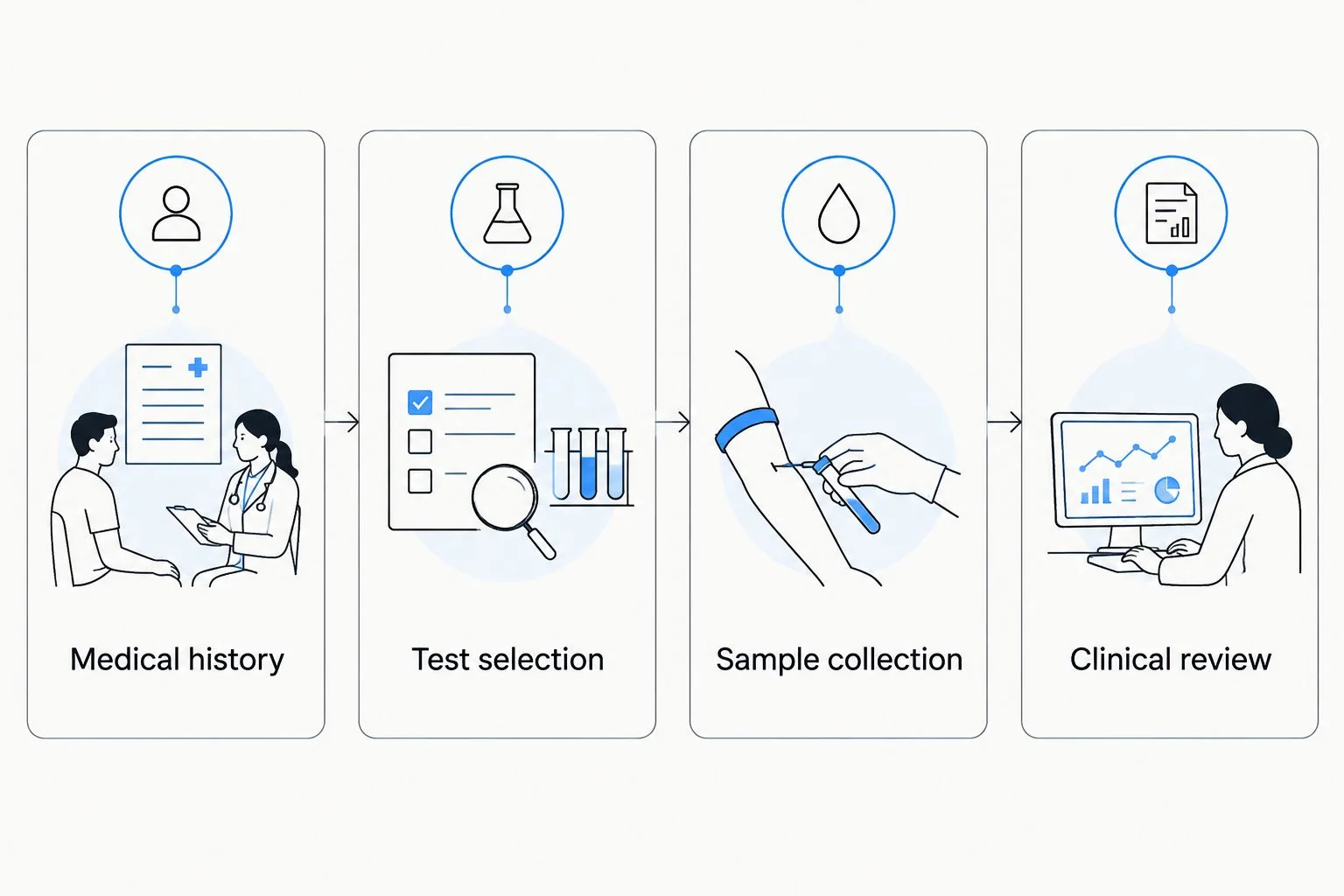
The pathway is Medical history, Test selection, Sample collection, then Clinical review. The prescribing decision belongs at the end of that sequence, after the clinician has the information needed to assess you.
Second workflow: use an existing lab report
You do not always need to begin with a new sample. If you already have laboratory results from another clinician, start by asking whether they meet the prescribing requirements.
- Collect the original report. Include all relevant pages rather than copying values into a message. Keep the collection date visible.
- Explain why the testing was performed. Results from a routine visit and results collected during an acute illness have different clinical contexts. Add any medication changes or new symptoms since collection.
- Request an acceptance decision. Ask whether the existing report covers the required tests and whether the clinician needs updated measurements. Do not declare the report current based on a cutoff you found elsewhere.
- Complete only the requested next steps. If the clinician accepts part of the report, clarify which remaining tests are needed before arranging more collection.
Best for: Adults with existing laboratory records who want to avoid duplicating accepted tests. The advantage is using information already available; the limitation is that an older or incomplete report does not necessarily answer the current clinical question.
This 2026 workflow also applies when transferring care. A previous prescription documents prior treatment, but a new clinician still needs to evaluate whether continuing it is appropriate.
Troubleshooting
The clinician does not accept the home test
Ask whether the issue is the laboratory, specimen method, missing tests, or report format. Request the accepted alternative before collecting again. Repeating the same unaccepted test does not fix the mismatch.
The laboratory rejects the sample
Follow the laboratory's recollection instructions. Common specimen problems include insufficient quantity, labeling errors, and handling problems. Do not treat rejection as a result or improvise a replacement collection method.
Your report contains an abnormal value
Contact the ordering or prescribing clinician for interpretation and next steps. A result outside the reference interval is not a diagnosis by itself. If you have severe symptoms, seek timely medical care rather than waiting for a routine prescribing appointment.
Your report appears normal, but treatment is declined
Ask which clinical factor drives the decision. Normal laboratory results do not remove medication contraindications, establish eligibility, or resolve concerns about your history. Do not seek a different test simply to obtain a desired prescribing outcome.
You cannot find the report or confirm receipt
Contact the laboratory to confirm whether processing is complete and request the full report. Separately confirm that the prescribing clinician received it. A laboratory releasing results and a clinician reviewing them are different steps.
Customize your workflow
Make one person or clinical team responsible for coordinating the prescribing decision. If your primary care clinician orders testing while a telehealth clinician evaluates treatment, clarify how results will move between them and who handles follow-up findings.
VevaRX provides online GLP-1 weight-loss care; keep laboratory acceptance separate from that service description. Ask about your own testing requirements before assuming that a home kit, outside report, or additional consultation is part of your pathway.
For the broader appointment-to-treatment sequence, read the telehealth consult-to-prescription GLP-1 workflow. Keep a medication list and symptom record alongside your laboratory documents, and update them whenever treatment or your health changes.
FAQ
Can an at-home lab test get me a GLP-1 prescription?
An at-home lab test cannot authorize a GLP-1 prescription by itself. A prescribing clinician must evaluate your eligibility, health history, medications, and any required results.
Do I need blood tests before starting GLP-1 treatment in 2026?
Your clinician decides whether blood tests are needed before GLP-1 treatment in 2026. The requested tests depend on your history and clinical concerns, not a universal home-testing checklist.
Does VevaRX accept results from any home testing company?
Confirm acceptance with VevaRX before collecting a specimen. Ask about the requested tests, laboratory, specimen method, and report format rather than assuming every outside result qualifies.
Is a finger-stick test better than an in-person blood draw?
Neither collection method is better for every test. Use the method that meets the laboratory's specimen requirements and the prescribing clinician's acceptance criteria.
Can I use blood test results from my regular doctor?
You can submit existing results for the prescribing clinician to assess. Include the full report and collection date; the clinician decides whether additional or updated testing is needed.
Do normal blood tests mean I qualify for semaglutide or tirzepatide?
Normal blood tests do not establish eligibility for semaglutide or tirzepatide. The clinician also evaluates the treatment indication, contraindications, medication interactions, and relevant medical history.
Should I stop my medicines before collecting a home sample?
Do not stop prescribed medicines unless your clinician specifically instructs you to do so. Follow the test-specific preparation instructions and ask about anything that conflicts with your usual treatment.
What should I do if my symptoms are severe while I wait for results?
Seek urgent medical assessment for severe symptoms rather than waiting for a routine lab review. Severe persistent abdominal pain, difficulty breathing, fainting, or inability to keep fluids down require prompt attention.
One last thing
The most useful question is not whether your result is normal; it is whether the result answers the clinician's question. A complete report can still be irrelevant to the requested evaluation, while a flagged value requires interpretation rather than automatic rejection.
Before your 2026 prescribing consultation, write down who will review the results and what happens if follow-up is needed. That closes the gap between collecting a sample and receiving medical care.
Related guides
This article is for informational purposes only and is not medical advice. Compounded medications are not approved by the FDA and have not been reviewed for safety, effectiveness, or quality. Prescription products require an online consultation with a licensed healthcare provider who will determine if a prescription is appropriate. Individual results vary.