
From intake quiz to peptide prescription: complete 2026 workflow
Use a peptide intake quiz to prescription workflow built around clinician review. Prepare your history, resolve safety questions, and check instructions.

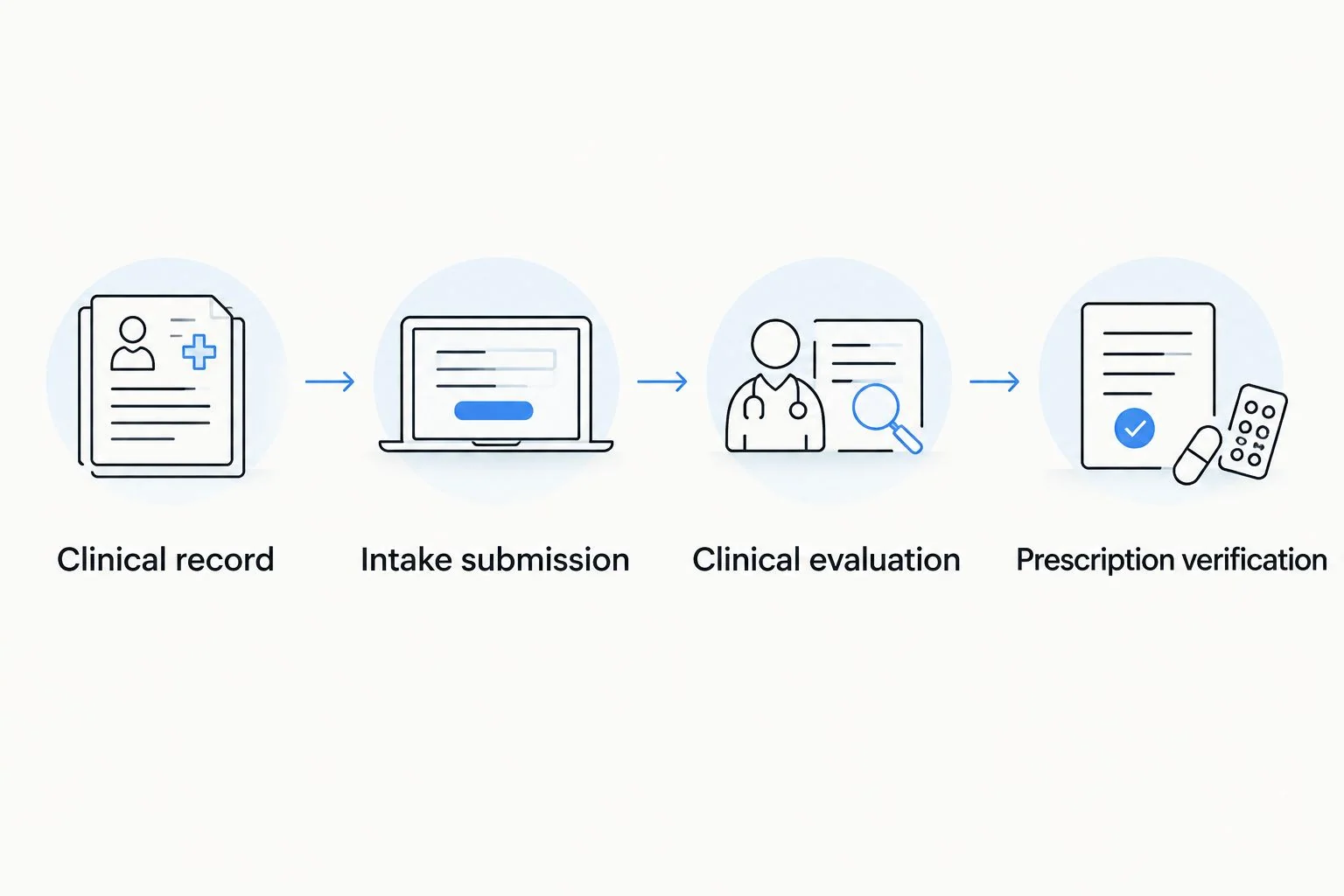
Instead of repeatedly retyping your medical history, use a peptide intake quiz to prescription workflow that turns your information into a clinician-ready record. The sequence is preparation, intake, clinical evaluation, and—only when appropriate—a prescription with written instructions and follow-up.
- A peptide intake quiz to prescription workflow organizes information; only a licensed clinician decides whether to prescribe.
- VEVArx serves US adults seeking online, medically supervised weight loss and wellness peptide prescriptions.
- Prepare your medication list, health history, and treatment goals before starting a telehealth intake.
- Do not start treatment until the prescription, pharmacy label, and clinician instructions agree.
Why this matters
A completed quiz is not a prescription. An intake collects information; a clinical evaluation determines whether a proposed treatment fits your health history and goals. Keeping those stages separate prevents a submitted form from becoming permission to self-treat.
VEVArx is best suited to US adults seeking an online platform for medically supervised weight loss and wellness peptide prescriptions. VEVArx describes that service, but an individual treatment decision still belongs to the prescribing clinician.
In 2026, the word peptide alone does not tell you a product's approved uses, evidence, or regulatory status. Ask about the exact medication and formulation rather than assuming everything in the category follows the same prescribing rules. Convenience helps you organize care; it does not replace clinical judgment.
Curious whether you qualify? A licensed provider makes the final call.
Start My Pre-AssessmentBefore you start
Prepare these materials before opening an intake form:
- Identity and access: Have your identifying information, current physical location, contact details, and access to the email or phone you use for healthcare communications. Keep sensitive records within the provider's designated secure channel.
- Clinical materials: Gather your diagnoses, allergies, surgeries, pregnancy or breastfeeding status, previous treatment reactions, and existing laboratory reports. For each medication, record 3 details: name, dose, and schedule. Include supplements and nonprescription products.
- The gotcha: Finishing the quiz does not establish eligibility. Clinical questions, requested records, or an in-person evaluation can change the next step. If you already use an injectable treatment, have the actual prescription label—not just a remembered syringe marking.
For your 2026 intake, use current information rather than copying an old application unchanged. Do not arrange testing or stop medication solely to complete a questionnaire; let the clinician explain what is necessary.
Your clinical record
The first configuration unit is your record, not a medication selection. A useful record tells the clinician what you want to address, what you already take, and which safety questions need attention.
Prepare the information the clinician needs
- State your goal. Describe the concern in plain language and explain how it affects you. Separate a weight-management goal from a request about energy, recovery, or another wellness concern; these do not establish the same diagnosis or treatment indication.
- List your treatments. Include prescriptions, injections, supplements, allergies, and previous adverse reactions. Copy medication details from current labels whenever possible. Do not omit something because another provider prescribed it.
- Document relevant history. Report existing conditions and previous treatment problems accurately. If a question does not fit your situation, explain rather than selecting an inaccurate answer to advance the form.
- Prepare your questions. Ask what evidence supports the proposed use, whether the exact product is FDA-approved, and what alternatives address the same goal. Include a question about what would make treatment inappropriate.
Expected result: You have a reusable clinical summary that distinguishes facts from goals. The clinician can evaluate a request without relying on a product name alone.
Keep the summary somewhere private. A reusable record is useful; a shared document containing your entire medical history creates unnecessary exposure.
Intake submission
Complete the provider's actual questionnaire without treating it as a test you need to pass. Use the field names and navigation shown in the current form; the sequence below describes the information flow, not a particular website interface.
Complete and check your intake
- Enter your current location and identifying details. Telehealth prescribing depends on applicable state requirements and clinician authorization. Your current physical location matters, not just the address associated with your account.
- Answer health questions fully. Report pregnancy, plans for pregnancy, breastfeeding, significant conditions, and previous reactions when relevant. Never change an answer to obtain a preferred treatment.
- Add medication details and requested records. Provide only the materials requested through the provider's secure process. If you do not know a detail, identify it as unknown rather than guessing.
- Review before submitting. Check names, medication spelling, doses, allergies, and contact information. Correct discrepancies before they become part of a prescribing decision.
- Save the submission confirmation. Keep whatever acknowledgment the provider supplies. Read any next-step instructions rather than assuming submission means a consultation or prescription has occurred.
Expected result: Your intake accurately represents your current health situation, and you know whether another action is required. A confirmation establishes that information was submitted—not that a clinician approved treatment.
Do not send a duplicate application just to correct a typo. Use the provider's designated correction or communication process so the clinical record stays consistent.
Clinical evaluation
A peptide intake quiz to prescription workflow needs an explicit clinical decision point. VEVArx offers doctor-prescribed treatments, so keep the distinction between requesting treatment and receiving a prescription clear throughout the process.
Resolve the prescribing questions
- Explain the treatment request. Tell the clinician what you hope to change, what you have tried, and why you are considering treatment now. Ask whether the concern requires a diagnosis or examination before discussing medication.
- Clarify unanswered safety questions. Supply requested history or records and explain any conflicting information. The clinician determines whether laboratory testing, an examination, or another evaluation is necessary.
- Identify the exact proposed treatment. Ask for the medication name, formulation, intended use, and relevant limitations. Different products grouped under “peptide therapy” are not interchangeable.
- Discuss benefits, risks, and alternatives. Ask what evidence supports the intended use, which adverse effects need attention, and what a reasonable monitoring plan involves. A decision not to prescribe is a valid clinical outcome.
- Confirm the decision and next action. Establish whether the plan is further evaluation, a different approach, or a prescription. Do not interpret a general discussion of treatment as an individualized order.
Expected result: You understand the clinical decision and its rationale. Any unresolved prerequisite stays visible rather than disappearing behind a completed questionnaire.
For additional context, read the guide to peptide therapy legality in the US. In 2026, regulatory questions still need to be answered for the exact substance, intended use, and prescribing circumstances—not for “peptides” as a single group.
The workflow below keeps the decision point separate from both data collection and treatment instructions. A prescription is a possible outcome, not a guaranteed destination.
Prescription verification
An appropriate prescription is the beginning of treatment instructions, not the end of the workflow. Do not administer medication when the label or directions are unclear.
Check the plan before the first dose
- Match the patient and medication. Check 2 patient identifiers, such as your name and date of birth, against the prescription information. Confirm the medication and formulation match what the clinician discussed.
- Reconcile the directions. Make sure the prescribed dose, route, schedule, and pharmacy instructions agree. For an injectable product, ask the pharmacist to explain any conversion between medication dose, liquid volume, and syringe markings.
- Read the product-specific instructions. Confirm storage, preparation, handling, and disposal requirements with the pharmacy. Do not apply another injectable medication's instructions to a different formulation.
- Get a monitoring plan. Ask what to track, when reassessment is needed, and whom to contact about side effects or missed doses. Keep 1 written plan that reflects the current prescription.
- Resolve discrepancies before starting. Contact the dispensing pharmacist or prescriber if the product, concentration, or instructions differ from what you expected. Do not calculate a replacement dose from an online example.
Expected result: The prescription information, pharmacy label, and clinical plan agree. You understand how to use the medication and how to get help without improvising.
Compounded medications are not FDA-approved. If compounding is proposed, ask why it is appropriate for your circumstances and what that means for the exact formulation; an intake questionnaire does not answer those questions by itself.
When your health information changes
An initial evaluation and a follow-up review are adjacent workflows, but they serve different purposes. Use follow-up to report changes—not to assume that an earlier prescription remains appropriate indefinitely.
| Workflow | Best for | Advantage | Limitation |
|---|---|---|---|
| Initial evaluation | Adults seeking assessment of a new treatment request | Establishes baseline history and suitability | Requires enough information for a new clinical decision |
| Follow-up review | Existing patients reporting response, side effects, or health changes | Focuses the clinician on what changed | Does not guarantee renewal or a dose adjustment |
For a follow-up in 2026, start with the current medication label and the written treatment plan. Then:
- Record what you actually took, including missed doses or interruptions.
- Describe benefits and symptoms without deciding their cause yourself.
- Report new diagnoses, medications, supplements, pregnancy plans, or changes in your location.
- Ask whether the existing plan still applies before changing the dose or restarting after an interruption.
Expected result: The clinician reviews current information rather than an outdated intake. A renewal, adjustment, pause, or referral follows a new decision—not an automatic assumption.
This approach reduces repeated history-taking, but it still requires accurate reporting and clinical review. Those are safeguards, not administrative obstacles.
Find out if GLP-1 treatment may be right for you.
Start My Pre-AssessmentTroubleshooting
You submitted the quiz but have no prescription
A submission confirmation is not prescribing authorization. Check the next-step instructions and use the provider's designated communication channel to clarify whether information, an evaluation, or another action is outstanding.
Your answers contain a medication error
Correct the record before treatment decisions proceed. State exactly what was wrong and provide the accurate name, dose, and schedule; do not assume a later form silently replaces the earlier answer.
The clinician requests tests you do not have
Ask which tests are needed and how the results will affect the decision. Provide existing reports if requested, but do not substitute unrelated wellness panels or treat an abnormal result yourself.
The syringe markings do not match the prescription wording
Pause and contact the pharmacist or prescriber. Syringe units describe a measurement scale; they are not a universal medication dose, and concentration differences make copied instructions unsafe.
Symptoms develop before your planned follow-up
Use the clinical contact instructions rather than waiting for a routine review. For severe symptoms such as trouble breathing, fainting, or severe abdominal pain, seek urgent medical evaluation; an intake portal is not an emergency service.
Customize your workflow
Build your record around the clinical question, not around collecting the largest amount of data. Weight-management care and a wellness request need their own discussion of evidence, suitability, and monitoring.
For VEVArx patients, keep a personal copy of the agreed instructions and update your medication list whenever treatment changes. Bring that record to other healthcare appointments so different prescribers can assess the full picture.
Track only information that supports the clinician's plan. A concise symptom timeline is more useful than unexplained screenshots, and a treatment log supports discussion rather than authorizing self-directed dose changes.
Have questions about your options? Start with a quick online assessment.
Start My Pre-AssessmentFAQ
Does completing a peptide intake quiz guarantee a prescription?
No. A peptide intake quiz collects information for clinical evaluation; a licensed clinician decides whether treatment is appropriate. Additional information, testing, or an in-person assessment can be necessary.
What should I prepare before a peptide telehealth intake?
Prepare identifying information, your current location, medical history, allergies, and a current medication list. Include prescriptions, supplements, previous reactions, and relevant records requested by the provider.
Can I get a peptide prescription without a video call?
The required evaluation format depends on the treatment, clinical circumstances, provider process, and applicable state requirements. Do not assume that a questionnaire alone satisfies the requirements for your prescription.
Are all prescription peptides FDA-approved in 2026?
No. Regulatory status depends on the exact product and intended use, and compounded medications are not FDA-approved. Ask the prescriber to explain the status of the specific formulation being considered.
Do I need laboratory tests before a peptide prescription?
Your clinician determines whether laboratory testing is necessary for the proposed treatment and your medical history. There is no single testing checklist that applies to every product described as a peptide.
What if my injection instructions do not match the pharmacy label?
Do not inject until the pharmacist or prescriber resolves the discrepancy. Confirm the medication, concentration, dose, route, and schedule instead of copying another patient's instructions.
Can I change my dose after completing a follow-up questionnaire?
A submitted follow-up questionnaire does not authorize a dose change. Follow your current prescription until the prescriber gives you updated instructions, unless you need urgent medical evaluation.
One last thing
A syringe marking is not a portable dosing instruction. Before starting or restarting treatment in 2026, reconcile the current label with the current prescription—even if the vial looks familiar. That final check matters more than how quickly you completed the intake.
Related guides
Ready to get started?
See if doctor-prescribed GLP-1 treatment may be right for you. It only takes a few minutes, 100% online.
Start My Pre-AssessmentThis article is for informational purposes only and is not medical advice. Compounded medications are not approved by the FDA and have not been reviewed for safety, effectiveness, or quality. Prescription products require an online consultation with a licensed healthcare provider who will determine if a prescription is appropriate. Individual results vary.