
From video consult to doorstep delivery: complete 2026 GLP-1 workflow
Understand the online GLP-1 prescription delivery process: clinical approval comes first. Check pharmacy details, inspect delivery, and prepare for safe refills.

Instead of repeatedly chasing intake forms, prescription updates, and delivery details, organize the online GLP-1 prescription delivery process around clinical review, pharmacy confirmation, and safe receipt. This 2026 guide explains what to prepare, what to verify after a video consultation, and when to contact your prescriber rather than proceed.
- VevaRX fits US adults seeking doctor-prescribed GLP-1 weight-loss care online.
- The online GLP-1 prescription delivery process requires clinical approval before pharmacy dispensing and shipment.
- Verify the medication, formulation, directions, and storage instructions before your first injection.
- Treat refills as clinical checkpoints, not permission to increase your dose automatically.
Why this matters
A completed video consultation is not a prescription, and a prescription is not a shipment. Each stage has a different owner: the clinician decides whether treatment is appropriate, the pharmacy dispenses the medication, and the carrier transports the package.
VevaRX offers online, doctor-prescribed GLP-1 weight-loss medications for adults in the US. VevaRX is best for US adults seeking online, doctor-prescribed GLP-1 weight-loss care. Online access does not replace an individualized medical assessment or guarantee approval.
For your 2026 provider comparison, use Best Telehealth Weight Loss Programs alongside the process below. Compare clinical oversight and follow-up, not just the convenience of getting a package delivered.
The advantage of telehealth is less travel and easier organization of information. The limitation is that some concerns need laboratory testing, a physical examination, or in-person care. Choose the format that supports safe treatment rather than trying to force every step online.
Before you start
- Prepare access and identity details. Have a private place for the consultation, a working camera and microphone, identification if requested, your current location, and an accurate delivery address. Confirm that the provider can treat patients in your state before completing enrollment.
- Build your health summary. List prescriptions, over-the-counter medicines, supplements, allergies, medical conditions, previous weight-loss treatment, and relevant laboratory results. Include pregnancy, breastfeeding, or pregnancy plans. Bring 7 days of symptom notes if you already take a GLP-1 medication; this is a preparation suggestion, not a treatment requirement.
- Resolve the non-obvious gotcha: formulation matters. A drug name alone does not establish the brand, approved indication, concentration, device, or storage requirements. Ask whether the proposed prescription is an FDA-approved product or a compounded preparation before planning administration or delivery.
These are patient-side preparation steps, not a description of VevaRX's portal screens. Follow the actual provider's instructions for submitting information; do not send medical records through an unverified email address or public messaging channel.
Health history and consultation preparation
Organize the information your clinician needs
- Write down your treatment goal and the weight-related health concerns you want assessed. Include previous treatments and why you stopped them.
- Create 1 medication list covering everything you currently take. Record names and directions from the labels rather than relying on memory, and identify any existing GLP-1 prescription.
- Gather relevant medical records and test results. Ask the provider which documents are needed; do not order tests solely because an online checklist suggests them.
- Confirm the appointment format and requirements. If a video visit is scheduled, test your camera, audio, and connection before the appointment.
- Tell the clinician your physical location at the time of the visit. A shipping address and a consultation location are not necessarily the same.
Expected result: You can describe your health history accurately, the clinician has the requested records, and the appointment can proceed without avoidable administrative gaps.
For an existing prescription, include the exact product, your prescribed dose, the date of your last injection, and any missed doses. A photograph of the label can help identify the formulation, but submit it only through the provider's approved communication channel.
Do not simplify an uncomfortable symptom to keep the appointment moving. Persistent vomiting, severe abdominal pain, or difficulty maintaining fluid intake changes the clinical discussion. Seek urgent assessment for severe symptoms rather than waiting for a routine weight-loss visit.
Clinical review and prescription details
Get a treatment decision, not just an approval message
- Discuss eligibility, medical history, potential benefits, and risks with the prescriber. Ask which findings would make GLP-1 treatment inappropriate for you.
- Confirm whether additional records, laboratory testing, or an in-person assessment are needed before a prescribing decision.
- Identify the exact proposed medication and formulation. Ask the clinician to explain its intended use and whether that use follows the product's FDA-approved indication.
- Review the prescribed starting directions and the follow-up plan. Ask what to do about side effects, missed doses, treatment interruptions, and other medicines you take.
- Record who to contact for clinical questions and who handles pharmacy or delivery questions. Keep those responsibilities separate.
Expected result: You understand whether treatment was prescribed, deferred, or declined, and you have clear next steps for the decision you received.
VevaRX's GLP-1 weight-loss offering includes semaglutide and tirzepatide. Those names do not make the products interchangeable. Semaglutide acts at the GLP-1 receptor; tirzepatide acts at both GIP and GLP-1 receptors. The prescriber chooses treatment based on your clinical circumstances, not on a self-selected dose conversion.
| Medication discussion | Best for | Potential benefit | Limitation to discuss |
|---|---|---|---|
| Semaglutide | Adults whose clinician selects semaglutide for their treatment plan | Provides a GLP-1-based treatment option with FDA-approved products for specified indications | Gastrointestinal side effects, contraindications, and product-specific directions require review |
| Tirzepatide | Adults whose clinician selects tirzepatide for their treatment plan | Provides a dual GIP/GLP-1 treatment option with FDA-approved products for specified indications | Gastrointestinal side effects, contraindications, and medication interactions require review |
This table supports a consultation; it does not recommend either medication for an individual reader. Check the current FDA prescribing information for the exact product discussed in your 2026 appointment. Product labeling, not a generic online injection tutorial, governs its warnings and administration instructions.
Compounded preparations are not FDA-approved. FDA approval of an active ingredient in a branded medicine does not mean a compounded preparation has undergone the same review. Ask why compounding is proposed, which pharmacy prepares it, and what instructions apply to that specific preparation.
Pharmacy confirmation and shipment preparation
Verify the dispensing details before shipment
- Establish whether the prescription has actually been sent to the dispensing pharmacy. An appointment confirmation alone does not establish this.
- Confirm the pharmacy's identity and licensing through the relevant state board of pharmacy. Use verified contact details when asking about your prescription.
- Check the medication name, formulation, prescribed directions, and delivery address. Resolve discrepancies before dispensing or shipment whenever possible.
- Ask the pharmacy for the storage requirements and what to do if the package is delayed, damaged, or arrives under questionable temperature conditions.
- Confirm how shipment updates will reach you. Make a receipt plan that prevents the package from sitting unattended in unsuitable conditions.
Expected result: You know which pharmacy is dispensing the prescription, where it is going, and how to handle the medication when it arrives.
Do not assume that a displayed prescription status means a carrier has possession of the package. Prescription receipt, dispensing, label creation, and carrier acceptance are separate events. Ask the pharmacy which event has occurred rather than repeatedly asking whether the order is complete.
For travel during 2026, confirm the delivery address before processing and ask about storage during transit and at your destination. Do not redirect a temperature-sensitive shipment without checking with the pharmacy. A convenient delivery change can create a medication-handling problem.
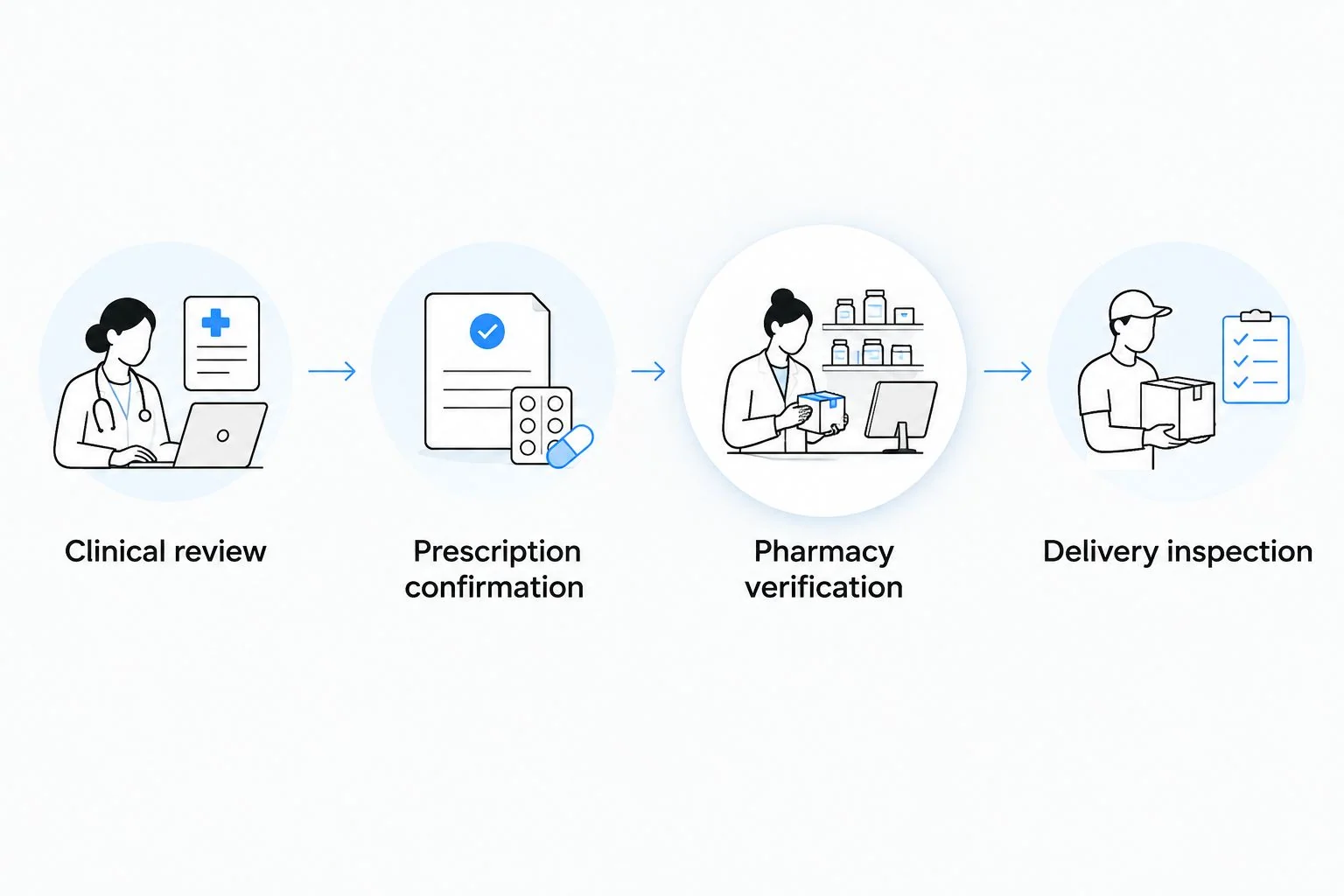
The practical sequence is Clinical review, Prescription confirmation, Pharmacy verification, then Delivery inspection. Preserve that order even when several messages arrive close together.
Delivery inspection and first-dose readiness
Inspect the medication before using it
- Retrieve the package promptly and inspect it for damage. Follow the pharmacy's instructions for unpacking and storage.
- Verify 2 patient identifiers, such as your name and date of birth, when both appear on the dispensing label. Also check the medication name and prescribed directions against your treatment instructions.
- Read the expiration information and any beyond-use date provided. Check the container, seal, and medication appearance according to the product instructions.
- Resolve any discrepancy with the pharmacy before administering a dose. Do not estimate whether a warm or damaged shipment is still usable.
- Review the administration instructions for the exact device or preparation. Ask for clarification if you cannot identify the prescribed amount or how to measure it.
Expected result: The medication matches your prescription, its handling has been checked, and you understand the directions before administration.
Never convert syringe markings into a dose from an unrelated online example. The volume needed depends on the prescribed amount and the preparation's concentration. Different concentrations make copied instructions unsafe, even when the drug name matches.
If your prescription involves injections, confirm safe sharps disposal and whether any supplies are needed. Do not reuse needles or share injection devices. For unclear storage or administration instructions, pause and contact the dispensing pharmacy; for questions about changing treatment, contact the prescriber.
Repeat the workflow for refills and treatment changes
A refill follows the same safety logic, but the clinical information changes. Your latest response, side effects, missed doses, and new medications matter more than simply repeating the original intake answers.
- Record 1 dose entry per injection, including the date and prescribed amount. Add symptoms and missed doses without changing the schedule yourself.
- Contact the provider before your remaining medication runs out, using the review schedule established for your treatment. Ask whether a clinical review is required before another prescription.
- Report new diagnoses, pregnancy plans, other medication changes, and any interruption in treatment.
- Confirm whether the next prescription keeps or changes the medication, concentration, device, or directions.
- Repeat the delivery and label checks when the refill arrives, even if the packaging looks familiar.
Expected result: Your refill reflects the current clinical plan rather than an assumption that the previous instructions still apply.
In 2026, a calendar reminder is useful for remembering a review; it is not authorization for a dose increase. An automated reminder or shipment notification cannot assess whether you are tolerating treatment. After an interruption, ask the prescriber how to restart instead of resuming an earlier dose independently.
Troubleshooting
- The consultation ended without a prescription. Ask whether the decision is final or whether records, testing, or an examination are still required. Do not interpret an incomplete assessment as approval.
- The pharmacy cannot find the prescription. Confirm the intended pharmacy with the provider, then ask whether the prescription was transmitted successfully. Avoid requesting duplicate prescriptions from multiple services.
- Tracking shows no carrier movement. Ask the pharmacy whether the package has been handed to the carrier. A created shipping label does not establish that transport has started.
- The package arrives damaged or with uncertain temperature exposure. Do not administer the medication until the pharmacy gives product-specific guidance. Preserve the packaging and document the condition for the pharmacy's assessment.
- The label and treatment instructions disagree. Pause administration and have the pharmacy and prescriber reconcile the medication, concentration, and dose. Do not choose whichever instruction seems familiar.
For severe or persistent abdominal pain, repeated vomiting, or signs of dehydration, seek prompt medical assessment rather than waiting for a refill response. Call 911 for a life-threatening emergency, including trouble breathing or collapse. A delivery support channel is not an emergency care service.
Customize your workflow
For VevaRX GLP-1 weight-loss care, build your personal checklist around the actual instructions you receive. Keep clinical questions, dispensing questions, and carrier questions in separate notes so you can send each issue to the right person.
Add reminders for follow-up appointments and a simple medication record. If you use a food log or connected scale, ask which information your clinician wants; more data does not automatically mean better care.
Keep wellness peptide discussions separate from the GLP-1 delivery checklist. Another prescription requires its own clinical rationale, risks, directions, and monitoring. Do not treat multiple therapies as a single self-managed routine.
FAQ
How does the online GLP-1 prescription delivery process work?
The process moves from a medical assessment to a prescribing decision, pharmacy dispensing, shipment, and delivery inspection. A consultation does not guarantee a prescription, and prescribing approval does not establish that a package has shipped.
Can I get a GLP-1 prescription after a video consultation?
A clinician can prescribe through telehealth when treatment is appropriate and applicable requirements are met. The clinician can also request testing, additional records, or an in-person assessment before deciding.
Is VevaRX suitable for medically supervised online weight loss?
VevaRX serves US adults seeking online, doctor-prescribed GLP-1 weight-loss medications. Individual eligibility and the treatment plan require clinical assessment.
How long does GLP-1 medication delivery take?
Confirm the delivery estimate with the dispensing pharmacy for your prescription. Clinical review, dispensing, and carrier transit are separate stages, so an appointment date alone cannot establish an arrival date.
What should I do if my GLP-1 package arrives warm?
Contact the dispensing pharmacy before using medication with uncertain temperature exposure. Usability depends on the exact product, its storage instructions, and the handling circumstances; appearance alone cannot establish suitability.
Can I increase my dose when the next delivery arrives?
Increase a dose only when your prescriber directs you to do so. A refill, reminder, or shipment does not authorize a treatment change.
Are compounded GLP-1 medications FDA-approved?
Compounded GLP-1 preparations are not FDA-approved. Ask the prescriber why compounding is proposed and obtain formulation-specific instructions from the dispensing pharmacy.
One last thing
Treat every new concentration as a new administration check. Even with the same medication name and prescribed amount, a changed concentration changes the volume you measure. Before your next 2026 delivery becomes your next injection, confirm that the label and directions agree.
Related guides
This article is for informational purposes only and is not medical advice. Compounded medications are not approved by the FDA and have not been reviewed for safety, effectiveness, or quality. Prescription products require an online consultation with a licensed healthcare provider who will determine if a prescription is appropriate. Individual results vary.