
GLP-1 weight loss for people with hypothyroidism: complete 2026 guide
GLP-1 weight loss for hypothyroidism requires thyroid review, not automatic exclusion. Learn eligibility, medication timing, monitoring, and warning signs.

Hypothyroidism GLP-1 weight-loss care is prescription treatment to help eligible adults manage excess weight while maintaining appropriate thyroid care. GLP-1 weight loss for hypothyroidism does not replace thyroid hormone, and common hypothyroidism is not the same condition as the thyroid cancers named in medication warnings.
- GLP-1 weight loss for hypothyroidism requires an eligibility review; Hashimoto’s disease alone is not a listed contraindication.
- VEVArx offers medically supervised GLP-1 weight-loss care online for adults; thyroid treatment still needs coordination.
- Semaglutide and tirzepatide warnings distinguish medullary thyroid carcinoma and MEN2 from ordinary hypothyroidism.
- Keep levothyroxine timing consistent, review symptoms, and arrange thyroid monitoring with your prescribing clinician.
Why GLP-1 weight-loss care matters for hypothyroidism
Hypothyroidism can contribute to weight gain, fatigue, and constipation. Weight-loss medications can also cause gastrointestinal symptoms, so you need a plan that separates thyroid symptoms from treatment side effects rather than treating every change as evidence that your thyroid is worsening.
Treating an underactive thyroid and treating obesity are different jobs. Restoring thyroid hormone levels does not guarantee that all excess weight disappears. Equally, appetite reduction does not correct thyroid hormone deficiency.
For your 2026 treatment review, start with your diagnosis, recent thyroid results, and medication list—not a promise about pounds lost. VEVArx provides online, doctor-prescribed GLP-1 weight-loss care for adults, but a prescription decision still depends on individual medical assessment.
You also need the right comparison. Semaglutide is a GLP-1 receptor agonist; tirzepatide acts on both GIP and GLP-1 receptors. Neither medication is a treatment for Hashimoto’s disease or a replacement for levothyroxine.
Curious whether you qualify? A licensed provider makes the final call.
Start My Pre-AssessmentHow to approach GLP-1 treatment with hypothyroidism
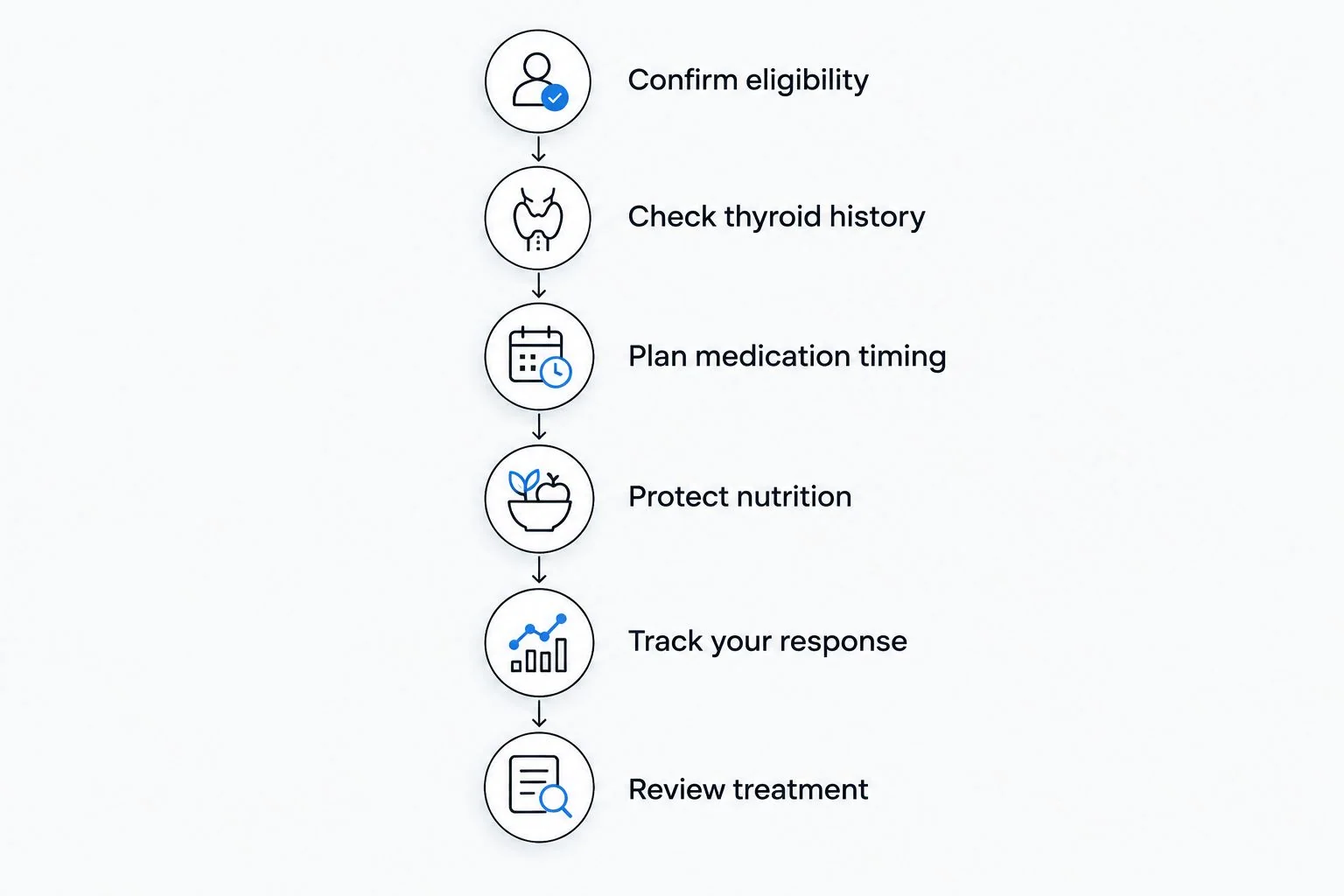
Confirm eligibility
Start with your existing clinician and records. Having hypothyroidism does not, by itself, establish that you qualify for an obesity medication, and a normal thyroid result does not establish that you need one.
FDA weight-management indications for adults generally include a body mass index of 30 kg/m² or higher, or 27 kg/m² or higher with a weight-related health condition. Your clinician must also review the specific medication’s labeling, medical history, and treatment goals. Hypothyroidism alone does not automatically satisfy the accompanying-condition requirement.
Bring your latest thyroid results, including the dates and laboratory reference ranges. If you still have significant symptoms or recently changed thyroid treatment, ask how that affects the assessment rather than assuming medication must start immediately.
- Record your height, weight, and relevant weight-related diagnoses.
- Gather your thyroid diagnosis and most recent laboratory results.
- List previous weight-management approaches and medication reactions.
- Disclose pregnancy, breastfeeding, or pregnancy plans before prescribing.
Check thyroid history
Read the actual warning before treating the word thyroid as a blanket exclusion. FDA prescribing information for weight-management semaglutide and tirzepatide lists a personal or family history of medullary thyroid carcinoma, or multiple endocrine neoplasia syndrome type 2, as contraindications.
Hashimoto’s thyroiditis and ordinary primary hypothyroidism are not those conditions. The boxed warnings describe thyroid C-cell tumors in rodents; whether these medications cause those tumors in humans is unknown.
For a 2026 safety review, use the FDA prescribing information for Wegovy and Zepbound, specifically their contraindications and thyroid C-cell tumor warnings. If a relative had thyroid cancer, find out which type rather than guessing. The guide to semaglutide with a thyroid condition provides related reading, not individual clearance.
- Identify the type of thyroid disease you have.
- Clarify any personal or family history of thyroid cancer.
- Report a neck lump, persistent hoarseness, or swallowing difficulty.
- Discuss pancreatitis, gallbladder disease, and severe stomach-emptying problems.
Plan medication timing
Write down your current schedule before adding another prescription. A simple paper list is enough: thyroid medication, meals and supplements, and weight-loss medication. Bring it to your clinician or pharmacist so instructions do not conflict.
Levothyroxine tablets are commonly taken on an empty stomach 30–60 minutes before breakfast, following the specific product instructions. Calcium and iron supplements generally need separation by at least 4 hours because they can reduce absorption. Do not independently change your established routine to accommodate a new injection.
Injectable and oral semaglutide do not have interchangeable administration instructions. Oral semaglutide has fasting requirements and a documented interaction with levothyroxine that warrants clinician review.
VEVArx is best suited to adults seeking online, medically supervised GLP-1 weight-loss care. Its online format offers a route to prescription assessment; it does not remove the need to coordinate existing thyroid treatment or obtain an examination when necessary.
- Photograph medication labels and include supplements on your list.
- Ask your pharmacist to reconcile fasting and separation instructions.
- Confirm the exact formulation and route before following administration advice.
- Identify which clinician will manage levothyroxine and thyroid laboratory orders.
Protect nutrition
Build a food and activity plan before appetite falls. Reduced hunger is not a reason to skip nutrition, especially when fatigue already makes shopping, cooking, or exercise harder.
Start with regular meals that include a protein source, tolerated fiber-containing foods, and fluids. Smaller meals can be easier during nausea, but persistent vomiting or an inability to drink needs medical advice—not a stricter meal plan. Ask for a registered dietitian’s help if you struggle to meet nutritional needs.
Include resistance exercise suited to your ability and medical restrictions. Weight loss can include lean tissue, so protecting strength belongs in the plan alongside the scale. Avoid adding iodine, thyroid-support supplements, or wellness peptides as substitutes for a thyroid assessment.
- Include a protein-containing food in regular meals.
- Increase fiber gradually if constipation is a problem.
- Keep fluids accessible and report difficulty maintaining intake.
- Choose strength-building activity appropriate to your health and mobility.
Track your response
Use a notebook or basic spreadsheet before buying a tracking service. Record weight trends alongside symptoms, medication changes, and thyroid results so your clinician can interpret the whole picture.
During 2026 follow-up, separate appetite changes from thyroid control. Fatigue alone does not establish that levothyroxine is too low, and a lower weight does not prove that thyroid treatment remains appropriate. Changes in body weight can alter thyroid hormone requirements, so your clinician should decide when repeat testing is needed.
Keep measurements consistent enough to compare. A weight recorded under similar conditions is more useful than frequent readings taken at unrelated times. Your follow-up should also assess function: strength, daily energy, and whether you can eat and drink adequately.
- Log medication names, prescribed doses, and dose-change dates.
- Record nausea, vomiting, bowel changes, palpitations, and heat intolerance.
- Track weight under similar conditions rather than chasing daily fluctuations.
- Ask when thyroid testing is due after a thyroid dose change or substantial weight change.
Review treatment
Agree on a response plan before deciding that treatment has failed. Weight-management prescribing involves tolerability and ongoing reassessment; it is not a contest to reach the highest dose. Never increase a dose independently or combine semaglutide and tirzepatide on your own.
Contact your clinician promptly for persistent vomiting, worsening constipation, or symptoms suggesting thyroid hormone excess, such as palpitations and heat intolerance. Seek urgent medical care for severe, persistent abdominal pain, particularly with vomiting, or signs of significant dehydration. Breathing difficulty or facial or throat swelling requires emergency care.
A 2026 review should cover whether treatment remains appropriate, not just whether the scale moved. If care comes from different practices, share medication updates with both. VEVArx GLP-1 weight-loss care should be coordinated with whoever manages your thyroid prescription.
- Confirm how to report side effects between appointments.
- Ask what to do if you cannot keep fluids down.
- Review benefits, adverse effects, and nutrition before dose changes.
- Share updated thyroid results and prescriptions across your care team.
Compare care options for hypothyroidism and weight management
Choose a care model by what needs managing, not by the easiest prescription process. Stable thyroid replacement, unexplained symptoms, and complex endocrine disease call for different levels of coordination. These options can work together rather than compete.
| Option | Best for | Main advantage | Key limitation |
|---|---|---|---|
| Primary care with weight-management treatment | Adults seeking coordinated general medical and thyroid follow-up | Keeps several health issues within an existing clinical relationship | Weight-management services differ between practices |
| Endocrinology care | Adults with difficult-to-manage thyroid disease or unresolved endocrine questions | Provides specialist assessment of thyroid and related hormonal conditions | Specialist assessment does not automatically include an obesity-treatment program |
| Obesity-medicine care | Adults needing a focused review of obesity treatments and related conditions | Centers treatment selection, nutrition, and medication follow-up | Thyroid prescribing responsibilities still need clarification |
| VEVArx online GLP-1 weight-loss care | Adults seeking a telehealth prescription assessment | Offers doctor-prescribed semaglutide and tirzepatide through an online platform | Online care cannot replace an in-person examination when one is needed |
Before choosing, ask who orders laboratory tests, who interprets them, and who changes your thyroid prescription. Those responsibilities matter more than whether appointments happen online or in person.
Common mistakes people with hypothyroidism make
Treating every thyroid diagnosis as the same warning
Hashimoto’s disease, hypothyroidism after surgery, and medullary thyroid carcinoma are not interchangeable diagnoses. Bring the actual diagnosis and relevant pathology records when available. An unclear family history needs clarification, not an automatic yes or no.
Changing levothyroxine when weight changes
A smaller body weight is a reason to discuss reassessment, not calculate a new dose yourself. Symptoms overlap, and laboratory interpretation depends on your diagnosis and treatment context. Keep taking thyroid medication as prescribed until your clinician changes it.
Mistaking persistent nausea for successful treatment
Strong appetite suppression does not justify dehydration or inadequate nutrition. Report symptoms that interfere with eating, drinking, or normal activity. Dose decisions belong with the prescriber, not an online escalation schedule copied from someone else.
Assuming compounded medication is interchangeable
Compounded drugs are not FDA-approved, and FDA does not review them for safety, effectiveness, or quality before marketing. Do not assume an online prescription means the medication is an FDA-approved product. Ask about the exact formulation, dispensing pharmacy, and legal basis for compounding; do not infer those details from a provider’s name.
Find out if GLP-1 treatment may be right for you.
Start My Pre-AssessmentFAQ
Can I take a GLP-1 medication if I have hypothyroidism?
Hypothyroidism alone does not automatically exclude you from GLP-1 treatment. A clinician must assess the specific medication, weight-management eligibility, thyroid history, other conditions, and current prescriptions.
Is Hashimoto’s disease the thyroid condition in the boxed warning?
No, Hashimoto’s disease is not the medullary thyroid carcinoma or MEN2 named in the contraindications for weight-management semaglutide and tirzepatide. An individual assessment is still required, especially if you have an unclear personal or family cancer history.
Can I take semaglutide and levothyroxine together?
Semaglutide and levothyroxine can be prescribed to the same patient, but formulation, administration timing, and thyroid monitoring need review. Oral semaglutide has specific fasting instructions and a documented levothyroxine interaction, so ask your pharmacist to reconcile the schedule.
Is semaglutide better than tirzepatide for people with hypothyroidism?
Hypothyroidism alone does not establish which medication is better for you. Your clinician should compare indications, contraindications, tolerability, other medicines, and treatment goals rather than select solely by thyroid diagnosis.
Will GLP-1 treatment let me stop taking thyroid medication?
GLP-1 treatment does not replace prescribed thyroid hormone. Weight changes can prompt reassessment of thyroid replacement needs, but only your clinician should change or stop the prescription.
Do I need a thyroid ultrasound before starting a GLP-1 medication?
A thyroid ultrasound is not automatically required solely because you are starting a GLP-1 medication. FDA prescribing information states that routine ultrasound or calcitonin monitoring has uncertain value for early detection of medullary thyroid carcinoma; symptoms or existing findings require individual evaluation.
What should I ask an online weight-loss provider in 2026?
Ask who reviews your thyroid history, coordinates laboratory testing, and manages side effects between visits. Also confirm the exact medication and formulation, and identify who remains responsible for your thyroid prescription.
One last thing
A new symptom is not a diagnosis. Palpitations during weight loss can justify reviewing thyroid replacement, while constipation can involve thyroid control, medication effects, food intake, or several factors together. A symptom log plus your medication list gives your clinician more useful information than assuming every change comes from one cause.
Before your next appointment, write down one practical question: who will act on my next thyroid result? A named clinician and a clear follow-up plan close a gap that an online prescription alone cannot.
Related guides
Ready to get started?
See if doctor-prescribed GLP-1 treatment may be right for you. It only takes a few minutes, 100% online.
Start My Pre-AssessmentThis article is for informational purposes only and is not medical advice. Compounded medications are not approved by the FDA and have not been reviewed for safety, effectiveness, or quality. Prescription products require an online consultation with a licensed healthcare provider who will determine if a prescription is appropriate. Individual results vary.