
How do you inject tirzepatide at home?
How do you inject tirzepatide at home? Follow your device instructions, rotate injection sites, check your prescribed dose, and avoid common errors.

You inject tirzepatide at home under the skin of your abdomen or thigh, or have another person inject the back of your upper arm, using the exact instructions supplied with your prescribed pen or vial. Take it once weekly as prescribed, rotate injection spots, and confirm the dose before injecting; pen instructions and syringe measurements are not interchangeable.
- How do you inject tirzepatide at home? Use your prescribed device instructions for a once-weekly subcutaneous injection.
- Rotate injection sites; never guess syringe units or repeat an uncertain dose.
- VEVArx offers medically supervised GLP-1 weight loss; injection technique still depends on your dispensed medication.
Why this matters
The right medication can still be injected incorrectly if you follow instructions for a different device. A preset pen, a multidose pen, and a vial with a syringe do not share one universal preparation method. Your pharmacy label and the instructions packaged with your medication take priority over a social media demonstration.
VEVArx offers doctor-prescribed GLP-1 weight-loss treatment for US adults. This 2026 guide explains the shared safety steps, but it does not replace hands-on instruction from your prescriber or pharmacist.
Curious whether you qualify? A licensed provider makes the final call.
Start My Pre-AssessmentHow do you inject tirzepatide at home?
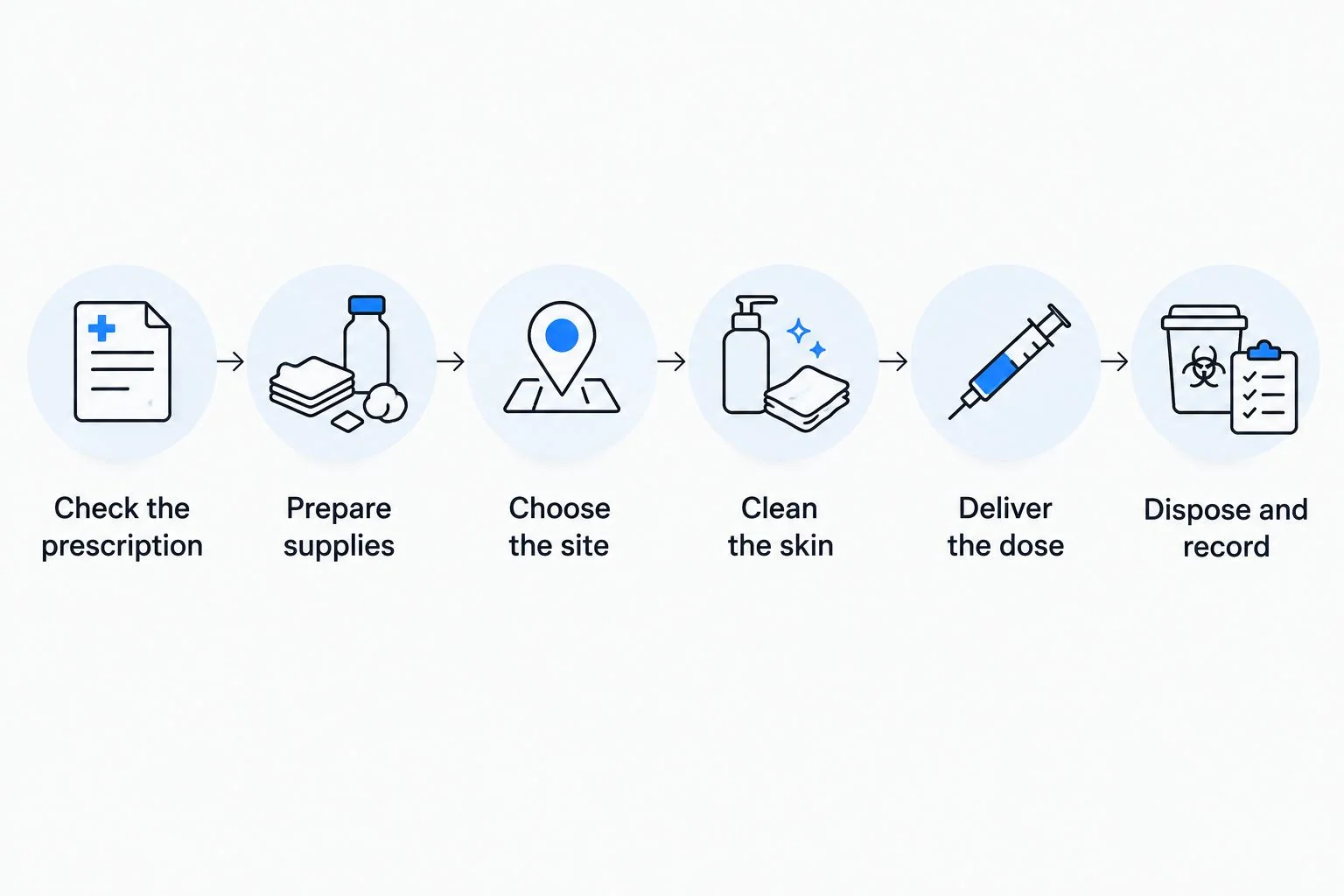
Follow this sequence after your clinician or pharmacist has explained your particular medication and device. If the written directions conflict, stop and have the dispensing pharmacy resolve the discrepancy before you inject.
Check the prescription
Read your name, medication name, prescribed dose, expiration date, and storage instructions. Confirm that the packaging matches what you were taught to use; a refill can look different without having the same operating instructions.
For a vial, check the concentration and the prescribed volume as well. Milligrams describe the drug dose; milliliters describe liquid volume; syringe units describe markings on a particular syringe. Never substitute one measurement for another or copy someone else's syringe marking.
Prepare supplies
Wash your hands and choose a clean, well-lit surface. Gather your medication, the required injection supplies, alcohol swabs, gauze, and a sharps container before you begin.
Inspect the medicine according to its label. Do not use medication that is expired, frozen, damaged, or outside its labeled appearance requirements; ask the pharmacist about an unexpected color, cloudiness, particles, or storage problem. Do not microwave, shake, or otherwise improvise preparation.
Choose the site
Use your abdomen or thigh, or ask another person to inject the back of your upper arm. For an abdominal injection, stay at least 2 inches from your belly button, consistent with FDA-approved tirzepatide injection instructions.
Choose a different spot each week. You can use the same general body area again, but avoid the exact previous puncture site and skin that is tender, bruised, hard, scarred, or damaged.
Clean the skin
Wipe the chosen spot with an alcohol swab and let it dry. Do not touch the cleaned area before injecting.
If you use a vial, disinfect its rubber stopper as instructed before drawing up medication. Use a new sterile needle and syringe for each injection, and never share pens, needles, syringes, or vials intended for one patient.
Deliver the dose
For a pen, follow its instructions for cap removal, needle attachment if applicable, positioning, activation, and confirmation that the dose is complete. Do not assume every pen needs priming, uses the same button sequence, or stays against the skin for the same time.
For a vial, use only the syringe type and volume specified by your dispensing pharmacy. Have the pharmacist demonstrate drawing up the dose, handling bubbles, inserting the needle, and delivering the injection; needle angle and skin-pinching instructions depend on the equipment and your training.
If you cannot confidently identify the prescribed syringe marking, do not inject. Ask the pharmacy to reconcile the prescription, vial concentration, and syringe together.
Dispose and record
Place used needles, syringes, and disposable injection devices in a sharps container promptly, following the device instructions. Do not leave exposed needles on a counter or put loose sharps in household trash or recycling.
Apply gentle pressure with gauze if you notice a small spot of blood; do not rub the area. Record the date, dose, and injection location so you can track your schedule and rotate sites next time.
Pen or vial: which instructions should you follow?
Follow the instructions for the product in your hands, not the format you used previously. In 2026, a general tirzepatide tutorial is not enough to identify your device's preparation, dose-setting, or disposal requirements.
| Format | Best for | Practical advantage | Limitation to check |
|---|---|---|---|
| Preset single-dose pen | Patients prescribed that exact fixed-dose device | Avoids drawing liquid into a syringe | Activation and completion signals are device-specific |
| Multidose pen | Patients prescribed and trained on that exact pen | Uses a pen-based delivery system | Needle handling and preparation depend on its instructions |
| Vial and syringe | Patients prescribed a vial and taught its measurements | The prescribed volume is visible in the syringe | Concentration and syringe mismatches can cause dosing errors |
None of these formats is a reason to change your prescribed dose. If your pharmacy changes the device or concentration, request updated instructions before your next injection.
Using a pen
Read the complete Instructions for Use before the first injection, including the sections on damaged devices and incomplete doses. Keep those instructions accessible instead of relying on memory.
Do not reuse a single-dose pen or try to extract leftover medication from a device. Never share a pen with another person, even if a new needle can be attached. If the pen does not operate as expected, stop and contact the dispensing pharmacy or the manufacturer named on its packaging.
Using a vial and syringe
Ask the pharmacist to show you the exact line to use on the exact syringe supplied. A concentration change means a familiar volume might no longer contain your prescribed dose.
Compounded tirzepatide is not FDA-approved, and an instruction sheet for an approved pen does not validate a compounded vial's concentration or dosing directions. Never inject a product labeled for research use, and do not mix powders or add diluent unless your licensed healthcare professional has specifically supplied and taught the appropriate preparation.
Why tirzepatide injection instructions vary
The injection route stays subcutaneous, but the preparation steps depend on what you receive. These differences explain why a friend's demonstration is not a substitute for your own instructions:
- Device design: A preset pen, multidose pen, and syringe require different handling.
- Medication concentration: The same liquid volume does not necessarily contain the same dose across different vials.
- Prescribed dose: Your clinician's current directions determine what you administer, not your appetite that day.
- Needle and syringe: Equipment affects measurement, insertion technique, and preparation.
- Product labeling: Storage, handling, and discard instructions belong to the specific dispensed product.
Before using a refill in 2026, compare the new label with your current instructions. If anything changed, get clarification rather than automatically repeating last month's routine.
What should you confirm before your first injection?
Make sure your prescriber knows your medical history, other medicines, and pregnancy plans. Tirzepatide carries a boxed warning about thyroid C-cell tumors observed in rodents and is contraindicated in people with a personal or family history of medullary thyroid carcinoma or multiple endocrine neoplasia syndrome type 2.
Tell your clinician if you use insulin or a sulfonylurea because the combination increases the risk of low blood sugar. Ask about oral medicines, too: tirzepatide delays stomach emptying and can affect their absorption.
For oral hormonal contraception, FDA-approved tirzepatide labeling advises switching to a nonoral method or adding a barrier method for 4 weeks after starting treatment and for 4 weeks after each dose increase. Discuss pregnancy promptly with your prescriber, and tell your procedural team about tirzepatide before anesthesia or deep sedation.
What if you miss a dose or think the injection failed?
FDA-approved tirzepatide prescribing information gives a missed-dose window of 4 days, or 96 hours. If more than 4 days have passed, skip the missed dose and resume on your regular day; do not take doses less than 3 days, or 72 hours, apart.
Check the instructions for your dispensed medication and contact your prescriber if you are unsure how they apply. After a longer treatment interruption, ask for a restart plan instead of assuming your previous dose remains appropriate.
An uncertain injection is different from a missed injection. If medicine leaks, a device stops, or you cannot tell whether the dose finished, do not automatically inject another dose. Contact your pharmacist or prescriber with the device name, prescribed dose, and what happened.
Which symptoms need medical attention?
Mild injection-site irritation can occur, but worsening redness, warmth, swelling, drainage, or fever needs medical assessment. Do not keep injecting into an irritated or infected-looking area.
Stop using tirzepatide and seek urgent medical evaluation for severe, persistent abdominal pain, especially if it extends to your back or occurs with vomiting. Trouble breathing, swelling of the face or throat, or fainting requires emergency help; these can signal a serious allergic reaction.
Persistent vomiting, inability to keep fluids down, or markedly reduced urination also warrants prompt care. If you suspect an overdose or dosing error, contact Poison Control at 1-800-222-1222 in the US; call 911 for collapse, seizures, breathing difficulty, or inability to awaken.
Find out if GLP-1 treatment may be right for you.
Start My Pre-AssessmentWhere should I inject tirzepatide for the best results?
The 3 labeled body areas are the abdomen, thigh, and upper arm, with another person administering an upper-arm injection. Choose a healthy area you can access safely rather than switching sites to chase stronger appetite suppression.
FDA-approved labeling reports similar tirzepatide exposure across these injection areas. Site rotation protects the skin; it is not a dose-adjustment strategy.
Can I change my weekly tirzepatide injection day?
A minimum of 72 hours between doses is required when changing the weekly administration day under FDA-approved tirzepatide labeling. Confirm the timing if you have recently missed a dose, because overlapping schedule changes create confusion.
Write the new day down and update your reminder. Do not take an extra injection simply to establish a more convenient calendar routine.
Where does online treatment fit?
VEVArx is for US adults seeking medically supervised GLP-1 weight loss through telehealth. Online care provides a route to prescription treatment, but it does not replace device-specific training or an in-person examination when symptoms require one.
Before starting, identify who handles prescription questions, who dispenses the medication, and whom you should contact about an injection error. Keep the pharmacy label and packaging accessible when asking for help so the clinician or pharmacist can identify your exact product.
Have questions about your options? Start with a quick online assessment.
Start My Pre-AssessmentFAQ
Can I inject tirzepatide myself at home?
You can self-inject prescribed tirzepatide at home after learning the instructions for your exact device. Have another person administer an injection into the back of your upper arm.
Do I inject tirzepatide into muscle?
No, tirzepatide is injected under the skin, not into muscle or a vein. Follow your device instructions and ask for training if you are unsure about needle placement.
How far from my belly button should I inject tirzepatide?
Stay at least 2 inches from your belly button when injecting tirzepatide into your abdomen. Choose healthy skin and rotate the exact injection spot each week.
Should I inject tirzepatide before or after eating?
Tirzepatide can be injected with or without food under FDA-approved labeling. Use the weekly schedule prescribed for you.
What if some tirzepatide leaks onto my skin?
Do not repeat the dose just because you see liquid on your skin. Check your device instructions and contact the pharmacist or prescriber if you cannot confirm that the injection finished.
Can I reuse my tirzepatide syringe or needle?
No, use a new sterile needle and syringe for every injection. Follow the device instructions and put used sharps into an appropriate sharps container.
Does VEVArx replace instruction from my dispensing pharmacist?
No, VEVArx telehealth treatment does not replace instructions for your dispensed injection device. Ask your dispensing pharmacist to resolve questions about concentration, syringe markings, preparation, or device operation.
One last thing
A familiar syringe line is not a permanent dose. If your vial concentration changes, the same marking can deliver a different amount of medication. Before your next refill injection, match the prescribed dose, concentration, and written volume again.
For your 2026 routine, keep the medication instructions with your supplies rather than saving an isolated screenshot. This educational guide draws on FDA-approved tirzepatide prescribing information and Instructions for Use; your current product labeling and individualized clinical directions govern your injection.
Related guides
Ready to get started?
See if doctor-prescribed GLP-1 treatment may be right for you. It only takes a few minutes, 100% online.
Start My Pre-AssessmentThis article is for informational purposes only and is not medical advice. Compounded medications are not approved by the FDA and have not been reviewed for safety, effectiveness, or quality. Prescription products require an online consultation with a licensed healthcare provider who will determine if a prescription is appropriate. Individual results vary.