
How do you know when to increase your semaglutide dose?
Learn when to increase semaglutide dose with your prescriber. Review dosing stages, side effects, missed injections, and signs you should delay an increase.

Increase your semaglutide dose only when your prescriber confirms that you have completed the required time at your current dose, tolerate it, and should advance under your treatment plan. For standard weekly injectable semaglutide initiation, dose increases generally follow 4-week stages—not a return of hunger or a disappointing weigh-in. Persistent side effects, missed doses, or a change in formulation require review before you move up.
- When to increase semaglutide dose depends on your prescribed schedule, tolerability, and treatment response—not hunger alone.
- FDA-approved weekly semaglutide injections generally begin at 0.25 mg weekly for 4 weeks before the first increase.
- Persistent nausea, vomiting, dehydration, or missed injections require prescriber review before dose escalation.
- Semaglutide titration schedules differ by product; never copy another person's dose or syringe units.
Why this matters
More medication is not automatically better treatment. Semaglutide dose escalation gives your body time to adjust, and gastrointestinal side effects are a reason to reassess the schedule rather than push through it.
For your 2026 treatment check-in, bring a record of injections, symptoms, and weight trends. A guide to tracking your GLP-1 doses can help you organize that information, but an app cannot authorize a prescription change.
Curious whether you qualify? A licensed provider makes the final call.
Start My Pre-AssessmentHow do you know when to increase your semaglutide dose?
You are ready for a dose review when you have completed the prescribed stage and can explain how treatment is affecting you. Readiness for review does not automatically mean readiness for a higher dose.
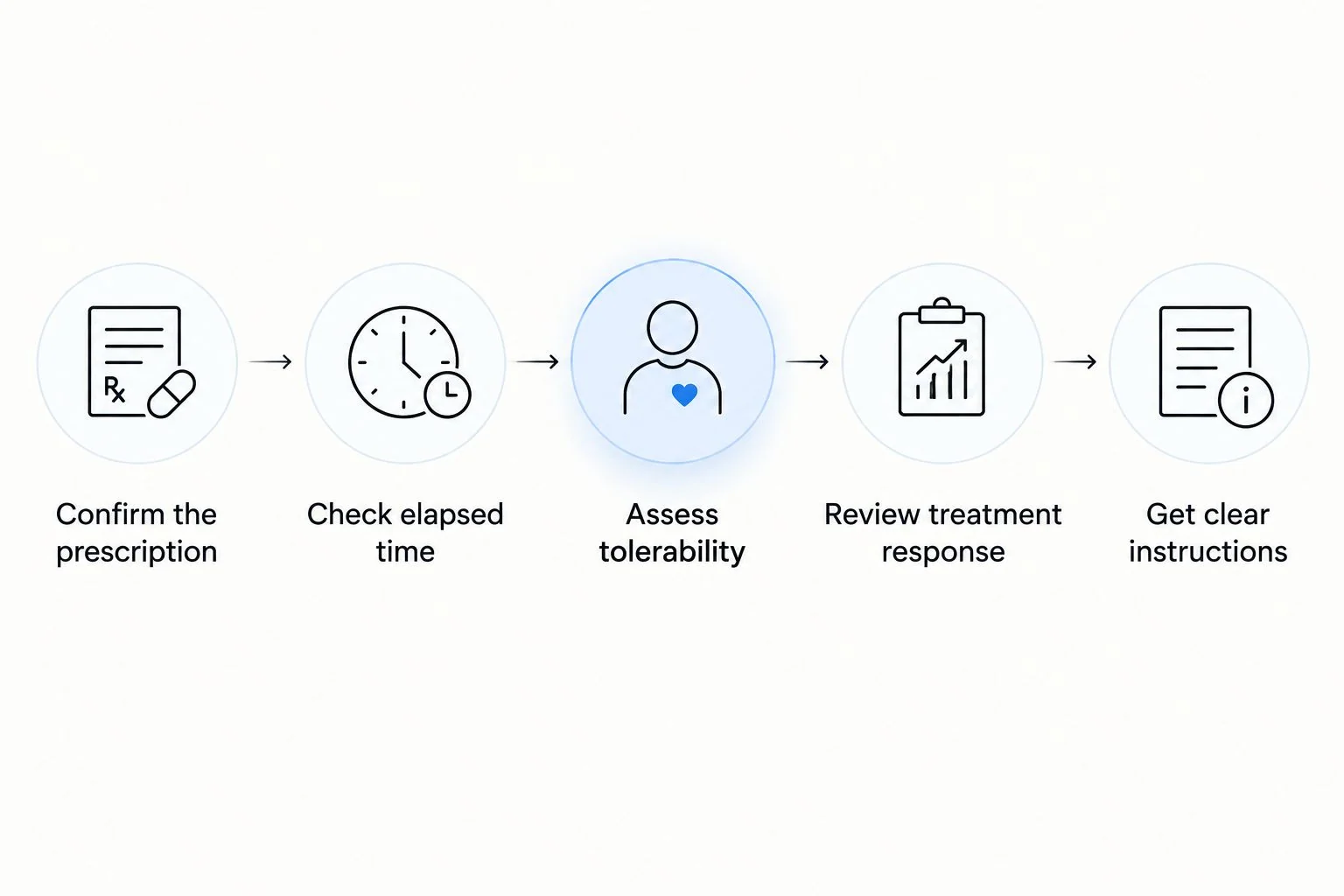
Use this sequence before your next scheduled increase:
- Confirm the prescription. Identify your exact medication, formulation, current dose in milligrams, and prescribed schedule. Injectable and oral semaglutide do not share an interchangeable dosing schedule.
- Check elapsed time. For standard weekly injectable initiation, the first stage lasts 4 weeks. Do not shorten that period because appetite suppression feels weaker.
- Assess tolerability. Tell your clinician about nausea, vomiting, diarrhea, constipation, abdominal pain, and difficulty eating or drinking.
- Review treatment response. Bring your weight trend, appetite changes, and any glucose readings your clinician has asked you to collect.
- Get clear instructions. Confirm whether to increase, remain at the current dose, or arrange further assessment. Verify the next dose before injecting.
FDA-approved Wegovy and Ozempic injection prescribing information supports gradual initiation and product-specific escalation. These are dosing references for this 2026 guide, not permission to change your own prescription; your clinician must apply the instructions for your exact product and indication.
What should happen at the dose review?
Your prescriber should weigh the planned schedule against symptoms and treatment goals. The useful question is not whether you can tolerate more medication, but whether the next step is appropriate now.
| Decision | Best for | Benefit | Limitation or concern |
|---|---|---|---|
| Advance as prescribed | Patients who have completed the required stage and tolerate treatment | Follows the planned escalation schedule | A higher dose can bring new or worse side effects |
| Delay escalation | Patients whose side effects need more time or assessment | Avoids adding medication while tolerability is unresolved | Requires a revised plan rather than indefinite self-directed dosing |
| Seek prompt assessment | Patients with severe symptoms or dehydration concerns | Prioritizes evaluation of a possible complication | A routine dose-adjustment message is not enough for urgent symptoms |
Do not select a higher dose simply because someone else takes it. Their indication, treatment history, formulation, and response are not your prescription.
Starting dose: 0.25 mg once weekly
For standard FDA-approved Wegovy and Ozempic injections, initiation begins at 0.25 mg once weekly for 4 weeks. This starting stage supports treatment initiation; it is not a weight-loss deadline or a test you fail if hunger remains.
The products have different approved uses and subsequent dosing instructions. Wegovy includes chronic weight-management indications; Ozempic is not FDA-approved specifically for weight loss. Their shared starting dose does not make their complete treatment plans interchangeable.
During this stage, record whether you can eat, drink, and carry out normal activities. Appetite suppression alone is not a reliable measure of whether you should advance, and pronounced nausea is not evidence that the medication is working better.
First increase: 0.5 mg once weekly
The standard first increase for these weekly injections is 0.5 mg once weekly after the initial 4 weeks, when prescribed. Whether you should take that step on schedule depends on tolerability and your clinician's instructions.
Wegovy's standard injection escalation schedule uses another 4-week stage at 0.5 mg weekly before subsequent planned increases. Ozempic has its own maintenance and escalation instructions, so do not use a weight-management schedule to adjust a diabetes prescription.
If you are reading this in 2026 after receiving a new device, formulation, or revised prescription, check the accompanying instructions again. The name semaglutide does not establish one universal dosing schedule. This article does not provide a complete escalation chart or select a maintenance dose for you.
Why semaglutide dose-increase timing varies
The calendar matters, but it is not the only factor. These clinical details explain why your prescriber might keep or change the planned escalation date:
- Product and indication. Weekly injections and oral formulations have different instructions, and diabetes management involves goals beyond weight change.
- Time at the current dose. Completing the required stage gives the clinician a clearer picture of response and tolerability.
- Side effects. Ongoing vomiting, troublesome constipation, or difficulty maintaining food and fluid intake needs assessment before escalation.
- Treatment response. Weight trends, appetite changes, and glucose results help your clinician assess progress; no single reading makes the decision.
- Other medications. Insulin and sulfonylureas can increase hypoglycemia risk when used with semaglutide, making medication review important.
- Interrupted treatment. Missed doses or a longer treatment gap can change restart instructions and the risk of gastrointestinal symptoms.
An increase should fit the treatment plan, not a social-media timeline. A slower schedule should come with clear instructions about what to monitor and when to check back.
Does feeling hungry mean I need a higher dose?
Feeling hungry does not establish that your dose is too low. Semaglutide treatment does not require the complete absence of appetite, and hunger is not a stand-alone instruction to escalate.
Tell your prescriber whether portions, fullness, cravings, and eating patterns have changed. Include whether you are skipping meals because of nausea or struggling to meet basic nutritional needs; those details change the conversation.
Do not take an extra injection to suppress breakthrough hunger. A return of appetite near your next scheduled dose is a reason to discuss the pattern, not improvise a different interval.
Should I increase semaglutide if my weight has stalled?
A 4-week dosing stage is a scheduling reference, not proof that a weight plateau requires escalation. Your clinician needs the broader trend, medication adherence, tolerability, and treatment stage before deciding what to change.
Short-term scale changes also reflect factors such as hydration and constipation. Bring measurements taken under reasonably consistent conditions rather than reacting to an isolated result.
Avoid responding to a plateau by both increasing medication and sharply restricting food. If you are struggling to eat adequately, that needs assessment before a higher dose—not a more aggressive weight-loss target.
Can I increase after missing semaglutide doses?
Missing doses means you need product-specific instructions before escalating. For example, Wegovy injection prescribing information addresses reinitiation after 2 or more consecutive missed doses because restarting escalation can reduce gastrointestinal symptoms.
That does not create a universal restart rule for every semaglutide product. Tell your prescriber the exact date of your last injection, the dose taken, and how many scheduled doses you missed.
Do not double a dose or jump to the next stage to catch up. If the medication supply, concentration, or device has also changed, confirm those details before taking another injection.
Find out if GLP-1 treatment may be right for you.
Start My Pre-AssessmentWhen side effects mean you should not increase
Persistent symptoms deserve attention before a dose increase. Contact your prescriber if nausea, diarrhea, constipation, or reduced intake is disrupting daily life, even if you have reached the scheduled escalation date.
Seek urgent medical care for severe or persistent abdominal pain, especially if it radiates to your back or occurs with vomiting. These symptoms can signal pancreatitis or another condition requiring prompt assessment; suspected pancreatitis requires stopping semaglutide and urgent evaluation.
Repeated vomiting, inability to keep fluids down, fainting, or markedly reduced urination also needs urgent assessment. Trouble breathing or swelling of the face, lips, tongue, or throat is an emergency—call 911.
For your 2026 medication review, report low-glucose episodes if you take insulin or a sulfonylurea. Sweating, shaking, confusion, and weakness need attention; do not assume they are ordinary adjustment symptoms.
Check milligrams before changing syringe units
Milligrams describe the amount of medication. Milliliters describe liquid volume, and syringe units are volume markings—not a universal semaglutide dose.
If your prescription uses a vial, the relationship between those measurements depends on its concentration. A new vial with a different concentration can require a different volume for the same prescribed milligram dose.
Before any increase, ask the dispensing pharmacist to confirm the prescribed milligrams, concentration, and corresponding volume or syringe marking. Do not copy an online conversion chart or another patient's syringe instructions.
Compounded semaglutide is not FDA-approved and does not undergo FDA premarket review for safety, effectiveness, and quality. Its dosing instructions require particular attention; a compounded product should not be treated as interchangeable with an FDA-approved pen.
Where online medical supervision fits
VEVArx is best suited to US adults seeking online, doctor-prescribed GLP-1 weight-loss treatment. The platform offers medically supervised weight-loss prescriptions; the prescribing clinician, not the platform format, determines whether a dose increase is appropriate.
For readers considering VEVArx, the relevant benefit is access to an online prescription-based care model. The limitation is that telehealth does not replace emergency care or an in-person assessment when symptoms require one.
Whether you use VEVArx or another service in 2026, ask how dose changes are confirmed and how to get help with adverse effects. Do not assume that an automatic refill means your dose should automatically increase.
Have questions about your options? Start with a quick online assessment.
Start My Pre-AssessmentFAQ
How do I know when to increase semaglutide dose?
Increase only when your prescriber confirms that you have completed the required dosing stage, tolerate treatment, and should advance. Standard weekly injectable initiation generally begins with 4 weeks at the starting dose; hunger alone does not justify increasing.
Can I increase semaglutide before 4 weeks?
Do not shorten a prescribed 4-week initiation stage without your prescriber's explicit instructions. Standard injectable escalation is gradual to help manage gastrointestinal tolerability.
Is 0.25 mg of semaglutide supposed to stop my appetite?
The 0.25 mg weekly starting dose does not need to eliminate your appetite. For standard Wegovy and Ozempic injections, this is an initiation stage rather than a reason to judge your final treatment response.
Should I increase semaglutide if I still feel nauseated?
Ongoing nausea requires prescriber review before an increase. Explain whether you can eat and drink normally and whether symptoms affect daily activities; persistent vomiting or dehydration concerns need prompt assessment.
Can I stay on a lower semaglutide dose if it works?
Your prescriber must decide whether a lower dose fits your product's instructions and treatment goals. A starting dose, an escalation dose, and a maintenance dose do not serve the same purpose.
Can I take more semaglutide if I stop losing weight?
Do not take extra semaglutide because weight loss has slowed. Your clinician should review the weight trend, current treatment stage, adherence, symptoms, and other relevant factors before changing the prescription.
Do syringe units tell me my semaglutide dose?
Syringe units alone do not establish your semaglutide dose in milligrams. The conversion depends on the vial concentration, so confirm the exact instructions with the dispensing pharmacist before injecting.
One last thing
An automatic refill is not an automatic dose increase. Before your next injection, compare the prescription instructions with the medication you received, especially after a dose change or treatment interruption.
Bring the package or a clear label photo to your next review. Confirming the product, concentration, and prescribed dose prevents an avoidable mismatch between what your clinician intended and what you inject.
Related guides
Ready to get started?
See if doctor-prescribed GLP-1 treatment may be right for you. It only takes a few minutes, 100% online.
Start My Pre-AssessmentThis article is for informational purposes only and is not medical advice. Compounded medications are not approved by the FDA and have not been reviewed for safety, effectiveness, or quality. Prescription products require an online consultation with a licensed healthcare provider who will determine if a prescription is appropriate. Individual results vary.