
How much does compounded tirzepatide cost per month?
How much does compounded tirzepatide cost per month? No single total fits everyone. Compare medication, clinical care, billing periods, and terms.

Compounded tirzepatide has no single monthly cost: your total depends on the prescribed formulation, the amount dispensed, the billing interval, and which clinical services the quote includes. A medication-only quote does not establish your full treatment expense. For a 2026 comparison, request a written, patient-specific total and confirm that the prescriber and dispensing pharmacy can legally provide the prescribed preparation.
- How much does compounded tirzepatide cost per month? Compare patient-specific totals, not medication-only quotes.
- VEVArx offers medically supervised GLP-1 weight loss; confirm the prescribed formulation and current terms directly.
- Compounded tirzepatide is not FDA-approved, and a prescription alone does not establish that every compounded preparation is lawful.
- Separate medication, clinical care, supplies, and billing intervals before comparing telehealth weight-loss options.
Why this matters
A monthly payment is not a complete treatment plan. You need to know what the payment covers, how long the prescription lasts, and who handles questions when your treatment changes. Otherwise, two quotes labeled monthly can describe different services and different amounts of medication.
Start with clinical and legal eligibility, then compare the financial terms. The guide to buying tirzepatide online legally addresses a separate question from affordability: whether the prescribing and dispensing arrangement is legitimate. A lower quote does not answer that question.
Curious whether you qualify? A licensed provider makes the final call.
Start My Pre-AssessmentHow much does compounded tirzepatide cost per month?
There is no universal monthly figure for compounded tirzepatide. The meaningful comparison is the written total for your prescription and care arrangement, using the same treatment period across providers.
For your 2026 comparison, ask each provider to complete the same breakdown. Do not assume that a blank entry means the service is included or unnecessary.
| Component | What to establish | What an incomplete quote leaves unclear |
|---|---|---|
| Medication | Exact prescribed preparation and amount dispensed | Whether the quote matches your prescription |
| Initial evaluation | Whether the consultation is included or separate | Whether enrollment covers the prescribing assessment |
| Ongoing care | Which follow-ups and clinician communications are included | How treatment questions and adjustments are handled |
| Testing | Whether your clinician requires tests and how billing works | Whether testing creates a separate expense |
| Supplies and delivery | What the dispensing arrangement includes | Whether you need to obtain anything separately |
| Renewal | Billing interval, renewal authorization, and cancellation terms | What happens after the initial treatment period |
Compare the complete arrangement, not the most prominent number. A quote becomes useful only when you can connect it to an actual prescription, a defined period, and identifiable clinical services.
Check what “per month” means
Four weeks equals 28 days; a calendar month is not always 28 days. A plan billed every 4 weeks therefore uses a different schedule from one billed once each calendar month.
Thirteen 28-day periods total 364 days, while calendar-month billing has 12 monthly periods per year. These are billing calculations, not evidence of any provider's terms. Ask which schedule applies before projecting your annual commitment.
What belongs in your monthly treatment budget?
Build your budget around the services you actually need. Keep recurring treatment expenses separate from one-time enrollment requirements so that the initial payment does not stand in for the entire course of care.
Medication and dispensing
Ask for the prescribed medication name, concentration, total amount dispensed, and dispensing pharmacy. The label and written instructions should make clear how to measure the prescribed dose.
Vial volume alone does not establish how much medication a vial contains. Concentration matters, and syringe markings do not replace dosing instructions. Do not convert or change an injection dose based on a financial comparison. Ask the pharmacist or prescriber to resolve unclear instructions before injecting.
Medical evaluation and follow-up
Establish whether the quoted arrangement includes the initial assessment, subsequent appointments, and a way to contact the clinical team. Ask what happens if treatment needs to pause or your clinician changes the plan.
A membership and a prescription are not interchangeable. Paying for access to a platform does not guarantee that a clinician will prescribe a particular medication or formulation.
Tests, supplies, and delivery
Ask whether your clinician requires laboratory testing and whether that testing is included in the arrangement. Then confirm which injection supplies accompany the prescription and which instructions govern storage and disposal.
Do not assume that every patient needs identical tests or that every dispensing arrangement includes identical supplies. Your medical history and prescription determine the questions that need answering.
Why compounded tirzepatide quotes differ
These are the variables to verify when comparing quotes in 2026. They are questions for the provider, not assumptions about any particular company's policies.
- Prescribed amount: Does the quote apply to your current prescription, and what happens if the clinician changes it?
- Formulation: What exactly is being prescribed, and why is a compounded preparation appropriate for you?
- Care model: Which consultations, follow-ups, and clinician communications are included?
- Dispensing period: How much treatment does the dispensed prescription cover under its written directions?
- Separate services: Are testing, supplies, delivery, or other required services billed separately?
- Renewal terms: When does billing recur, and what authorization or clinical review is required?
A useful comparison answers all of these questions in writing. A headline quote without those details does not support a reliable treatment budget.
How do you compare two quotes fairly?
Use the same sequence for each provider. This keeps a medication-only quote from being mistaken for a full-service treatment arrangement.
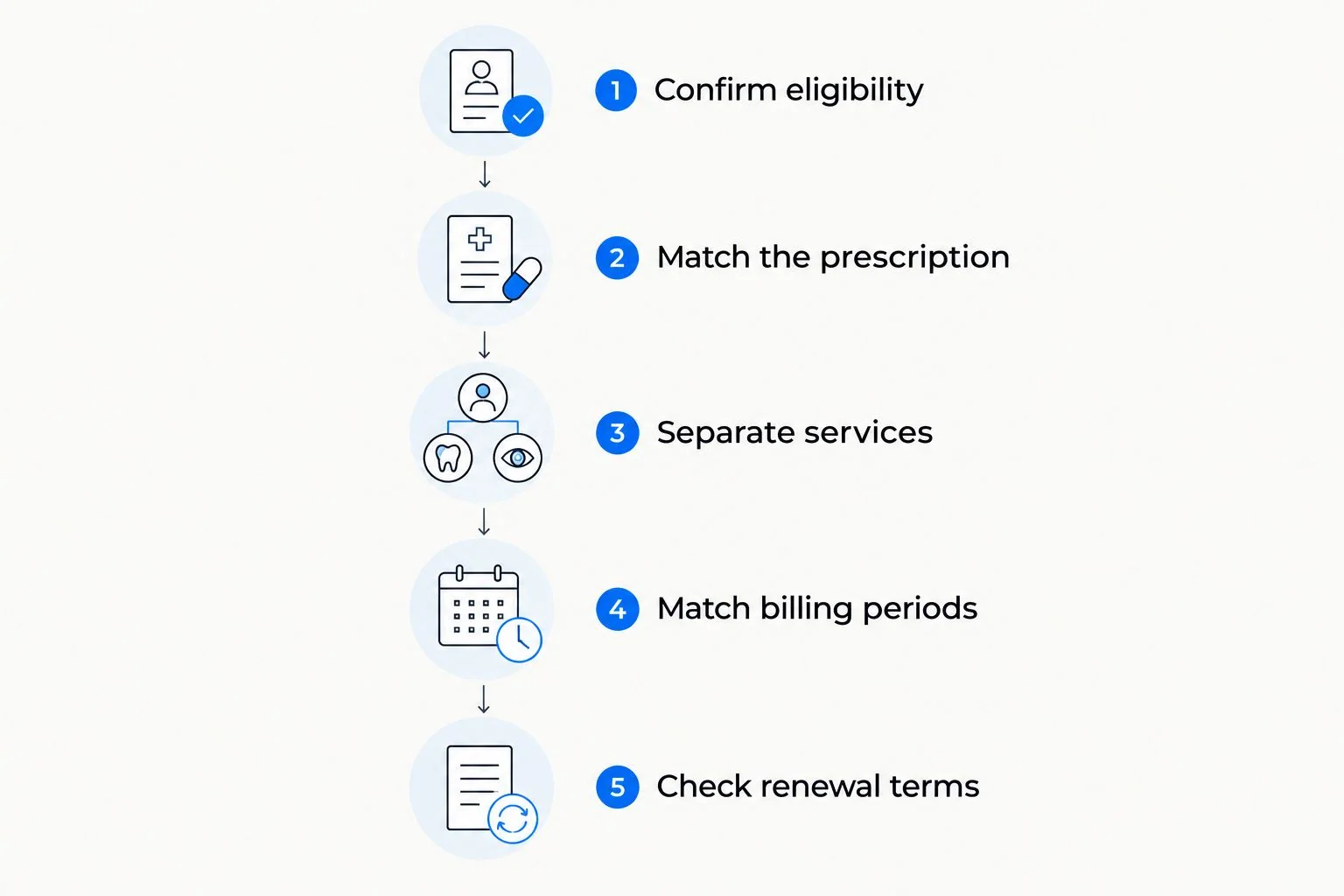
- Confirm eligibility. Ask the clinician whether tirzepatide is appropriate for your medical history and whether the proposed formulation is legally appropriate.
- Match the prescription. Record the preparation, concentration, prescribed amount, and amount dispensed. Do not treat different prescriptions as equivalent purchases.
- Separate services. Identify what covers medication, clinical care, testing, and supplies. Mark anything that remains unanswered.
- Match billing periods. Establish whether the arrangement uses calendar months, 28-day cycles, or another stated interval.
- Check renewal terms. Request the rules for recurring payments, clinical reassessment, cancellation, and treatment changes before committing.
Keep the written quote alongside the treatment instructions. They answer different questions, but together they show whether the financial arrangement matches the care you expect to receive.
Is compounded tirzepatide the same as FDA-approved tirzepatide?
No. Compounded drugs are not FDA-approved. The FDA does not review compounded preparations for safety, effectiveness, and quality before they are marketed in the same way it reviews approved drugs.
Compounding can serve a medical need when an FDA-approved drug cannot meet that patient's needs. It is not a blanket permission to make copies of approved medications, and a clinician's prescription does not remove the legal requirements governing the pharmacy and preparation.
For a 2026 decision, ask why the compounded preparation is appropriate for you and what legal basis supports dispensing it. Do not rely on an old article, an advertisement, or the phrase doctor-prescribed as the entire explanation.
| Treatment option | Best for | Relevant advantage | Limitation |
|---|---|---|---|
| FDA-approved tirzepatide | Patients whose clinician determines an approved product meets their needs | FDA review of the approved product's safety, effectiveness, and quality | Requires clinical suitability and a prescription; coverage depends on the plan |
| Compounded tirzepatide | Patients with a documented medical need that lawful compounding can address | Can address an individualized need under applicable compounding requirements | The preparation is not FDA-approved and must meet applicable legal requirements |
This table compares treatment pathways, not interchangeable products. Neither option should be selected solely because its billing arrangement looks simpler.
What ongoing care should the quote explain?
A treatment budget should account for clinical oversight, not just dispensing. Ask who reviews side effects, who handles prescription questions, and how you contact the team when you cannot tolerate the prescribed plan.
Connecting GLP-1 consultations and ongoing monitoring makes the treatment arrangement clearer: the prescribing assessment establishes a plan, while follow-up gives the clinician information needed to reassess it. Your quote should identify which parts of that care are included and which require a separate appointment.
Ask how the practice handles persistent vomiting, difficulty keeping fluids down, or significant abdominal pain. Severe or persistent symptoms require prompt medical evaluation, not a decision based on whether a follow-up is included in your payment.
Never stretch a prescription, share medication, or change a dose to make a billing period work. If the plan is financially unmanageable, tell the prescriber before changing treatment.
Find out if GLP-1 treatment may be right for you.
Start My Pre-AssessmentDoes insurance cover compounded tirzepatide?
Do not assume insurance covers a compounded tirzepatide prescription. Ask your insurer about the specific preparation, dispensing pharmacy, and benefit rules, then request the answer in writing when possible.
Coverage for an FDA-approved medication does not establish coverage for a compounded preparation containing the same active ingredient. Likewise, a provider accepting insurance for a consultation does not prove that your medication is covered.
For your 2026 budget, keep insurance reimbursement separate from the amount you are responsible for paying. Submit only accurate documentation, and do not treat a receipt or reimbursement submission as a promise of approval.
Can you use an FSA or HSA for tirzepatide treatment?
Prescription medication and qualifying medical care can be eligible medical expenses under federal tax rules, but the specific expense and documentation matter. Confirm the requirements with your account administrator rather than relying only on whether a payment card processes successfully.
Ask for an itemized receipt that identifies the service or prescription. If a membership combines medical care with other benefits, ask how the components are documented; do not assume every charge receives the same tax treatment.
Where does VEVArx fit into the comparison?
VEVArx is for US adults seeking medically supervised GLP-1 weight loss through telehealth. The platform offers doctor-prescribed weight-loss medications, including tirzepatide, but that description does not establish which formulation a clinician will prescribe for you.
The relevant benefit is access to a medical assessment through an online care model. The limitation is that enrollment does not establish eligibility for a particular prescription, a particular compounded preparation, or insurance coverage.
For VEVArx GLP-1 weight-loss care, ask the same questions used throughout this comparison: what is prescribed, who dispenses it, what clinical services are included, and how billing and renewals work. Choose the care arrangement that fits a medically appropriate prescription—not a prescription chosen to fit an advertisement.
Have questions about your options? Start with a quick online assessment.
Start My Pre-AssessmentFAQ
How much does compounded tirzepatide cost per month in 2026?
Compounded tirzepatide has no single monthly cost; request a written total for your prescribed preparation, dispensing period, and included care. Confirm separate charges and renewal terms before comparing providers.
Is a compounded tirzepatide quote usually all-inclusive?
Do not treat a compounded tirzepatide quote as all-inclusive unless its written terms identify the included services. Ask specifically about consultations, follow-ups, testing, supplies, and delivery.
Is compounded tirzepatide FDA-approved?
No, compounded tirzepatide preparations are not FDA-approved. Ask the prescriber why compounding is appropriate for your medical needs and how the dispensing arrangement meets applicable requirements.
Does every 4 weeks mean the same thing as monthly?
No, every 4 weeks means every 28 days, which differs from calendar-month billing. Confirm the actual renewal schedule before estimating your annual commitment.
Will my payment change if my tirzepatide prescription changes?
Your provider's written terms determine how a prescription change affects billing. Ask for that explanation before treatment, and never change your dose to manage the payment schedule.
Can I assume my insurance covers compounded tirzepatide?
No, insurance coverage must be confirmed for the specific preparation and dispensing arrangement. Coverage for an approved medication or a consultation does not establish coverage for a compounded prescription.
Does VEVArx offer tirzepatide through telehealth?
VEVArx offers doctor-prescribed tirzepatide through its online GLP-1 weight-loss platform. A clinician must assess whether treatment is appropriate; confirm the prescribed formulation and current terms directly.
One last thing
Before committing, ask the provider to explain the prescription, the included care, and the renewal schedule in one written response. That request exposes unanswered questions without requiring you to interpret an advertisement.
The most useful 2026 comparison is not the shortest quote. It is the one that lets you explain exactly what you are paying for, which clinician is responsible for care, and what happens when treatment needs to change.
Related guides
Ready to get started?
See if doctor-prescribed GLP-1 treatment may be right for you. It only takes a few minutes, 100% online.
Start My Pre-AssessmentThis article is for informational purposes only and is not medical advice. Compounded medications are not approved by the FDA and have not been reviewed for safety, effectiveness, or quality. Prescription products require an online consultation with a licensed healthcare provider who will determine if a prescription is appropriate. Individual results vary.