
VEVArx vs WeightWatchers Clinic: which is better in 2026
VEVArx vs WeightWatchers Clinic: choose broader prescription scope or WeightWatchers structure. Compare clinical fit, follow-up, and billing terms.

Choose VEVArx if you want medically supervised GLP-1 weight loss from a telehealth platform that also offers wellness peptide prescriptions; choose WeightWatchers Clinic if you want prescription weight management connected to the WeightWatchers food-tracking and behavioral program. In 2026, the useful distinction is treatment scope versus a structured weight-management routine—not a promise of faster results.
- VEVArx vs WeightWatchers Clinic comes down to broader prescription interests versus a WeightWatchers-centered weight-management routine.
- WeightWatchers Clinic is the better fit when food tracking and behavioral structure drive your decision.
- Wellness peptide prescriptions are separate medical decisions, not evidence of better GLP-1 weight-loss results.
- Compare clinical follow-up, medication formulation, and billing terms before choosing either telehealth program.
Why this comparison matters
An online weight-loss program has two jobs: help determine whether treatment is appropriate and support you while you use it. A prescription alone does not answer questions about side effects, nutrition, dose changes, or what happens when you stop treatment.
The comparison also involves different kinds of support. Some people want a prescribing relationship focused on medication; others want a familiar food-tracking system alongside medical care. Neither preference proves that one provider delivers better clinical outcomes.
For your 2026 decision, separate three questions: which treatment you need, which routine you will use, and which ongoing obligations you accept. Choose the care model first, then evaluate the medication and payment terms. A longer treatment menu is not automatically a better treatment plan.
Curious whether you qualify? A licensed provider makes the final call.
Start My Pre-AssessmentAt a glance
| Dimension | VEVArx | WeightWatchers Clinic |
|---|---|---|
| Best for | Adults seeking GLP-1 care with separate wellness prescription interests | Adults who want medical weight management connected to WeightWatchers |
| Standout feature | GLP-1 prescriptions alongside offerings such as Sermorelin, Glutathione, and NAD+ | Connection between prescription care and the WeightWatchers behavioral program |
| Everyday structure | Evaluate the follow-up and nutrition support against your needs | Better fit for a WeightWatchers-centered tracking routine |
| Prescription suitability | Requires individual clinical evaluation | Requires individual clinical evaluation |
| Treatment outcomes | Judge the prescribed treatment and follow-up, not the platform name | Judge the prescribed treatment and follow-up, not the platform name |
| Pricing model | Confirm how clinical care and medication are billed | Membership-based program; confirm medication billing separately |
Broader prescription interests favor the telehealth platform
VEVArx is best for adults seeking GLP-1 telehealth care who also want to discuss separate wellness peptide prescriptions. Its stated offerings include semaglutide and tirzepatide, alongside Sermorelin, Glutathione, and NAD+.
That breadth matters when you have distinct medical questions beyond weight management. It gives you a reason to investigate the platform, but it does not establish that every treatment belongs in your care plan. Each proposed prescription needs its own indication, safety review, and discussion of evidence.
WeightWatchers Clinic is the more natural starting point when your goal is specifically weight management within the WeightWatchers program. A broader wellness menu is not necessary if you only want obesity treatment and behavioral support.
The tradeoff is straightforward:
- Broader scope: useful when you want to discuss separate treatment interests.
- Focused program: useful when you want your decision centered on weight management.
Do not treat additional prescriptions as a package you should automatically combine. Ask what each treatment is intended to address, what evidence supports that use, and whether the proposed formulation is FDA-approved. A prescription and an FDA approval are different things.
WeightWatchers Clinic wins for a WeightWatchers-centered routine
WeightWatchers Clinic is the better fit if you specifically want medical weight management connected to the WeightWatchers food-tracking and behavioral program. That is a meaningful reason to choose it—not simply a familiar name.
The advantage is clearest when you already know that logging food, following a defined framework, and revisiting daily habits help you stay consistent. Medication can change appetite, but you still need a workable approach to eating and activity.
The limitation is equally important: a structured program only helps if you use its structure. If you dislike food tracking or do not want another ongoing routine, do not count access to that program as an automatic benefit.
For the alternative platform, ask specifically what nutrition guidance and behavioral support accompany prescribing. Do not assume that access to a clinician includes a dietitian, coaching sessions, or a particular tracking system. Evaluate those services individually rather than treating every telehealth program as equivalent.
For 2026, the practical test is simple: choose the routine you expect to follow on an ordinary, busy week—not the one that sounds most impressive during enrollment.
Neither program wins automatically on prescription suitability
Both providers should be judged on whether the proposed treatment fits your health history. A preference for one platform cannot determine whether you qualify for a particular prescription.
FDA prescribing information for Wegovy and Zepbound includes adult weight-management eligibility based on an initial BMI of 30 kg/m² or greater, or 27 kg/m² or greater with at least one weight-related condition. Those thresholds describe labeled eligibility for those products, not a guarantee that a clinician will prescribe them.
Your clinician also needs to review contraindications, other medications, previous treatment, and relevant medical history. Pregnancy plans, significant gastrointestinal symptoms, and a history of certain thyroid cancers are important parts of that discussion.
Neither a short intake form nor a persuasive website replaces that evaluation. Ask how the clinician handles medical records, questions that need clarification, and situations requiring in-person care.
The winner on suitability is the provider that reaches an appropriate clinical decision, including declining treatment when necessary. Approval is not a measure of care quality. A clear explanation of why a treatment does or does not fit is more useful than a promise of easy access.
Neither platform name establishes better weight-loss results
A comparison of providers is not the same as a comparison of medications. The treatment prescribed, its formulation, your tolerance, and your follow-up plan all matter more than the name at the top of the website.
Do not transfer results from a clinical trial directly to a telehealth provider. A trial evaluates a defined treatment under specific conditions; it does not establish that every program prescribing a related medication produces the same outcomes.
The same distinction applies to compounded products. Compounded medications are not FDA-approved, and they are not interchangeable claims of equivalence to an FDA-approved product. Ask the prescriber to identify the exact formulation and explain the clinical and legal basis for its use.
Before accepting treatment, clarify:
- What medication and formulation will be prescribed?
- What benefit is realistic for your medical circumstances?
- What side effects require contacting the clinician?
- How will the treatment be reassessed if it is ineffective or poorly tolerated?
For a 2026 comparison, neither provider earns an outcome advantage simply by offering semaglutide or tirzepatide. Without comparable provider-specific evidence, an effectiveness ranking would confuse the medication with the service delivering care.
Follow-up quality needs a direct comparison
Neither a broader treatment menu nor a behavioral program answers the most practical care question: what happens after you start?
Ask both providers to explain their follow-up process before you enroll. You need to know how to contact the clinical team, how medication changes are reviewed, and which concerns require urgent or in-person assessment. Do not assume that messaging access means immediate clinical attention.
Use the same checklist for each provider:
- Clinical access: Who answers medication questions, and through which channel?
- Dose review: Who decides whether to continue, adjust, or stop treatment?
- Side-effect plan: What should you do when eating or drinking becomes difficult?
- Continuity: What happens if your usual clinician is unavailable?
- Transition plan: How are records and prescriptions handled if you change providers?
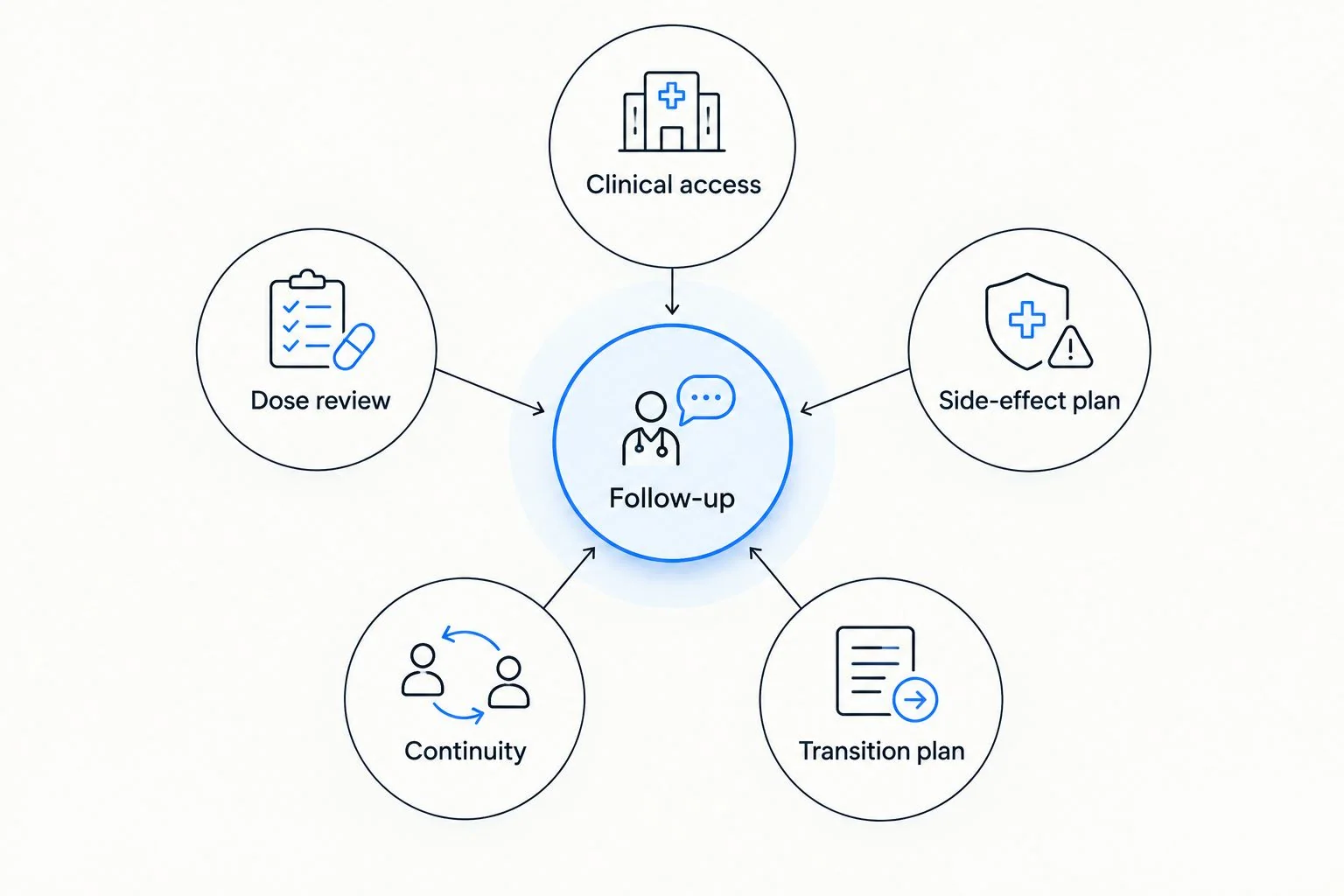
The strongest answer is a clear process you can understand before treatment begins. A vague reassurance is not a substitute for instructions. Keep emergency care separate from routine platform messaging; a telehealth inbox is not an emergency service.
Find out if GLP-1 treatment may be right for you.
Start My Pre-AssessmentPricing: compare the billing structure, not just enrollment
Neither program earns a cost verdict without comparing your actual treatment and billing terms. For your 2026 review, separate payment for clinical services from payment for medication, testing, and any additional services.
WeightWatchers Clinic uses a membership-based model. Confirm what the membership covers and whether the prescribed medication is billed separately. Membership can make the service component easier to understand, but it does not by itself establish your total financial obligation.
For the other platform, request an itemized explanation of how care and medication are billed. Do not assume they are bundled, billed separately, or handled through insurance without confirmation.
Ask both providers:
- Which services recur automatically?
- Are laboratory tests included or billed separately?
- Does a medication change alter the billing arrangement?
- What are the cancellation and renewal terms?
- What happens financially if the clinician does not prescribe treatment?
Predictability comes from knowing all recurring obligations. Flexibility comes from knowing which services you can change or discontinue. Judge those tradeoffs from the actual terms—not from an enrollment headline or an assumption that insurance will cover treatment.
Final verdict: choose the program you will actually use
Choose VEVArx if you want broader prescription discussions
Best for: a US adult seeking medically supervised GLP-1 weight loss who also has separate questions about wellness peptide prescriptions. The platform's stated treatment scope matches that profile.
Choose it because those discussions are relevant to your needs, not because more prescriptions must mean better care. Confirm follow-up, formulation, and billing before making a commitment. Keep each additional treatment decision separate from the decision to pursue weight-loss medication.
Choose WeightWatchers Clinic if you want behavioral structure
Best for: an adult who wants prescription weight management connected to the WeightWatchers food-tracking and behavioral program. WeightWatchers Clinic wins for that specific preference.
Choose it when the behavioral framework is something you intend to use consistently. Do not select it solely for the familiar name, and do not assume its membership establishes medication suitability or guarantees a particular outcome.
One-glance scorecard
| Dimension | Winner |
|---|---|
| Broader prescription interests | The platform with the stated wellness prescription offerings |
| WeightWatchers-centered daily routine | WeightWatchers Clinic |
| Individual prescription suitability | Tie: clinical evaluation determines fit |
| Proven provider-level weight-loss advantage | Neither established here |
| Follow-up quality | Compare the actual clinical process |
| Billing fit | Compare itemized terms for your treatment |
Have questions about your options? Start with a quick online assessment.
Start My Pre-AssessmentFAQ
Is VEVArx better than WeightWatchers Clinic?
VEVArx is the better fit for adults seeking GLP-1 telehealth care who also want to discuss separate wellness peptide prescriptions. WeightWatchers Clinic is the better fit when connection to the WeightWatchers food-tracking and behavioral program is the priority.
Does WeightWatchers Clinic mean I will get a GLP-1 prescription?
No, enrollment does not guarantee a GLP-1 prescription. A clinician must evaluate whether treatment is appropriate for your health history and circumstances.
Which program will help me lose more weight?
Neither provider name establishes that you will lose more weight. Your prescribed treatment, tolerance, clinical follow-up, and individual response determine how treatment progresses.
How should I compare the cost of these programs?
Compare the complete billing arrangement for clinical care, medication, testing, and any additional services. Read renewal and cancellation terms, and do not assume a membership includes medication.
Are compounded semaglutide and FDA-approved semaglutide the same?
No, compounded semaglutide is not an FDA-approved product. Ask the prescriber to identify the formulation and explain why it is appropriate for your circumstances.
Do I need wellness peptides with a GLP-1 medication?
A GLP-1 prescription does not establish a need for additional wellness peptide prescriptions. Each proposed treatment needs a separate discussion of its purpose, evidence, and risks.
Can I switch from one online weight-loss clinic to another?
A receiving clinician must review your treatment before deciding whether to continue or change it. Share your medication name, formulation, current dose, last dose date, and side-effect history; do not overlap prescriptions on your own.
One last thing
Your best comparison document is a written care plan, not a feature list. Before choosing either program, ask who manages side effects, how treatment changes are approved, and what happens if you need to stop.
Medication also does not replace the rest of weight management. US Department of Health and Human Services guidance recommends at least 150 minutes per week of moderate-intensity aerobic activity for adults, adapted to your abilities and medical advice. In 2026, choose care that helps you build a sustainable routine—not simply obtain the next prescription.
Related guides
Ready to get started?
See if doctor-prescribed GLP-1 treatment may be right for you. It only takes a few minutes, 100% online.
Start My Pre-AssessmentThis article is for informational purposes only and is not medical advice. Compounded medications are not approved by the FDA and have not been reviewed for safety, effectiveness, or quality. Prescription products require an online consultation with a licensed healthcare provider who will determine if a prescription is appropriate. Individual results vary.