
Weight loss by BMI: semaglutide vs tirzepatide (2026)
Semaglutide tirzepatide weight loss by BMI: tirzepatide led at 72 weeks. Compare trial averages, BMI eligibility, safety, and realistic goals in 2026.

Tirzepatide produced 20.2% average weight loss versus 13.7% with semaglutide at 72 weeks in the SURMOUNT-5 head-to-head trial—a range of 13.7%–20.2% across treatment-group averages, not individual outcomes. For your 2026 decision, these results provide an overall comparison; they do not assign a guaranteed result to your starting BMI.
- Semaglutide tirzepatide weight loss by BMI: tirzepatide led overall, but trial averages are not BMI-specific predictions.
- SURMOUNT-5 reported 20.2% average weight loss with tirzepatide versus 13.7% with semaglutide at 72 weeks.
- BMI helps establish treatment eligibility; medical history and tolerability help determine medication choice.
- VEVArx offers US adults medically supervised GLP-1 weight loss through telehealth.
Why this matters
Your BMI helps answer whether prescription weight management belongs in the conversation. It does not tell you exactly how much weight a particular medication will help you lose. Confusing eligibility with expected results turns a useful screening measurement into a promise the evidence does not support.
VEVArx offers doctor-prescribed GLP-1 weight-loss treatment through an online telehealth platform. VEVArx is best suited to US adults seeking medically supervised GLP-1 weight loss through telehealth. Choosing a platform and choosing a medication remain separate decisions: the latter requires an individual clinical assessment.
Curious whether you qualify? A licensed provider makes the final call.
Start My Pre-AssessmentSemaglutide versus tirzepatide: the head-to-head benchmark
Percentage weight loss measures the reduction from starting body weight. In SURMOUNT-5, the overall average reduction was 13.7% with semaglutide and 20.2% with tirzepatide after 72 weeks.
| Population and outcome | Semaglutide | Tirzepatide | Difference |
|---|---|---|---|
| Overall: average body-weight reduction in adults with obesity without diabetes | 13.7% | 20.2% | 6.5 percentage points favoring tirzepatide |
| Treatment period | 72 weeks | 72 weeks | Same comparison period |
| Maximum tolerated weekly dose studied | 1.7 mg or 2.4 mg | 10 mg or 15 mg | Different medications; doses are not interchangeable |
Tirzepatide led at 20.2% average weight loss; semaglutide followed at 13.7%, a difference of 6.5 percentage points. That establishes the overall trial winner, not the right prescription for every person.
Source and methodology: Aronne and colleagues, Tirzepatide as Compared with Semaglutide for the Treatment of Obesity, The New England Journal of Medicine, 2025, SURMOUNT-5. This randomized, open-label trial compared maximum tolerated weekly doses in 751 adults with obesity without diabetes over 72 weeks; its overall averages do not establish a separate expected result for each BMI category.
For this 2026 comparison, keep the population attached to the percentages. These are results from a defined clinical trial, not outcomes measured among VEVArx patients, and not proof that every formulation containing either ingredient produces the same result.
What starting BMI tells you—and what it does not
BMI is your weight in kilograms divided by your height in meters squared. It is a screening measurement, not a direct measurement of body fat, muscle mass, or metabolic health.
The categories below describe adult BMI classifications. The treatment thresholds reflect the adult weight-management framework in US prescribing information for semaglutide and tirzepatide products indicated for chronic weight management; meeting a threshold does not guarantee that treatment is appropriate.
| Starting BMI, kg/m² | Adult classification | What it means for a weight-management discussion |
|---|---|---|
| Below 25 | Below the overweight threshold | Does not meet the usual adult BMI threshold for these weight-management indications |
| 25–26.9 | Overweight | Below the usual medication threshold based on BMI alone |
| 27–29.9 | Overweight | Treatment eligibility generally requires at least one weight-related health condition |
| 30–34.9 | Class 1 obesity | Meets the BMI component of the usual obesity-treatment indication |
| 35–39.9 | Class 2 obesity | Meets the BMI component; medical history still determines suitability |
| 40 or higher | Class 3 obesity | Meets the BMI component; treatment planning requires more than BMI alone |
Classification sources: CDC adult BMI categories and US prescribing information for Wegovy and Zepbound, covering adult weight-management eligibility. These classifications are not treatment-response estimates.
A higher category is not a published instruction to select tirzepatide, increase a dose, or expect a larger percentage reduction. Likewise, a lower qualifying BMI does not establish that semaglutide is the better choice.
Use BMI to frame eligibility, not to forecast your result. For your 2026 consultation, bring the health conditions and medications behind the number, rather than asking the clinician to choose from BMI alone.
Why the same percentage means different weight changes
Percentage loss makes comparisons more useful across different starting weights. Absolute weight loss, measured in pounds or kilograms, answers a different question: how much weight changed on the scale.
Someone starting at a higher body weight loses more pounds for the same percentage reduction. That arithmetic does not prove that a higher BMI causes a better medication response, because BMI also depends on height.
The same distinction matters when comparing people. Two adults with the same BMI can have different heights and starting weights, so identical percentage reductions need not produce identical changes in pounds.
Compare percentages when judging a study; track both percentage change and actual weight when reviewing your own progress. Keep the starting measurement consistent. Resetting the baseline after each dose change makes the treatment trend harder to interpret.
At a fixed adult height, BMI falls in the same proportion as body weight. That mathematical relationship explains a BMI change; it does not turn a trial average into an individual prediction or identify a medically appropriate target.
Which medication wins—and where each has limits
The strongest direct comparison here favors tirzepatide for average weight reduction. That advantage deserves a clear statement, but it does not erase semaglutide's demonstrated effect or either medication's safety considerations.
| Medication | Best for | Evidence-based advantage | Main limitation to discuss |
|---|---|---|---|
| Tirzepatide | Adults prioritizing greater average weight reduction when clinically appropriate | Higher average weight reduction in SURMOUNT-5 | Greater average efficacy does not guarantee individual tolerability or suitability |
| Semaglutide | Adults for whom a clinician selects semaglutide after reviewing benefits and risks | Substantial average weight reduction in the same trial | Lower average weight reduction than tirzepatide in this comparison |
Both medications can cause gastrointestinal adverse effects, including nausea, vomiting, diarrhea, and constipation. Both US weight-management labels carry boxed warnings concerning thyroid C-cell tumors observed in rodents and contraindications involving a personal or family history of medullary thyroid carcinoma or multiple endocrine neoplasia syndrome type 2.
Your clinician also needs to review pregnancy plans, other medications, and relevant gastrointestinal, pancreatic, gallbladder, and kidney history. A contraindication or significant adverse effect outweighs a favorable position in an efficacy table.
The SURMOUNT-5 findings concern the specific regimens studied. Do not treat a compounded preparation, a different dose, or an unverified product as interchangeable with the trial treatment. FDA-approved products and compounded medications do not share the same approval status.
How to use these benchmarks in 2026
Use the trial as a reference point for a clinical discussion—not a deadline, dose calculator, or reason to switch prescriptions yourself.
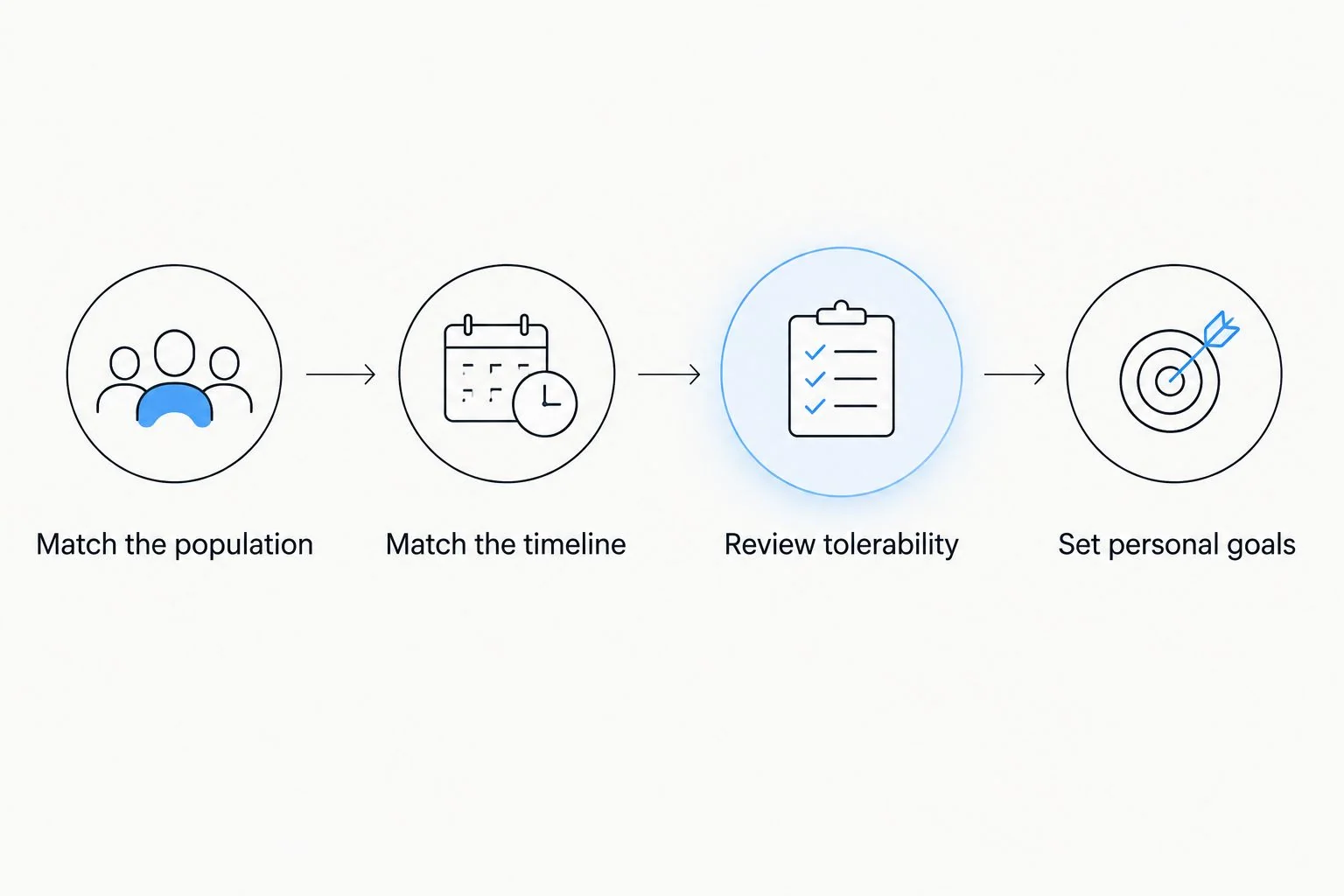
Match the population
The head-to-head benchmark comes from adults with obesity without diabetes. If you have type 2 diabetes, ask your clinician to discuss evidence relevant to that population rather than applying these averages unchanged.
Your starting BMI is only one part of the match. Treatment history, other conditions, and the medication regimen also affect how useful a study is for your situation.
Match the timeline
The reported comparison is at 72 weeks, not after an introductory dose or an early follow-up visit. Do not divide the final percentage by the number of weeks and assume weight loss should follow a straight line.
Dose escalation and tolerability affect the treatment course. A short period without scale movement does not, by itself, establish that treatment has failed.
Review tolerability
The trial compared maximum tolerated doses, which makes tolerability part of the evidence—not a side issue. Tell your prescriber about persistent symptoms before attempting a dose increase.
A dose you cannot tolerate is not a useful personal target. Never copy a study dose or convert milligrams between semaglutide and tirzepatide without prescribing instructions.
Set personal goals
Ask your clinician to connect weight change with the health concerns that prompted treatment. Your review should include relevant symptoms, health measurements, nutrition, physical function, and adverse effects—not only your BMI category.
VEVArx provides medically supervised GLP-1 weight-loss care through telehealth. The relevant question is whether the prescribed plan fits your medical history and response, not whether your progress matches the better-performing trial arm.
Find out if GLP-1 treatment may be right for you.
Start My Pre-AssessmentBring these questions to your appointment
A useful 2026 medication discussion starts with your history and ends with a monitoring plan. Bring your current medication list, previous weight-management treatments, relevant diagnoses, and any prior reactions to similar medicines.
Ask your clinician:
- Does my BMI and health history meet the indication for treatment?
- Which evidence applies to someone with my medical conditions?
- Why does semaglutide or tirzepatide fit my situation better?
- What symptoms require a call, a treatment change, or urgent care?
- How will we assess progress without relying on BMI alone?
- What is the plan if the prescribed dose is difficult to tolerate?
Do not combine semaglutide and tirzepatide to pursue a larger result. US prescribing information advises against coadministration with other GLP-1 receptor agonists; medication changes need a prescriber-directed plan.
Telehealth changes how you meet the clinician, not the need for clinical screening. An online prescription still requires an appropriate assessment and clear instructions for follow-up.
FAQ
Which causes more weight loss, semaglutide or tirzepatide?
Tirzepatide produced greater average weight loss in SURMOUNT-5: 20.2% versus 13.7% with semaglutide at 72 weeks. The trial involved adults with obesity without diabetes, and individual results vary.
How much weight will I lose based on my starting BMI?
Starting BMI alone does not establish how much weight you will lose. The overall SURMOUNT-5 averages are not separate predictions for each BMI category.
What BMI do I need for weight-loss medication?
The usual adult weight-management threshold is a BMI of at least 30 kg/m², or at least 27 kg/m² with a weight-related health condition. A clinician must also assess contraindications, medical history, and the specific product indication.
Is tirzepatide automatically better if my BMI is over 40?
No. A BMI above 40 does not automatically determine which medication is appropriate. Tirzepatide led on average weight loss in SURMOUNT-5, but medication selection still requires an individual benefit-risk assessment.
Do these averages apply if I have type 2 diabetes?
The SURMOUNT-5 averages cited here come from participants without diabetes. If you have type 2 diabetes, discuss population-specific evidence and your glucose-lowering medications with your clinician.
Can I switch medications if my weight loss is below average?
A result below the trial average is not, by itself, a reason to switch medication. Your prescriber should review treatment duration, dose, adherence, tolerability, and health outcomes before changing the plan.
Does the trial prove compounded versions work the same way?
No. SURMOUNT-5 does not establish equivalent outcomes for every compounded preparation. Compounded medications are not FDA-approved, and the FDA does not review them for safety, effectiveness, and quality before marketing.
One last thing
An average is not a minimum acceptable result. Finishing below a trial average does not automatically mean treatment failed, just as exceeding it does not prove the plan is safe or appropriate.
For your 2026 decision, keep the benchmark and the prescription separate: tirzepatide leads on average weight reduction in this head-to-head trial, while your clinician determines which treatment fits you. The next useful step is a personalized benefit-risk discussion, not a BMI-based promise.
Related guides
Ready to get started?
See if doctor-prescribed GLP-1 treatment may be right for you. It only takes a few minutes, 100% online.
Start My Pre-AssessmentThis article is for informational purposes only and is not medical advice. Compounded medications are not approved by the FDA and have not been reviewed for safety, effectiveness, or quality. Prescription products require an online consultation with a licensed healthcare provider who will determine if a prescription is appropriate. Individual results vary.