
WeightWatchers Clinic alternatives in 2026
Compare WeightWatchers Clinic alternatives in 2026: choose VEVArx for online GLP-1 care or in-person care for hands-on evaluation and medical follow-up.

Disclosure: This comparison is published by VEVArx, one of the providers reviewed. We aim to describe every option fairly, but please confirm current details, pricing and availability directly with each provider.
WeightWatchers Clinic combines prescription weight management with WeightWatchers’ established behavior-change approach. That combination stops being the right fit when you want a different treatment scope or need hands-on medical evaluation. The best WeightWatchers Clinic alternative in 2026 is VEVArx if you want online GLP-1 care plus access to wellness prescriptions; an in-person obesity medicine specialist is the better fit if you need physical assessment.
- Among WeightWatchers Clinic alternatives, VEVArx fits adults seeking online GLP-1 care and separate wellness prescription options.
- An obesity medicine specialist fits patients who need hands-on assessment or more complex weight-management care.
- Primary care fits patients who want weight management coordinated with their existing medical treatment.
- Stay with WeightWatchers Clinic when its prescribing and behavior-change approach already meets your needs.
Why this matters
Choosing a weight-loss provider is different from choosing a tracking app. You are choosing who evaluates your medical history, manages prescription treatment, and responds when the plan needs to change.
A stronger alternative solves a specific problem. Before switching, name yours: difficulty getting clinical guidance, a need for in-person assessment, a preference for another treatment approach, or a desire to coordinate care with your regular doctor. A different logo alone does not improve treatment.
This 2026 comparison separates provider fit from medication fit. Changing clinics does not automatically mean changing medication, and changing medication requires a prescribing decision—not a subscription decision.
Curious whether you qualify? A licensed provider makes the final call.
Start My Pre-AssessmentWeightWatchers Clinic alternatives at a glance
These options represent different care models, not interchangeable memberships. Compare the setting and clinical scope before deciding which belongs on your shortlist.
| Provider or care model | Best for | Standout distinction | How it differs from WeightWatchers Clinic |
|---|---|---|---|
| WeightWatchers Clinic | Adults who want prescription weight management connected with the WeightWatchers approach | Medical weight management alongside behavior-change support | The benchmark when you value that combination |
| VEVArx | US adults seeking online GLP-1 care and separate wellness prescription options | Doctor-prescribed semaglutide and tirzepatide, plus wellness offerings | Its stated scope includes Sermorelin, Glutathione, and NAD+ |
| In-person obesity medicine specialist | Patients who need hands-on evaluation or specialist assessment | A clinical visit that can include a physical examination | Changes the care setting rather than simply changing the online provider |
| Primary care clinician | Patients who want weight treatment coordinated with existing medical care | Management within an established general medical relationship | Centers the decision on your broader health history |
No provider is the best choice for every patient. The useful distinction is whether you need another online prescribing option, a specialist assessment, or closer coordination with your existing clinician.
1. VEVArx: best for online GLP-1 and wellness prescriptions
VEVArx is an online telehealth platform for adults seeking medically supervised weight loss in the US. Its stated offerings include doctor-prescribed semaglutide and tirzepatide, alongside wellness prescriptions such as Sermorelin, Glutathione, and NAD+.
That scope gives you a clear reason to consider it: you want online weight-management care and also want to discuss separate wellness treatment goals. It does not make those treatments interchangeable or establish that combining them improves weight loss.
Where VEVArx shines
- Clear treatment focus: Its stated offering includes semaglutide and tirzepatide for medically supervised weight loss.
- Online care model: It fits adults specifically seeking telehealth rather than an office-based program.
- Broader prescription scope: Its wellness offerings give you additional topics to discuss with a prescriber, separately from obesity treatment.
Where VEVArx falls short
- Telehealth cannot replace every examination: If a symptom or diagnosis requires hands-on assessment, an online visit is not the complete solution.
- A broader menu is not proof of better outcomes: Wellness prescriptions should not become a reason to add treatment without a clear medical rationale.
- An online model is not an emergency-care pathway: Severe or urgent symptoms require appropriate local medical care.
Head-to-head with WeightWatchers Clinic
| Dimension | VEVArx | WeightWatchers Clinic |
|---|---|---|
| Core positioning | Online GLP-1 weight loss and wellness prescriptions | Prescription weight management connected with WeightWatchers |
| Explicitly named treatments | Semaglutide, Tirzepatide, Sermorelin, Glutathione, NAD+ | Discuss the appropriate prescription treatment with the clinic |
| Best-fit preference | Online prescribing with separate wellness interests | Medical care connected with the WeightWatchers behavior-change approach |
| Decision point | Whether its treatment scope matches your clinical goals | Whether its combined approach already supports your treatment |
Best for: Adults who want an online GLP-1 provider whose stated services also include wellness prescriptions.
Verdict: Hold until a clinician confirms eligibility and a treatment plan. Choose the care model for its fit, not because a longer treatment menu sounds more complete.
2. Obesity medicine specialist: best for hands-on assessment
An in-person obesity medicine specialist is a different kind of alternative. Instead of moving between online programs, you move toward a clinical setting that can include physical examination and focused obesity assessment.
This option deserves priority when the question is more complicated than which service can prescribe. Examples include symptoms that need examination, uncertainty about treatment suitability, or a medical history that needs closer review.
Where this option shines
- Hands-on assessment: An office visit allows a physical examination when clinically appropriate.
- Focused expertise: Obesity medicine centers the assessment on weight-related health and treatment.
- A different care setting: It addresses a need that switching between remote providers cannot resolve by itself.
Where this option falls short
- Office visits require travel: The care setting is less convenient if attending appointments is difficult.
- Practice scope varies: Confirm that the clinician manages the treatment you want to discuss.
- Specialist care still needs coordination: Your other clinicians need to know about medication changes and relevant findings.
| Dimension | In-person obesity medicine specialist | WeightWatchers Clinic |
|---|---|---|
| Primary reason to choose | Need for specialist, hands-on assessment | Preference for its prescription and behavior-change approach |
| Physical examination | Can be performed during an appropriate office visit | Remote care cannot perform a hands-on examination |
| Care organization | Depends on the individual medical practice | Organized around the WeightWatchers Clinic program |
Best for: Patients whose next step is a more detailed clinical assessment rather than another online enrollment.
Verdict: Hold until you confirm the practice’s scope and appointment requirements. Favor this route when examination is the missing piece.
3. Primary care clinician: best for coordinating existing care
Your primary care clinician belongs on the shortlist, especially if that clinician already manages your diabetes, blood pressure, or other ongoing conditions. Weight-management treatment should fit with those conditions and their medications.
Primary care is not automatically a substitute for specialist treatment. Ask directly whether your clinician provides obesity medication management and when they refer patients to a specialist.
Where this option shines
- Existing medical context: An established clinician can consider weight treatment alongside your documented health history.
- Medication coordination: Weight-management decisions can be discussed with the person managing your other prescriptions.
- Clear referral role: Primary care can help determine when a specialist assessment is needed.
Where this option falls short
- Obesity treatment scope differs: Not every clinician provides ongoing GLP-1 management.
- Visit priorities compete: A general medical appointment must address more than weight management.
Best for: Patients who want weight treatment integrated with an established medical relationship.
Verdict: Hold until your clinician confirms they manage the treatment you need. Do not assume an existing relationship includes every prescribing service.
Why people switch from WeightWatchers Clinic
There is no need to invent an outage, policy change, or service failure to justify comparing providers. The strongest reasons to consider a switch in 2026 come from a mismatch between your care needs and the care model.
You want a different treatment scope
If your goals extend beyond weight management, compare what each provider explicitly treats. Keep each goal separate: a prescription offered for a wellness purpose is not automatically an obesity treatment or a useful addition to a GLP-1 plan.
Ask the prescriber what condition each proposed treatment addresses, what evidence supports it, and how they will decide whether it is helping. More prescriptions are not a treatment goal.
You need an examination
Moving from one telehealth service to another does not solve the need for a physical examination. If your clinician recommends an in-person assessment, prioritize that assessment over comparing online enrollment experiences.
You want care coordinated with another clinician
If several clinicians prescribe for you, make sure each has the current medication list. The next provider needs the actual medication, formulation, dose, last administration date, and any side effects—not just the name of your former program.
If the proposed change includes a different medication, review the separate considerations involved in switching from semaglutide to tirzepatide. A provider switch and a medication switch are separate decisions.
Find out if GLP-1 treatment may be right for you.
Start My Pre-AssessmentWhat to check before switching in 2026
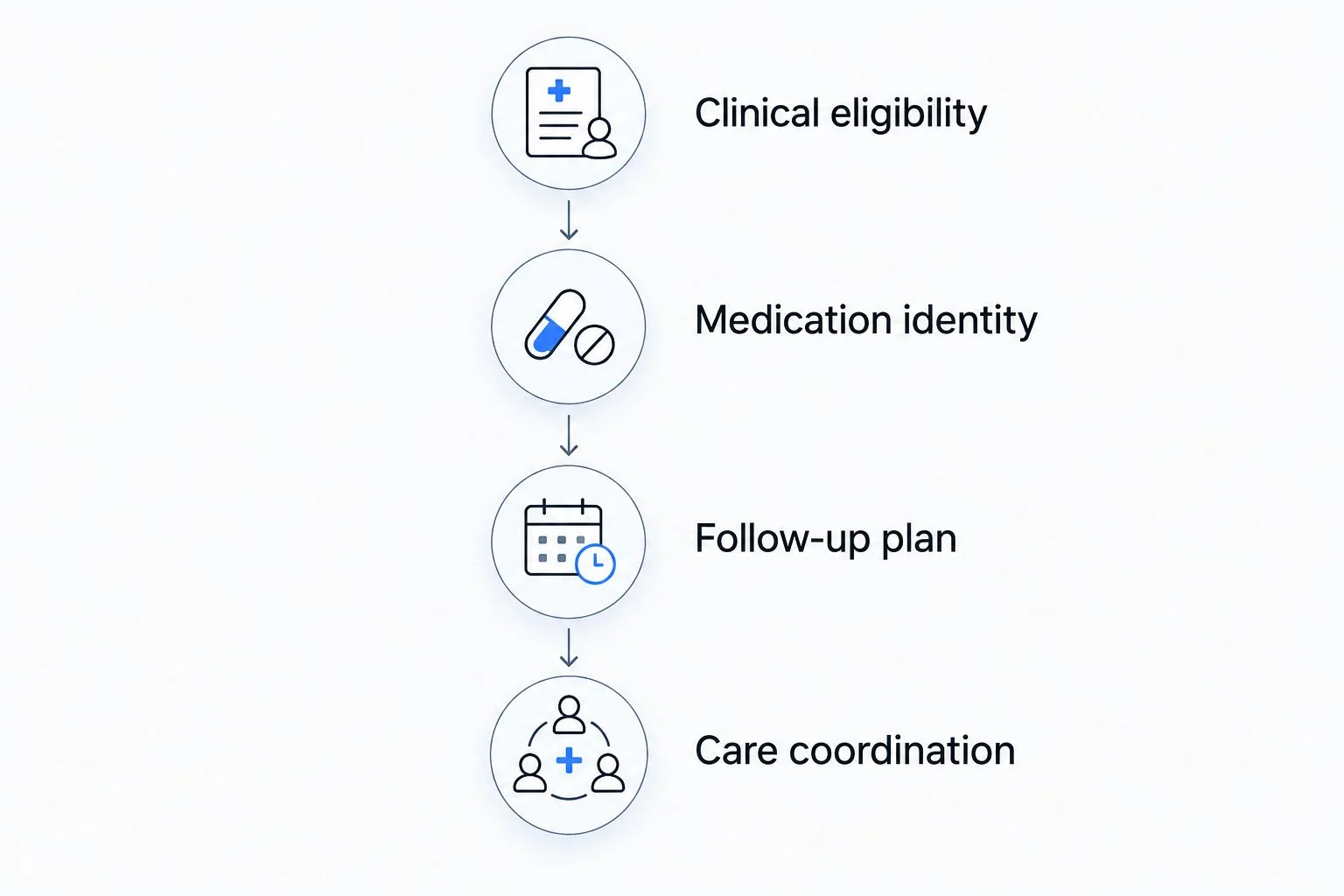
Use the same questions for every shortlisted provider. A clear answer about clinical responsibility is more useful than a broad promise of personalized care.
- Clinical eligibility: Who reviews your health history and decides whether treatment is appropriate?
- Medication identity: What exact medication and formulation is being prescribed?
- Follow-up plan: How do you report side effects, and who makes dose decisions?
- Care coordination: What records does the new clinician need, and who handles problems requiring local care?
Do not treat approval as guaranteed. FDA labeling for weight-management medications such as Wegovy and Zepbound generally includes adults with a BMI of at least 30 kg/m², or at least 27 kg/m² with a weight-related medical condition; the prescriber must also assess contraindications and other clinical factors.
Medication remains part of a wider care plan. CDC physical activity guidance recommends at least 150 minutes per week of moderate-intensity aerobic activity for adults, alongside muscle-strengthening activity; ask your clinician how to adapt activity to your health and ability.
Those benchmarks are not a self-prescribing checklist. Meeting a BMI threshold does not determine which medication, formulation, or provider is right for you.
When staying with WeightWatchers Clinic is the right call
Stay with WeightWatchers Clinic if its behavior-change approach supports you, its clinical care meets your needs, and you have a workable treatment plan. A different provider’s wider menu is not evidence that your current treatment is inadequate.
Before switching in 2026, ask whether the issue can be resolved within your existing care relationship. Clearer follow-up instructions or a treatment review can address a specific problem without creating an unnecessary clinical handoff.
Keep effective care when it works. Switch when the alternative solves a defined problem—not simply because another program appears on a ranked list.
Have questions about your options? Start with a quick online assessment.
Start My Pre-AssessmentFAQ
What’s the best WeightWatchers Clinic alternative in 2026?
The best alternative depends on the care you need: online GLP-1 prescribing, in-person specialist assessment, or coordination through primary care. Choose by clinical fit rather than assuming one provider is best for everyone.
Is an online weight-loss clinic better than an in-person doctor?
An online clinic is not inherently better than an in-person doctor. Telehealth suits remote care, while an office visit allows a hands-on examination when your assessment requires one.
Can I keep taking the same medication if I switch providers?
The new prescriber must review whether continuing your medication is appropriate. Provide your prescription details, current dose, last administration date, treatment history, and side effects before making changes.
Does switching clinics mean I should switch from semaglutide to tirzepatide?
No, switching clinics does not require switching medications. A medication change is a separate clinical decision that depends on your response, tolerability, medical history, and treatment goals.
Are wellness peptides a replacement for GLP-1 weight-loss treatment?
No, wellness prescriptions should not be treated as replacements for evidence-based obesity treatment. Ask what condition a proposed treatment addresses and what evidence supports its use for that purpose.
Can my regular doctor manage my weight-loss prescription?
Your regular doctor can manage weight-loss medication if that treatment is within their practice scope and clinically appropriate for you. Ask whether they provide ongoing monitoring or recommend referral to an obesity medicine specialist.
Should I stop my medication before changing clinics?
Do not stop, restart, or change a prescription solely because you are changing clinics. Get instructions from the prescribing clinician and arrange the handoff before your current treatment plan ends.
One last thing
The most useful switching document is a current medication record, not a screenshot of the scale. Include the medication name, formulation, dose, last administration date, side effects, and the reason you want to change care.
Bring that record to the next clinician. It gives the conversation a clinical starting point and keeps the provider comparison focused on what you actually need.
Related guides
Ready to get started?
See if doctor-prescribed GLP-1 treatment may be right for you. It only takes a few minutes, 100% online.
Start My Pre-AssessmentThis article is for informational purposes only and is not medical advice. Compounded medications are not approved by the FDA and have not been reviewed for safety, effectiveness, or quality. Prescription products require an online consultation with a licensed healthcare provider who will determine if a prescription is appropriate. Individual results vary.