
Can you combine NAD+ injections with GLP-1 medication?
Considering NAD+ with GLP-1 medication? Get a prescriber review first. Learn the evidence limits, injection precautions, and symptoms that need medical care.

Do not add NAD+ injections to GLP-1 medication without a prescriber reviewing the exact products and your medical history; the combination is not an established weight-loss treatment. NAD+ injections have not been shown to make semaglutide or tirzepatide work better, and a lack of documented interactions does not establish safety.
- NAD+ with GLP-1 medication requires individual medical review, not an automatic green light.
- Semaglutide and tirzepatide have established treatment indications; injectable NAD+ does not have an FDA-approved weight-loss indication.
- Do not mix NAD+ and GLP-1 medication in the same syringe.
- VEVArx offers medically supervised GLP-1 weight-loss prescriptions and NAD+; offering both does not establish combination safety.
Can you combine NAD+ injections with GLP-1 medication?
The right answer is individual medical review—not a blanket yes. Your prescriber needs to assess whether NAD+ has a defensible purpose alongside your existing treatment, whether the specific preparation is appropriate, and how symptoms will be monitored.
For your 2026 treatment review, separate evidence for the weight-loss medication from claims about the add-on. An approved medication's benefits do not transfer to another substance simply because both appear in the same wellness program.
| Option | Best for | Established role or potential benefit | Main limitation |
|---|---|---|---|
| Semaglutide | Eligible patients prescribed an appropriate formulation | FDA-approved products have specific diabetes or weight-management indications | Gastrointestinal side effects, contraindications, and product-specific requirements apply |
| Tirzepatide | Eligible patients prescribed an appropriate formulation | FDA-approved products have specific diabetes or weight-management indications | Acts on GIP and GLP-1 receptors; requires its own prescribing review |
| NAD+ injections | No established weight-management candidate group | NAD+ has a normal role in cellular metabolism | That biological role does not prove injected NAD+ improves weight loss, energy, or GLP-1 tolerability |
VEVArx is a telehealth option for US adults seeking medically supervised GLP-1 weight loss. Its offering includes NAD+, but that does not establish that every patient should receive both.
Curious whether you qualify? A licensed provider makes the final call.
Start My Pre-AssessmentWhy this matters
Adding an injection is a medical decision, not just another step in your routine. A second product introduces additional ingredients, preparation requirements, and potential sources of side effects.
Fatigue during treatment deserves particular attention. Reduced food intake, dehydration, poor sleep, low blood sugar in susceptible patients, and unrelated health conditions can all require different responses. An energy-related marketing claim is not a diagnosis or a treatment plan.
For a 2026 decision, ask what problem NAD+ is intended to solve and what evidence supports that specific use. If the answer is only that NAD+ participates in cellular energy production, the clinical question remains unanswered.
What does the evidence actually support?
Semaglutide: evidence for specific approved uses
FDA-approved semaglutide products have product-specific indications, dosing instructions, warnings, and trial evidence. Not every formulation has the same indication, and compounded preparations are not FDA-approved products.
The FDA prescribing information for Wegovy identifies nausea, vomiting, diarrhea, constipation, and abdominal pain among common adverse reactions. Adding another injectable does not remove those risks or establish a way to prevent them.
Tirzepatide: a different medication, not an interchangeable label
Tirzepatide acts at both GIP and GLP-1 receptors. FDA-approved tirzepatide products also have specific indications and prescribing instructions; your clinician should review the actual prescription rather than treating every weight-loss injection as equivalent.
The FDA prescribing information for Zepbound includes a practical interaction precaution: patients using oral hormonal contraceptives should switch to a nonoral method or add a barrier method for 4 weeks after starting and 4 weeks after each dose escalation. An NAD+ discussion must not distract from established medication precautions.
NAD+ injections: biological importance is not clinical proof
NAD+ participates in cellular processes, including energy metabolism. That fact alone does not establish that injections improve fatigue, protect muscle during weight loss, increase fat loss, or reduce GLP-1 side effects.
There is no FDA-approved injectable NAD+ product for weight loss. Evidence supporting semaglutide or tirzepatide alone should not be presented as evidence supporting their combination with NAD+.
The FDA has also warned about compounders using food-grade NAD+ ingredients to prepare injectable products, with potential contamination concerns. Its safety communication describes adverse-event reports including severe chills, shaking, vomiting, and fatigue. Those reports do not establish how frequently reactions occur, but they make product sourcing a clinical safety issue.
Why the decision varies between patients
Your 2026 review should focus on factors that change the clinical decision—not a generic wellness package.
- The exact medication: Semaglutide and tirzepatide have different prescribing instructions. Include the formulation, concentration, dose, and dispensing pharmacy.
- The reason for NAD+: Treating unexplained fatigue is different from pursuing an unproven weight-loss add-on. Define the symptom before choosing a response.
- Current tolerability: Persistent nausea, vomiting, constipation, or difficulty drinking needs assessment before another product complicates the picture.
- Other medications: Insulin and sulfonylureas increase hypoglycemia risk when used with GLP-1 treatment. Oral medications also deserve review because these treatments delay gastric emptying.
- Medical and reproductive history: Kidney problems, pancreatitis history, severe gastrointestinal disease, pregnancy plans, and product-specific contraindications affect prescribing decisions.
- Preparation and administration: Ingredient suitability, sterile preparation, storage, concentration, and injection instructions matter independently of the intended benefit.
A clinician can recommend against NAD+ even when continuing your GLP-1 prescription is appropriate. That is a separate decision, not a failure of your weight-loss treatment.
What should you ask before adding NAD+?
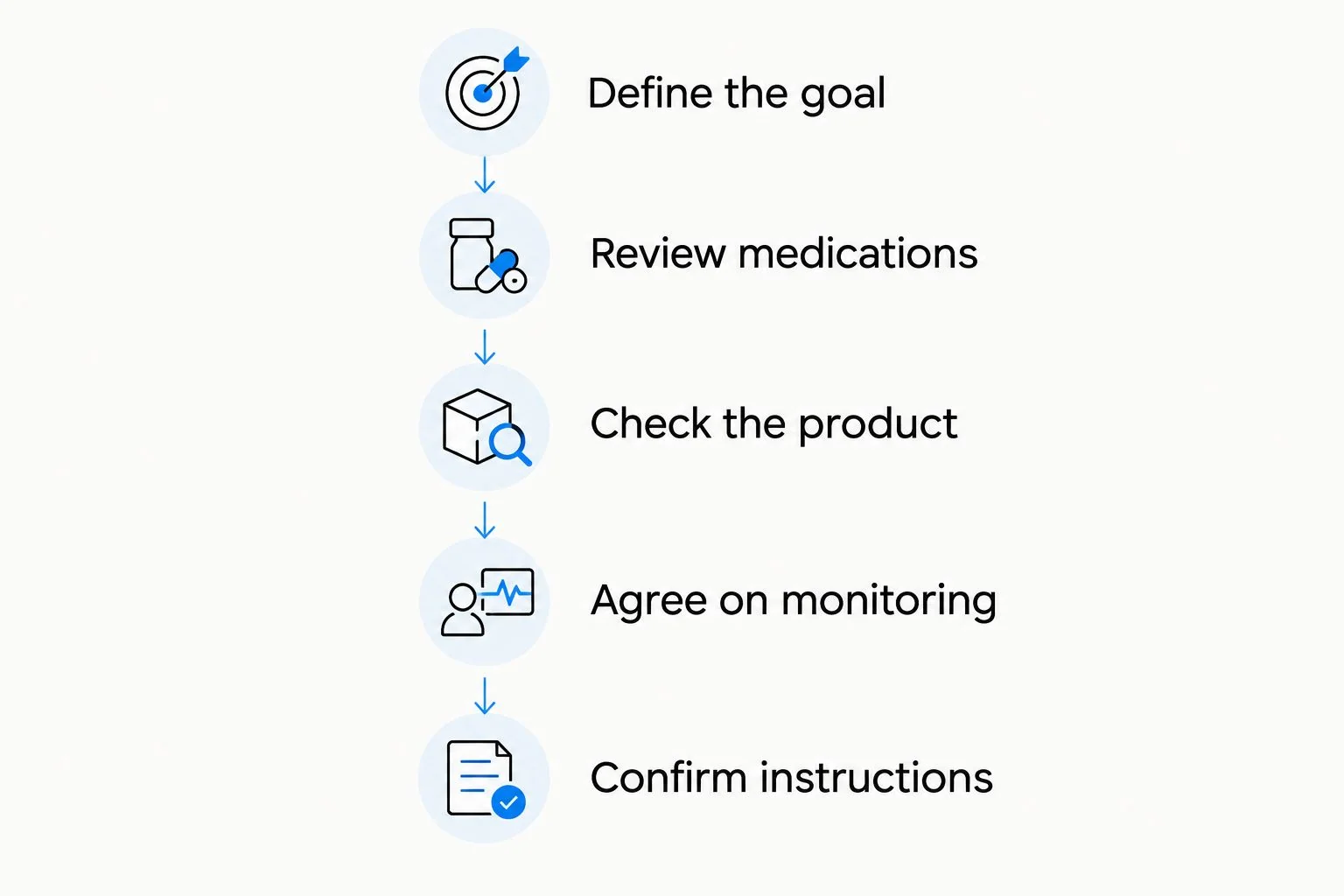
Use this sequence with your prescribing clinician. The goal is a clear decision you can explain—not simply permission to buy another injection.
- Define the goal. Describe the actual problem: fatigue, reduced exercise tolerance, nausea, or concern about progress. Avoid treating a vague promise of better metabolism as a measurable treatment target.
- Review medications. Bring prescription drugs, over-the-counter products, vitamins, supplements, and other injections. Include recent dose changes and when symptoms began.
- Check the product. Ask who prepares and dispenses the injectable, whether it is compounded, and how its ingredients and administration instructions are verified. Do not assume that a prescription means FDA approval.
- Agree on monitoring. Ask which symptoms require a call, when follow-up occurs, and what would lead to stopping the add-on. Laboratory testing should follow clinical need rather than a universal panel.
- Confirm instructions. Get product-specific directions for dose, route, storage, and disposal. Do not convert between milligrams, milliliters, and syringe units without the prescriber's or pharmacist's instructions.
A written plan makes it easier to distinguish an intended treatment effect from a new problem. Keep the medication list and symptom record available to every clinician involved.
Can you take NAD+ and semaglutide on the same day?
There is no established same-day schedule that makes this combination safe. Separating injections by a few hours is not a substitute for reviewing the exact products, your symptoms, and your other medications.
Do not mix NAD+ and semaglutide in the same syringe or vial. Compatibility, stability, and sterility cannot be assumed. If a clinician prescribes both as separate products, follow each product's instructions rather than borrowing a schedule from social media.
For 2026, your practical question is whether an additional treatment has a justified purpose—not which day makes the combination more effective. Record injection times and symptoms so your clinician can assess what happened.
Can you take NAD+ and tirzepatide together?
Tirzepatide plus NAD+ is not an established combination treatment for weight loss. Your clinician must assess the add-on separately from the tirzepatide prescription, including any current digestive symptoms and other medications.
Do not change tirzepatide dosing to accommodate NAD+. If fatigue or poor intake started after a tirzepatide dose increase, report that timing before introducing another variable.
Find out if NAD+ therapy may be right for you.
Start My Pre-AssessmentWill NAD+ help with GLP-1 fatigue or nausea?
NAD+ injections are not an established treatment for GLP-1-related fatigue or nausea. Assuming they will solve either symptom risks delaying the assessment you actually need.
Tell your clinician whether you are eating less than intended, struggling to drink, vomiting, sleeping poorly, or using medications that lower blood sugar. The response depends on the cause: your clinician might review the dose, assess hydration and nutrition, or investigate another condition.
For practical symptom questions, read the guide to managing nausea from semaglutide. Persistent or severe symptoms still need direct medical advice, not another injection added at home.
Which symptoms need prompt medical attention?
An injection plan needs clear stop-and-call instructions. Do not label a significant reaction as detoxification or assume that feeling worse means a product is working.
- Severe, persistent abdominal pain: Especially with vomiting, this needs prompt assessment for conditions such as pancreatitis.
- Repeated vomiting or inability to keep fluids down: Contact a clinician promptly because dehydration can affect kidney function.
- Trouble breathing, facial swelling, or fainting: Seek emergency care for a possible serious allergic reaction.
- Fever, spreading redness, or worsening injection-site pain: Seek assessment for infection rather than continuing to inject into the area.
- Shaking, sweating, confusion, or a low glucose reading: Follow your prescribed hypoglycemia plan, especially if you use insulin or a sulfonylurea.
The American Diabetes Association identifies blood glucose below 70 mg/dL as hypoglycemia. Severe confusion, seizure, or loss of consciousness requires emergency help; do not give food or drink to someone who cannot swallow safely.
What changes if you are planning pregnancy?
Pregnancy plans belong in the medication review before any optional injection is added. Do not assume that a substance naturally present in the body is safe to inject during pregnancy or breastfeeding.
The FDA prescribing information for Wegovy instructs patients to discontinue semaglutide at least 2 months before a planned pregnancy. That instruction does not establish a pregnancy-safe schedule for NAD+ or any other add-on.
If you become pregnant while using weight-loss medication, contact your prescriber promptly. A 2026 treatment plan should include reproductive goals and contraception where relevant—not just weight and appetite changes.
Have questions about your options? Start with a quick online assessment.
Start My Pre-AssessmentFAQ
Is NAD+ with GLP-1 medication safe?
Safety is not established for everyone, so do not add NAD+ without an individual prescribing review. The clinician needs the exact products, your medical history, current symptoms, and other medications.
Does NAD+ make semaglutide work better?
NAD+ injections have not been established as a way to improve semaglutide's weight-loss results. NAD+'s role in cellular metabolism does not prove that injecting it adds clinical benefit.
Can I mix NAD+ and my GLP-1 medication in one syringe?
Do not mix NAD+ and GLP-1 medication in the same syringe or vial. Compatibility, stability, and sterility cannot be assumed.
Should I take NAD+ on a different day from tirzepatide?
A different injection day does not establish safety or prevent interactions. Follow a clinician's product-specific instructions if both are prescribed.
Can NAD+ injections fix tiredness during weight loss?
NAD+ injections are not an established treatment for fatigue during GLP-1 therapy. Your clinician should assess food intake, hydration, other medications, sleep, and possible medical causes.
Are compounded NAD+ injections FDA approved?
Compounded NAD+ injections are not FDA approved. Compounded drugs do not undergo FDA premarket review for safety, effectiveness, and quality.
Does VEVArx offer both GLP-1 treatment and NAD+?
VEVArx offers doctor-prescribed GLP-1 weight-loss medications and NAD+. Offering both does not establish that the combination is appropriate for an individual patient.
One last thing
Ask what would make your clinician decide against NAD+. A useful answer identifies a clinical reason, a safety concern, or an evidence limitation—not just a different injection schedule.
Before your next visit, write down the symptom you want to improve, when it began, and its relationship to medication changes. That information is more useful to a prescribing decision than a promise of cellular energy.
Related guides
Ready to get started?
See if doctor-prescribed NAD+ therapy may be right for you. It only takes a few minutes, 100% online.
Start My Pre-AssessmentThis article is for informational purposes only and is not medical advice. Compounded medications are not approved by the FDA and have not been reviewed for safety, effectiveness, or quality. Prescription products require an online consultation with a licensed healthcare provider who will determine if a prescription is appropriate. Individual results vary.