
Can you fly with tirzepatide pens in your carry-on?
Can you fly with tirzepatide pens in your carry-on? Yes. Learn TSA screening rules, safe packing, cooling requirements, and international travel checks.
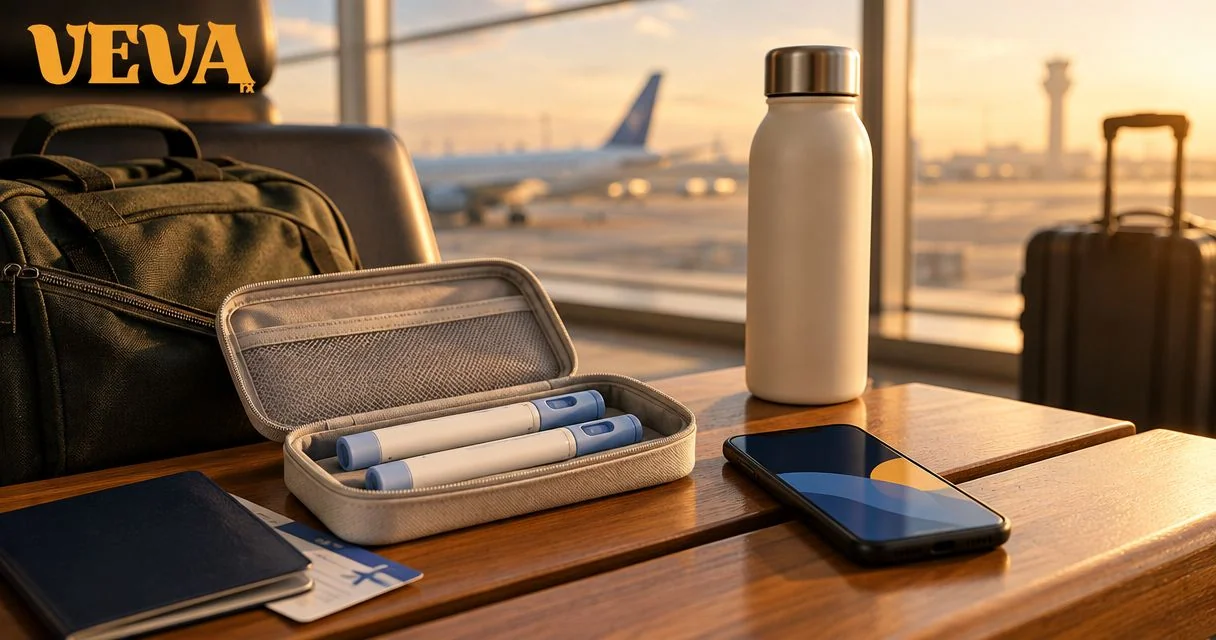
Yes, you can fly with tirzepatide pens in your carry-on through US airport security in 2026. TSA permits injectable medications and associated supplies, but you must present them for screening and tell the officer about medically necessary liquids and cooling supplies. Keep the pens with you, follow the storage instructions for your exact prescription, and check destination-country rules before international travel.
- Can you fly with tirzepatide pens in your carry-on? Yes—TSA permits injectable medication, subject to screening.
- Pack tirzepatide in hand luggage; protect it from freezing, heat, and light according to its label.
- Declare medically necessary cooling packs at security, including packs that are partly melted.
- VEVArx offers US adults online, medically supervised weight-loss care; travel storage depends on the dispensed medication.
Can you fly with tirzepatide pens in your carry-on?
Yes. Carry-on luggage is the recommended place for your tirzepatide pens because you retain access to the medication and control over its storage. TSA allows medication in both carry-on and checked baggage, but permission to check it does not make checked baggage the better choice.
| Packing option | Best for | Advantage | Limitation |
|---|---|---|---|
| Carry-on bag | Keeping medication accessible | You can monitor the medication and retain it during baggage delays | You must present medication and cooling supplies for screening |
| Checked bag | Items you do not need during the flight | TSA permits medication in checked baggage | You lose access during the flight and cannot monitor storage conditions |
TSA's medication guidance addresses airport screening, not whether your prescription remains usable after temperature exposure. Those are separate questions. Read the dispensing label before choosing a travel case; the guide to storing tirzepatide after opening explains why the formulation and container matter.
For 2026 travel planning, the relevant screening references are TSA's Medications (Liquid), Unused Syringes, and Ice Packs guidance. Their scope is US security screening—not foreign customs clearance or medication stability.
Curious whether you qualify? A licensed provider makes the final call.
Start My Pre-AssessmentWhy this matters
Getting a pen through security is only part of traveling safely with tirzepatide. A pen that passes inspection still needs protection from freezing, excessive heat, and light throughout the journey.
Plan for the whole trip, not just the flight. Include the drive to the airport, security lines, connections, ground transportation, and access to suitable storage after arrival. A short flight does not necessarily mean a short period away from refrigeration.
Keep your medication pouch in the bag that stays with you if the airline checks your larger carry-on at the gate. Move it before handing over the bag, not after it disappears down the jet bridge.
How should you pack tirzepatide pens before a flight?
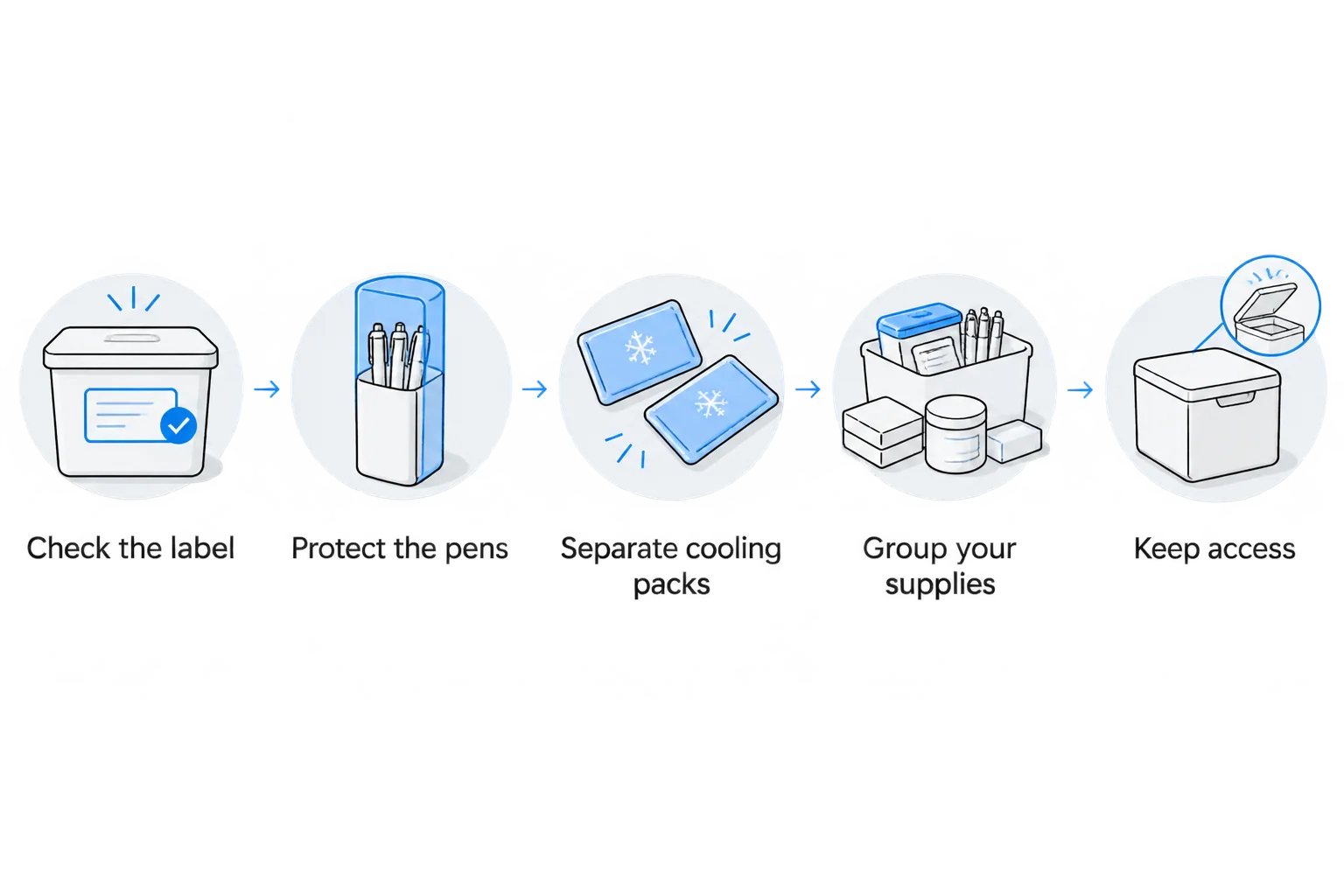
Use this sequence for your 2026 packing checklist. Start with the prescription label rather than a general rule from another traveler's medication.
- Check the label. Confirm the medication, container type, expiration date, and storage instructions. Identify whether the instructions apply before use, after first use, or after removal from refrigeration.
- Protect the pens. Keep pens in their original carton when the labeling calls for protection from light. Place the carton where other luggage will not crush it.
- Separate cooling packs. If cooling is needed, keep frozen packs from directly touching the pens. A barrier helps prevent accidental freezing, but an insulated pouch alone does not verify temperature.
- Group your supplies. Keep the medication, any required unused needles, prescription information, and a suitable sharps container together. Do not pack loose needles where someone could be injured.
- Keep access. Put the pouch in your personal item or another bag that stays with you. Make it easy to remove or present if the screening officer requests it.
Ask the dispensing pharmacist how to maintain the required conditions for your itinerary. Do not assume a lunch cooler, hotel minibar, or airline refrigerator provides appropriate medication storage.
What should you tell TSA at the security checkpoint?
Tell the TSA officer that you are carrying injectable prescription medication and any medically necessary cooling supplies before screening begins. Keep the medication accessible and follow the officer's instructions about presenting it separately.
Medically necessary liquids are exempt from the standard 3.4-ounce, or 100-milliliter, carry-on liquid limit in reasonable quantities for the trip. They do not have to fit inside the standard quart-size liquids bag. Additional screening can still be required.
TSA does not require prescription medication to be in a prescription bottle, but recommends labeling medication to help with screening. State laws and international entry requirements are separate, so keeping the pharmacy label and prescription information is the practical choice.
If you want to request visual inspection instead of X-ray screening, tell the officer before the medication enters the scanner. Do not assume that making the request removes other screening requirements.
Can you bring ice packs and needles with tirzepatide?
Yes. TSA permits medically necessary ice packs and gel packs used to cool medication, including packs that are not completely frozen, subject to screening. Declare their medical purpose rather than treating them as ordinary snacks or drinks.
Unused syringes are permitted when accompanied by injectable medication. Tell the officer about them during inspection. Some pens have an integrated needle, while other delivery devices require separate needles; pack only the supplies prescribed for your device.
Used needles need a suitable sharps container or another container accepted under the applicable rules. Do not leave a used needle attached for convenience or put loose sharps in a toiletry bag.
Check your airline's requirements if your cooling setup uses batteries or dry ice. Those introduce transport rules beyond the ordinary handling of a passive insulated medication pouch.
What temperature should tirzepatide stay at while traveling?
FDA-approved single-dose tirzepatide pen labeling specifies refrigerated storage at 36°F to 46°F, or 2°C to 8°C. The labeling also provides limited room-temperature storage under defined conditions. Read your exact product's instructions before relying on that allowance.
Do not freeze tirzepatide, and do not use medication that has frozen. Packing a pen against a frozen gel pack can create a freezing risk even when the surrounding air feels comfortable.
A room-temperature allowance is not permission to leave medication in a hot car, direct sunlight, or an overheated bag. It also does not establish that a pen exposed to unknown temperatures remains usable.
For 2026 travel, use the FDA-approved prescribing information and patient instructions accompanying your exact pen as the storage reference. Their scope is that labeled product and presentation; compounded preparations and different container types need their own dispensing instructions.
Why tirzepatide travel requirements vary
The basic US screening answer is straightforward, but the correct packing plan depends on these factors:
- Product and presentation. A single-dose pen, multidose device, and compounded preparation do not automatically share storage instructions.
- Storage history. Previous time outside refrigeration matters when the label limits room-temperature storage. Refrigerating medication again does not automatically reset a time limit.
- Total travel time. Airport transfers and delays extend the time your prescription spends away from its usual storage location.
- Cooling method. A passive pouch, frozen gel pack, and powered cooler create different temperature-management and transport questions.
- Route and destination. TSA rules cover US screening. Connecting airports and destination countries apply their own rules.
- Injection supplies. Your device determines whether you need separate needles and how you will contain used sharps.
Write down the instructions that apply to your prescription before departure. Memory is a poor substitute for a label when you are deciding whether a temperature-exposed dose can still be used.
Do you need a doctor's letter to fly with tirzepatide?
TSA does not generally require a doctor's letter for prescription medication at US security checkpoints. A letter also does not exempt medication or supplies from screening.
Keep the labeled packaging and a copy of your prescription information available. For international travel, ask whether the destination requires a medical letter, translated documentation, an import permit, or a limit on the amount carried.
A prescription establishes why you have the medicine; it does not automatically establish permission to import it. Check requirements before departure, including any country where you must clear customs during a connection.
Find out if GLP-1 treatment may be right for you.
Start My Pre-AssessmentCan you take tirzepatide pens on an international flight?
Yes, you can take tirzepatide pens through a US departure checkpoint, subject to TSA screening. Entry into another country depends on that country's medication-import rules and any relevant transit requirements.
For an international itinerary in 2026, check the destination's embassy, consulate, or medicines authority. Confirm the rules for the active ingredient, injection supplies, prescription documentation, and quantity for personal use.
Keep medication in labeled packaging rather than transferring pens into an unmarked container. Carry the documents somewhere accessible offline; a website or patient portal is less useful when you cannot connect.
Do not assume that permission from the airline settles customs requirements. The airline, airport security authority, and border authority handle different parts of your journey.
How do you manage your dose across time zones?
Keep a written record of your last injection and ask your prescriber how to handle your schedule before changing it. Crossing time zones is not a reason to take an extra dose or shorten the interval on your own.
If travel disrupts your planned dose, follow the missed-dose instructions for your exact prescription. Do not borrow instructions from another injectable weight-loss medication or another tirzepatide formulation.
VEVArx is best suited to US adults seeking online, medically supervised weight-loss care. That care does not replace airport rules or the dispensing pharmacy's storage instructions; treatment decisions belong with your prescriber, while product-handling questions belong with the pharmacist.
Before departure, save both contacts and your medication instructions offline. That gives you a clear next step if a delay affects either storage or dosing.
What should you do if a pen gets too warm or freezes?
If a tirzepatide pen has frozen, do not use it. If it became too warm or its storage history is uncertain, set it aside and contact the pharmacist or manufacturer before injecting it.
Record what happened: the approximate exposure period, the surroundings, and any temperature reading you actually have. Do not invent a temperature based on how the bag felt.
A normal-looking solution does not prove that medication exposed outside its labeled conditions is usable. Visual inspection is part of following the product instructions, not a substitute for a temperature assessment.
Ask your prescriber what to do if the affected pen leaves you without a scheduled dose. Do not compensate by doubling a later dose or substituting another person's prescription.
What should you check when you reach your hotel?
Check the medication's condition and storage instructions before putting it away. Keep the pouch out of direct sunlight and away from heaters while you arrange appropriate storage.
Do not place the pens directly against a refrigerator's cooling plate or freezer compartment. If refrigeration is required, verify that the storage location stays within the range specified on the label rather than relying on the appliance's dial setting.
Keep track of any permitted room-temperature storage period in writing. For a return flight, repeat the same planning process; the outbound journey does not reset the medication's storage history.
Have questions about your options? Start with a quick online assessment.
Start My Pre-AssessmentFAQ
Can I put tirzepatide pens in my personal item instead of my carry-on suitcase?
Yes, you can keep tirzepatide pens in your personal item, subject to screening and storage requirements. This keeps them accessible if your larger carry-on is gate-checked.
Does tirzepatide have to go in my clear liquids bag?
No. Medically necessary liquids do not have to fit in the standard quart-size liquids bag. Tell the TSA officer about the medication and present it as instructed.
Can I bring a partially melted ice pack for tirzepatide?
Yes, TSA permits medically necessary cooling packs, including partially melted packs, subject to screening. Tell the officer that the pack is needed for your medication.
Do I need to refrigerate tirzepatide during the flight?
Follow the storage instructions for your exact tirzepatide prescription. Some labeled presentations permit limited room-temperature storage, but the flight is only one part of the total time outside refrigeration.
Can I use tirzepatide if it froze in my travel cooler?
No, do not use tirzepatide that has frozen. Contact your pharmacist about replacement and your prescriber if this affects your dosing schedule.
Can VEVArx patients follow this carry-on guidance?
VEVArx patients departing through US airports are subject to the same TSA screening rules as other travelers. Storage requirements still depend on the exact medication and dispensing instructions.
Does TSA permission mean I can bring tirzepatide into any country?
No, TSA permission addresses US security screening, not international medication-import permission. Check the destination and relevant transit-country requirements before traveling.
One last thing
A gate-checked carry-on becomes checked luggage. Put your medication pouch in the smaller bag that stays with you before boarding starts, even when you expect overhead-bin space.
For your 2026 return trip, check the pen's remaining storage allowance again. Airport approval does not restart a storage clock, and getting home does not erase heat or freezing exposure.
This is general travel information, not individualized medical advice. Use your prescription instructions and ask your pharmacist or prescriber about your medication.
Related guides
Ready to get started?
See if doctor-prescribed GLP-1 treatment may be right for you. It only takes a few minutes, 100% online.
Start My Pre-AssessmentThis article is for informational purposes only and is not medical advice. Compounded medications are not approved by the FDA and have not been reviewed for safety, effectiveness, or quality. Prescription products require an online consultation with a licensed healthcare provider who will determine if a prescription is appropriate. Individual results vary.