
Can you take glutathione injections while pregnant?
Can you take glutathione injections while pregnant? Avoid elective use; learn what to do after a dose and what to ask your prenatal clinician.

Avoid elective glutathione injections while pregnant unless your obstetric clinician specifically recommends them for a medical reason; pregnancy safety has not been established. A prescription, an antioxidant claim, or the fact that your body makes glutathione does not establish that an injected preparation is safe for your baby. If you already received an injection, contact your prenatal clinician before another dose—an exposure alone does not establish that harm occurred.
- Can you take glutathione injections while pregnant? Avoid elective use unless your obstetric clinician recommends it.
- Glutathione occurs naturally, but that does not establish the pregnancy safety of glutathione injections.
- After an accidental exposure, share the product label, dose, timing, and symptoms with your prenatal clinician.
- FDA approval and pregnancy safety are separate questions; compounded drugs are not FDA-approved.
Why this matters
Pregnancy changes the decision from “Does this treatment fit my wellness goals?” to “Is there a medical benefit that justifies exposure?” For an elective injection, uncertain pregnancy safety is a reason to pause, not a reason to experiment.
The same caution applies when you review whether you can take peptides while pregnant. Different substances require separate assessments; being grouped together on a wellness menu does not make their risks interchangeable.
For your 2026 treatment decisions, prioritize a pregnancy-specific review over a general wellness recommendation. Your prenatal clinician needs the exact preparation and the reason you are using it.
Curious whether you qualify? A licensed provider makes the final call.
Start My Pre-AssessmentCan you take glutathione injections while pregnant?
Do not start or continue elective glutathione injections during pregnancy without review by your obstetric clinician. Adequate human pregnancy evidence has not established a safe injected dose, schedule, or trimester for wellness use.
Glutathione has normal functions in the body, including antioxidant activity. That biological role is not evidence that giving additional glutathione by injection improves pregnancy outcomes or is safe at a particular dose.
These distinctions matter when you assess a recommendation:
| Question | What it tells you | What it does not establish |
|---|---|---|
| Does the body make glutathione? | Glutathione has normal biological functions | That injected glutathione is safe during pregnancy |
| Did a clinician prescribe it? | A clinician authorized that preparation | That pregnancy-specific safety has been established |
| Is it compounded? | It was prepared through compounding | That FDA reviewed the finished drug for safety or effectiveness |
| Was it tolerated before pregnancy? | You previously received it without a recognized reaction | That fetal exposure is safe |
| Is the purpose cosmetic or general wellness? | The intended benefit is elective | That the benefit justifies uncertain pregnancy risk |
FDA guidance on compounded drugs explains that these drugs are not FDA-approved: the agency does not verify their safety, effectiveness, or quality before marketing. That distinction applies beyond pregnancy, but it is especially relevant when someone presents a compounded injection as automatically safe.
What does “safety has not been established” actually mean?
It means you should not interpret limited information as reassurance. It also does not mean every exposure causes harm.
A useful assessment needs information about the substance, preparation, route, amount, timing, and pregnancy. A claim that glutathione is simply “good for cells” does not answer those questions.
For a medically necessary treatment, your obstetric clinician weighs the expected benefit against the risks of treatment and of leaving the condition untreated. That is different from continuing an optional cosmetic or wellness injection.
What should you do if you already had an injection?
Contact your prenatal clinician and the prescribing clinician before the next elective injection. Do not assume an exposure has harmed the pregnancy, and do not let reassurance from a seller replace a clinical review.
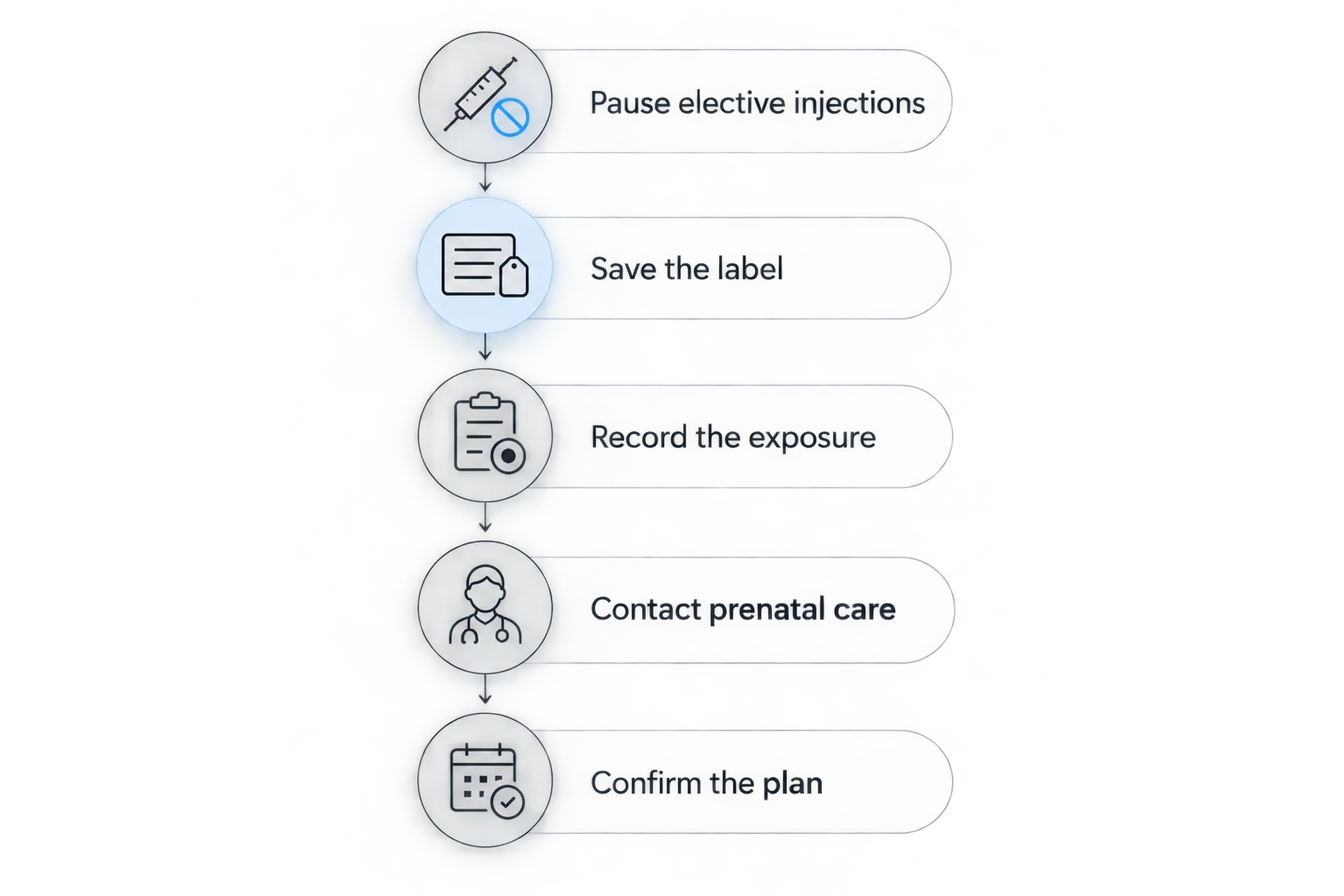
Use this sequence to make the conversation useful:
- Pause elective injections. If a clinician prescribed the treatment for a diagnosed medical condition, contact that clinician promptly for instructions about the next dose.
- Save the label. Photograph the vial, packaging, pharmacy details, ingredient list, and prescription directions. Include any other ingredients mixed into the preparation.
- Record the exposure. Write down when you received it, the prescribed amount, how it was administered, and any symptoms afterward. Record the concentration and injected volume if known; do not guess.
- Contact prenatal care. Tell your clinician how far along you are or provide your last menstrual period if pregnancy dating is not yet established.
- Confirm the plan. Ask whether you need an examination, symptom monitoring, a pharmacist review, or consultation with a pregnancy-exposure information service.
An exposure log is more useful than a screenshot of a general product description. Keep the original packaging until your care team has the information it needs.
When should you seek urgent help?
Call 911 for trouble breathing, swelling of the tongue or throat, collapse, or other signs of a severe allergic reaction. Do not wait for a portal response.
Seek prompt medical assessment for fever, worsening injection-site redness or pain, or feeling seriously unwell after an injection. Tell the treating team that you are pregnant and bring the product information if you can do so without delaying care.
Why pregnancy advice varies between people
A clinician's recommendation depends on more than the word “glutathione.” These factors explain why a general answer cannot replace an individual assessment:
- Reason for treatment. A proposed treatment for a diagnosed condition requires a different benefit-risk discussion from an elective skin or wellness treatment.
- Exact preparation. The full ingredient list matters, including additives and other substances combined with glutathione.
- Exposure details. Dose, concentration, route, and frequency help clinicians assess what you actually received.
- Pregnancy timing. Gestational age is relevant to medication-exposure assessment; it does not create an automatically safe trimester.
- Your medical history. Allergies, current symptoms, other medications, and underlying conditions affect the review.
- Product handling. Injectable preparations require appropriate sterility and handling; contamination introduces risks separate from the active ingredient.
Individualized advice is not the same as proof of safety. Ask your clinician to explain what supports the recommendation and what remains uncertain.
Is a lower dose or a different route safer?
A smaller amount does not become pregnancy-safe simply because it is smaller. There is no established wellness-injection dose to recommend during pregnancy.
Changing the route also changes the exposure rather than resolving the evidence question. An oral supplement, an intramuscular injection, and an intravenous infusion should not be treated as equivalent.
| Approach | Potential advantage | Limitation during pregnancy | Best for |
|---|---|---|---|
| Defer elective supplementation | Avoids additional elective exposure | Does not address an underlying symptom or diagnosis | Pausing while your prenatal clinician reviews the situation |
| Continue injections after specialist review | Allows consideration of a specific medical indication | Pregnancy safety cannot be assumed; injection-related risks remain | An individualized medical decision, not self-directed wellness use |
| Switch to an oral supplement | Avoids an injection procedure | Does not establish pregnancy safety or a suitable dose | Only a clinician-directed plan |
| Review nutrition with prenatal care | Connects dietary advice to your pregnancy needs | Is not a substitute for evaluating persistent symptoms | Routine pregnancy nutrition planning |
Do not replace one unreviewed product with another. Bring oral supplements, powders, patches, and combination products into the same medication review.
What should you ask before any proposed treatment in 2026?
Ask the clinician to explain the medical goal before discussing an injection schedule. A clear diagnosis and a reason to treat matter more than a broad promise about energy, detoxification, or skin appearance.
Bring these questions to your appointment:
- What condition are we treating, and does it need treatment during pregnancy?
- What human pregnancy evidence supports this exact preparation and route?
- What are the risks of postponing the treatment?
- Is there an alternative with better-established pregnancy safety?
- Who will coordinate this decision with my obstetric clinician?
- What symptoms require urgent care, and whom should I contact afterward?
Ask for instructions you can share with every prescriber. A useful 2026 medication list includes prescriptions, over-the-counter products, supplements, and elective injections—not just daily tablets.
If your main concern is fatigue, skin changes, or another new symptom, describe that concern directly. Your prenatal clinician can evaluate the symptom rather than assuming an antioxidant injection is the right response.
Where does telehealth fit during pregnancy?
VEVArx is best suited to adults seeking medically supervised telehealth weight loss, not a replacement for prenatal care. Its stated services include doctor-prescribed weight-loss medications and wellness options such as glutathione; that service description does not establish pregnancy suitability.
The useful role of a telehealth prescriber is to contribute the prescription history and treatment rationale to your care team. The limitation is that a wellness consultation does not replace an obstetric assessment or an in-person evaluation when symptoms require one.
If VEVArx prescribed your treatment, tell the prescribing clinician about the pregnancy and ask how to share the exact prescription with your obstetric clinician. VEVArx glutathione treatment still requires a pregnancy-specific review; access to a prescription is not pregnancy clearance.
For 2026, keep the same rule across telehealth, a medical spa, and an in-person clinic: the setting does not establish fetal safety. The evidence and your clinical circumstances drive the decision.
Find out if glutathione therapy may be right for you.
Start My Pre-AssessmentIs glutathione safe in the first trimester?
No safe first-trimester injection dose has been established for elective glutathione use. Do not interpret the absence of symptoms after an injection as evidence that the exposure was safe for the pregnancy.
Tell your prenatal clinician about any exposure before you knew you were pregnant. Accurate timing helps the assessment; it does not justify predicting an outcome from a single detail.
Can I restart glutathione after delivery?
Delivery does not automatically clear a treatment for use while breastfeeding. Ask for a separate review that considers the exact preparation, the reason for treatment, and whether you are nursing.
Your 2026 postpartum plan should distinguish recovery, breastfeeding, and elective wellness goals. A decision made during pregnancy should not silently become permission to restart later.
Have questions about your options? Start with a quick online assessment.
Start My Pre-AssessmentFAQ
Can you take glutathione injections while pregnant?
Avoid elective glutathione injections during pregnancy unless your obstetric clinician specifically recommends them for a medical reason. Pregnancy safety has not been established for wellness injection use.
What if I had a glutathione injection before I knew I was pregnant?
Contact your prenatal clinician with the product label, dose, route, and timing before another elective injection. An exposure alone does not establish that harm occurred.
Is there a safe glutathione injection dose during pregnancy?
There is no established pregnancy-safe dose for elective glutathione injections. Do not use a lower dose or a longer interval as a substitute for a pregnancy-specific clinical review.
Is glutathione safe because the body makes it naturally?
Natural production does not establish the safety of injected glutathione during pregnancy. An injected preparation introduces a particular dose, route, and ingredients that require separate assessment.
Can I switch to oral glutathione while pregnant?
Do not assume oral glutathione is a pregnancy-safe substitute for injections. Ask your prenatal clinician to review the exact supplement and whether there is a medical reason to take it.
Does a prescription mean glutathione is safe during pregnancy?
A prescription does not establish pregnancy safety. Tell the prescriber about your pregnancy and coordinate the decision with your obstetric clinician before further elective treatment.
Are glutathione injections safe while breastfeeding?
Breastfeeding safety should not be assumed from pregnancy advice or from glutathione's natural role in the body. Request a separate review of the preparation and the need for treatment before restarting.
One last thing
The concentration on a vial and the volume injected are different pieces of information. A note that records only syringe markings can leave your clinician unable to reconstruct the actual amount without the product concentration.
Photograph both the prescription label and your dosing instructions. For a pregnancy-exposure review, that simple record is more useful than a claim that an injection was “low dose.”
Related guides
Ready to get started?
See if doctor-prescribed glutathione therapy may be right for you. It only takes a few minutes, 100% online.
Start My Pre-AssessmentThis article is for informational purposes only and is not medical advice. Compounded medications are not approved by the FDA and have not been reviewed for safety, effectiveness, or quality. Prescription products require an online consultation with a licensed healthcare provider who will determine if a prescription is appropriate. Individual results vary.