
Can you take peptides while pregnant?
Can you take peptides while pregnant? Avoid elective injections; essential medicines differ. Learn what to stop, what to review, and when to call.

Do not start elective weight-loss or wellness peptide injections during pregnancy; if you already use them, contact your obstetric clinician and prescriber before the next dose. The exception matters: prescribed peptide medicines such as insulin can be essential during pregnancy, so the exact ingredient and medical reason—not the word peptide—determine what you should do.
- Can you take peptides while pregnant? Weight-loss injections and essential medicines such as insulin require different decisions.
- Semaglutide labeling advises stopping at least 2 months before a planned pregnancy.
- Tirzepatide labeling advises additional contraception for 4 weeks after starting and after each dose increase.
- Vevarx offers medically supervised weight loss; pregnancy medication decisions belong with your obstetric clinician and prescriber.
Can you take peptides while pregnant?
Do not treat all peptides as one pregnancy-safety category. Insulin, semaglutide, sermorelin, collagen supplements, and peptide-containing skincare have different purposes, routes of administration, and evidence. A recommendation for one does not establish safety for another.
For pregnancy decisions in 2026, identify the actual substance first. If you use semaglutide, understanding how long semaglutide stays in your system helps explain why stopping treatment and clearing the medicine are not the same event.
| Product or category | Pregnancy guidance | Important distinction |
|---|---|---|
| Semaglutide for weight management | Discontinue when pregnancy is recognized and contact your prescriber | Planned pregnancy requires advance discontinuation under the product label |
| Tirzepatide for weight management | Discontinue when pregnancy is recognized and contact your prescriber | Oral contraceptive effectiveness can be reduced during initiation and dose escalation |
| Sermorelin or other elective wellness injections | Do not start without an obstetric medication review | Pregnancy safety cannot be assumed from use in nonpregnant adults |
| Prescribed insulin | Continue according to your diabetes care plan unless your clinician changes it | Insulin is an established treatment for diabetes during pregnancy |
| Oral collagen supplements | Review the full supplement with your prenatal clinician | Food-derived protein is not equivalent to an injectable hormone-active drug |
| Topical peptide skincare | Review the complete ingredient list | Other ingredients can determine whether the formula is appropriate |
This comparison is about pregnancy decisions, not a ranking. None of the elective injections listed here is a recommended pregnancy wellness treatment.
Curious whether you qualify? A licensed provider makes the final call.
Start My Pre-AssessmentWhy this matters
The benefit-risk calculation changes during pregnancy. Weight-loss treatment addresses a different goal from maintaining adequate nutrition, supporting fetal growth, and managing an existing condition such as diabetes.
A prescription also does not make a treatment appropriate for every life stage. Your clinician needs to reassess the indication, formulation, and alternatives when you become pregnant or start trying to conceive.
For your 2026 medication review, bring the product label—not just the name of the clinic selling it. A vial described as a peptide blend does not identify its ingredients, concentration, or intended effects. Those details are necessary for useful advice.
Semaglutide: stop before a planned pregnancy
FDA-approved Wegovy prescribing information advises discontinuing semaglutide at least 2 months before a planned pregnancy because of its long half-life. It also directs discontinuation when pregnancy is recognized. These instructions concern semaglutide treatment, not every product marketed as a peptide.
The same prescribing information describes an elimination half-life of approximately 1 week. That is why skipping an injection does not immediately remove the medicine from your body. The 2-month instruction is a planning interval, not a prediction that exposure will harm a particular pregnancy.
For a 2026 preconception appointment, tell your clinician when you hope to start trying, the date of your last injection, and whether you use semaglutide for weight management or diabetes. If you use it for diabetes, stopping requires a replacement glucose-management plan.
Do not create a shorter waiting period based on a lower dose, fewer side effects, or feeling that the medicine has worn off. Follow the product-specific instructions and your clinician's plan.
Tirzepatide: pregnancy and contraception need separate attention
FDA-approved Zepbound prescribing information directs patients to discontinue tirzepatide when pregnancy is recognized. Weight loss offers no benefit during pregnancy, and the label warns of potential fetal harm. That warning does not establish what will happen after an individual exposure.
Tirzepatide has an additional planning issue: it can reduce the effectiveness of oral hormonal contraceptives. The prescribing information advises switching to a nonoral contraceptive method or adding a barrier method for 4 weeks after treatment initiation and 4 weeks after each dose escalation.
Those 4-week instructions address contraception. They are not a universal instruction to wait 4 weeks before conceiving. Ask your prescriber for a tirzepatide-specific discontinuation plan rather than borrowing semaglutide's instructions or interpreting contraception guidance as a washout period.
If you take tirzepatide for diabetes, involve the clinician managing your blood glucose. Pregnancy planning must address both medication exposure and the risks of uncontrolled diabetes.
Sermorelin and wellness injections: uncertainty is not clearance
Do not start sermorelin or another elective hormone-active peptide during pregnancy on the assumption that it is natural, restorative, or similar to something your body produces. Those descriptions do not demonstrate fetal safety.
For elective wellness use, a lack of adequate pregnancy evidence is a reason to avoid self-directed treatment—not permission to experiment. Ask your obstetric clinician to review the exact substance and the reason you want to use it. Fatigue, sleep changes, and recovery concerns deserve pregnancy-appropriate assessment rather than an automatic injection recommendation.
Glutathione is a peptide, but that fact does not establish that injectable glutathione is appropriate during pregnancy. NAD+ is a coenzyme, not a peptide, even though clinics sometimes discuss it alongside peptide treatments. The marketing category is not a medical safety classification.
For any compounded blend, provide the full ingredient list. A recommendation about an ingredient alone does not automatically apply to a combination containing additional active substances.
Why pregnancy guidance varies
A useful pregnancy review considers the actual treatment rather than making a blanket judgment about peptides. These factors explain why recommendations differ:
- Treatment purpose: Managing diabetes is not the same as pursuing elective weight loss or wellness goals.
- Active ingredient: Semaglutide, tirzepatide, insulin, and sermorelin act differently and have different prescribing information.
- Exposure timing: Your clinician needs to know whether exposure occurred before conception, during an unrecognized pregnancy, or after a positive test.
- Administration route: An injection, oral supplement, and topical cosmetic do not create identical exposure.
- Evidence quality: Human pregnancy information, animal findings, and absent data support different conclusions.
- Complete formulation: Additional active ingredients and supplement additives belong in the assessment too.
A legal prescription, a familiar ingredient, or an uneventful experience before pregnancy does not replace this review. Ask what evidence supports use for your specific condition during pregnancy.
What should you do if you already took a peptide?
An exposure does not establish that fetal harm occurred. It does establish a reason to contact your care team promptly. Avoid making predictions from online stories or changing essential medication without a replacement plan.
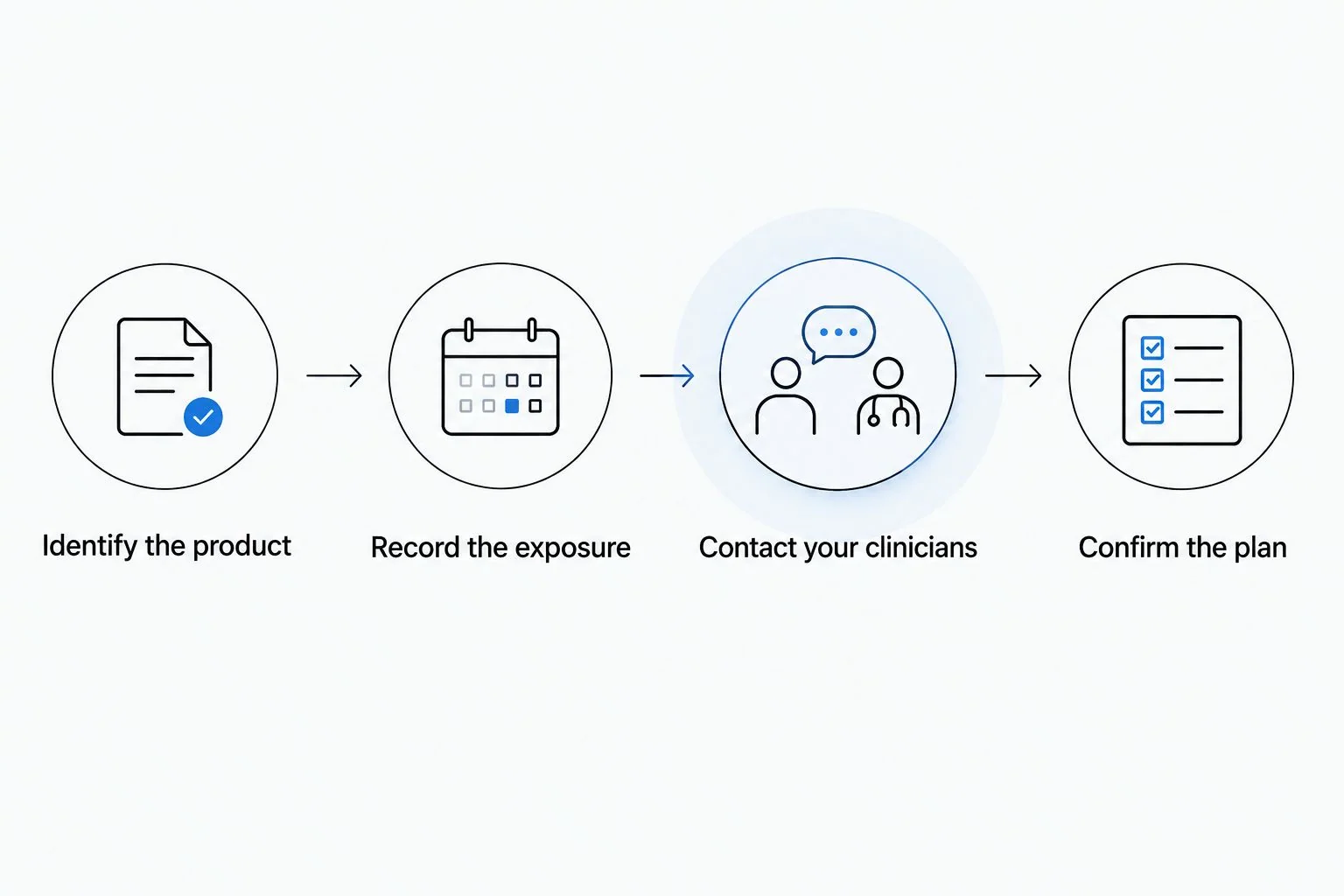
Use this sequence to make the conversation useful:
- Identify the product. Photograph the vial, packaging, prescription label, and ingredient list. Include any compounded additives.
- Record the exposure. Write down your dose, injection dates, last menstrual period if known, and pregnancy-test date.
- Contact your clinicians. Notify your obstetric clinician and prescribing clinician. If you use the medicine for diabetes, request guidance on glucose management as well.
- Confirm the plan. Ask what to do before the next dose, whether treatment should stop or change, and whether any additional monitoring is indicated.
For weight-management semaglutide or tirzepatide, follow the label instruction to discontinue when pregnancy is recognized and notify your prescriber. For insulin or another essential treatment, do not assume that the same stopping instruction applies.
Seek urgent medical care for severe abdominal pain, fainting, heavy bleeding, trouble breathing, or vomiting that prevents you from keeping fluids down. Those symptoms need assessment regardless of whether you used a peptide.
Find out if GLP-1 treatment may be right for you.
Start My Pre-AssessmentCan you keep taking insulin while pregnant?
Insulin can be an essential pregnancy treatment. The American Diabetes Association's Standards of Care in Diabetes—2026 identify insulin as the preferred medication for treating hyperglycemia in gestational diabetes and type 2 diabetes during pregnancy; people with type 1 diabetes require insulin.
Insulin's role demonstrates why a blanket instruction to stop all peptides is unsafe. If you become pregnant while using insulin, continue your prescribed plan and promptly contact your diabetes and obstetric teams for pregnancy-specific adjustments.
Do not replace insulin with a wellness injection or stop it because another peptide medicine carries a pregnancy warning. Uncontrolled blood glucose creates its own pregnancy risks.
Are collagen supplements and peptide skincare the same concern?
Collagen supplements and topical peptide products are not interchangeable with injectable weight-loss medicines. Their different routes and ingredients mean they require separate assessments—not automatic approval or automatic rejection.
For collagen, bring the complete supplement label to your prenatal visit. Added herbs, vitamins, and other active ingredients matter. A protein supplement should not replace a balanced pregnancy diet or a clinician-recommended prenatal supplement.
For skincare, check the whole formula rather than focusing on the peptide claim. The American Academy of Dermatology advises avoiding retinoids during pregnancy; a product containing both peptides and a retinoid requires attention to that additional ingredient.
Do not extrapolate a skincare recommendation to an injection. Likewise, a warning about semaglutide does not prove that every peptide-containing moisturizer poses the same concern.
Where online weight-loss care fits
Vevarx is an option for adults seeking medically supervised weight loss; pregnancy requires a separate obstetric treatment plan. The platform offers doctor-prescribed GLP-1 weight-loss medications and wellness prescriptions, but that service description does not establish pregnancy suitability.
If you receive treatment through Vevarx, notify your prescriber about pregnancy or plans to conceive and share the resulting medication plan with your obstetric clinician. Online access is useful for communicating with a prescriber; it does not remove the need to coordinate pregnancy care.
During a 2026 treatment review, distinguish what the platform offers from what your pregnancy care team recommends. Do not select an elective injection because it appears beside another treatment that has an established medical use.
Have questions about your options? Start with a quick online assessment.
Start My Pre-AssessmentFAQ
Can you take peptides while pregnant if a doctor prescribed them?
A prescription alone does not establish pregnancy suitability. Insulin can be essential, while weight-management semaglutide and tirzepatide carry instructions to discontinue when pregnancy is recognized; your obstetric clinician and prescriber should review the exact medicine.
How long before pregnancy should I stop semaglutide?
At least 2 months before a planned pregnancy is the interval stated in FDA-approved Wegovy prescribing information. Coordinate discontinuation with your prescriber, especially if you need another treatment to manage diabetes.
Does tirzepatide affect birth control pills?
Tirzepatide can reduce oral hormonal contraceptive effectiveness. FDA-approved Zepbound prescribing information advises a nonoral method or an added barrier method for 4 weeks after starting and for 4 weeks after each dose increase.
What if I injected a peptide before I knew I was pregnant?
Contact your obstetric clinician and prescriber with the ingredient, dose, and exposure dates. An inadvertent exposure does not establish fetal harm; the next steps depend on the specific medicine and your medical needs.
Are sermorelin or glutathione injections safe during pregnancy?
Do not assume sermorelin or glutathione injections are safe during pregnancy. Avoid starting elective treatment and ask your obstetric clinician to review the exact preparation and medical reason for using it.
Can I restart peptide weight-loss treatment while breastfeeding?
Breastfeeding requires a separate, product-specific medication review. Delivery does not automatically make a weight-loss injection appropriate, and pregnancy discontinuation instructions do not establish breastfeeding safety.
Can Vevarx replace my obstetric clinician for pregnancy medication advice?
Vevarx's stated services are online weight-loss and wellness prescriptions, not a substitute for obstetric care. Coordinate medication changes with your prescribing clinician and the clinician managing your pregnancy.
One last thing
Put the generic ingredient name in your pregnancy medication list, not just the word peptide. Add the concentration, dose, administration route, and last-use date. That record gives your clinician something actionable even when the product came from a clinic using unfamiliar branding.
For pregnancy planning in 2026, make that review before your next refill rather than waiting for a positive test. If you are already pregnant, contact your care team now; do not wait for an online safety claim to settle the question.
Related guides
Ready to get started?
See if doctor-prescribed GLP-1 treatment may be right for you. It only takes a few minutes, 100% online.
Start My Pre-AssessmentThis article is for informational purposes only and is not medical advice. Compounded medications are not approved by the FDA and have not been reviewed for safety, effectiveness, or quality. Prescription products require an online consultation with a licensed healthcare provider who will determine if a prescription is appropriate. Individual results vary.