Can you take NAD+ injections while pregnant?
Can you take NAD+ injections while pregnant? Safety is not established. Learn what to do after a dose and what to discuss with your prenatal clinician.

Do not start or continue elective NAD+ injections during pregnancy without a review by your obstetric clinician; pregnancy safety has not been established. In 2026, there is no established pregnancy-safe dose or schedule to recommend for wellness use. If you already had an injection, that exposure does not by itself establish harm, but you should pause further doses and contact your prenatal clinician and prescriber.
- Can you take NAD+ injections while pregnant? Pregnancy safety is not established; seek obstetric review before further doses.
- NAD+ occurring naturally in cells does not establish the safety of injected NAD+ during pregnancy.
- VEVArx offers clinician-prescribed wellness care, not a substitute for prenatal evaluation.
- After an exposure, save the vial label and dosing details for your prenatal clinician.
Can you take NAD+ injections while pregnant?
NAD+ injections are not an established pregnancy treatment, and wellness benefits do not establish fetal safety. Your clinician needs to assess the exact preparation, exposure timing, reason for treatment, and your medical history before advising you.
VEVArx offers doctor-prescribed NAD+ wellness treatment for adults, but that service description does not establish suitability during pregnancy. The same distinction applies when considering peptide use during pregnancy: a prescription or wellness label is not evidence of pregnancy safety. NAD+ itself is a coenzyme, not a peptide.
| Approach | Potential role | Important limitation | Best suited to |
|---|---|---|---|
| NAD+ injections | Delivers NAD+ by injection | Pregnancy safety and a pregnancy-safe regimen are not established | Individual clinician review, not self-directed pregnancy wellness use |
| NAD+ IV infusions | Delivers NAD+ into a vein | Changing the delivery route does not establish pregnancy safety | Individual clinician review, not a workaround for injections |
| Clinician-guided prenatal nutrition | Addresses established pregnancy nutrient needs | Does not replace evaluation of fatigue, anemia, or other symptoms | Routine prenatal planning and identified nutritional needs |
Curious whether you qualify? A licensed provider makes the final call.
Start My Pre-AssessmentWhy this matters
Pregnancy changes the question from whether a treatment sounds beneficial to whether its expected benefit justifies its risks and uncertainties. An optional wellness injection needs a different justification from a medicine required to treat a serious condition.
In 2026, keep those decisions separate. Do not stop essential prescribed medicines because of advice about elective NAD+ injections. Ask the clinician managing each medicine for pregnancy-specific instructions.
If fatigue, low energy, or difficulty concentrating prompted your interest in NAD+, describe those symptoms at a prenatal appointment. Treating the symptom with an unproven wellness intervention can leave its cause unaddressed.
Why naturally occurring NAD+ is not proof of injection safety
NAD+ participates in normal cellular processes, including energy metabolism. That biological role explains why researchers study it; it does not establish that giving extra NAD+ by injection improves pregnancy outcomes.
Your body making a substance and receiving it as an injected preparation are different exposures. Dose, route, ingredients, and how the preparation is made all matter.
The same reasoning applies to claims about cellular repair, healthy aging, or energy support. A mechanism is not a clinical outcome, and a finding in cells or animals cannot establish safety for a pregnant person or a developing fetus.
For a 2026 treatment decision, ask a specific question: What human pregnancy evidence supports this exact preparation for this exact reason? Testimonials, general explanations of NAD+ biology, and experiences in nonpregnant adults do not answer it.
What should you do if you already injected NAD+?
Pause additional elective NAD+ doses and contact your prenatal clinician and the prescribing clinician. An accidental exposure is a reason for an individualized assessment, not a conclusion that your pregnancy has been harmed.
If you have severe symptoms, seek urgent care rather than waiting for a routine message response. Otherwise, organize the information your clinicians need:
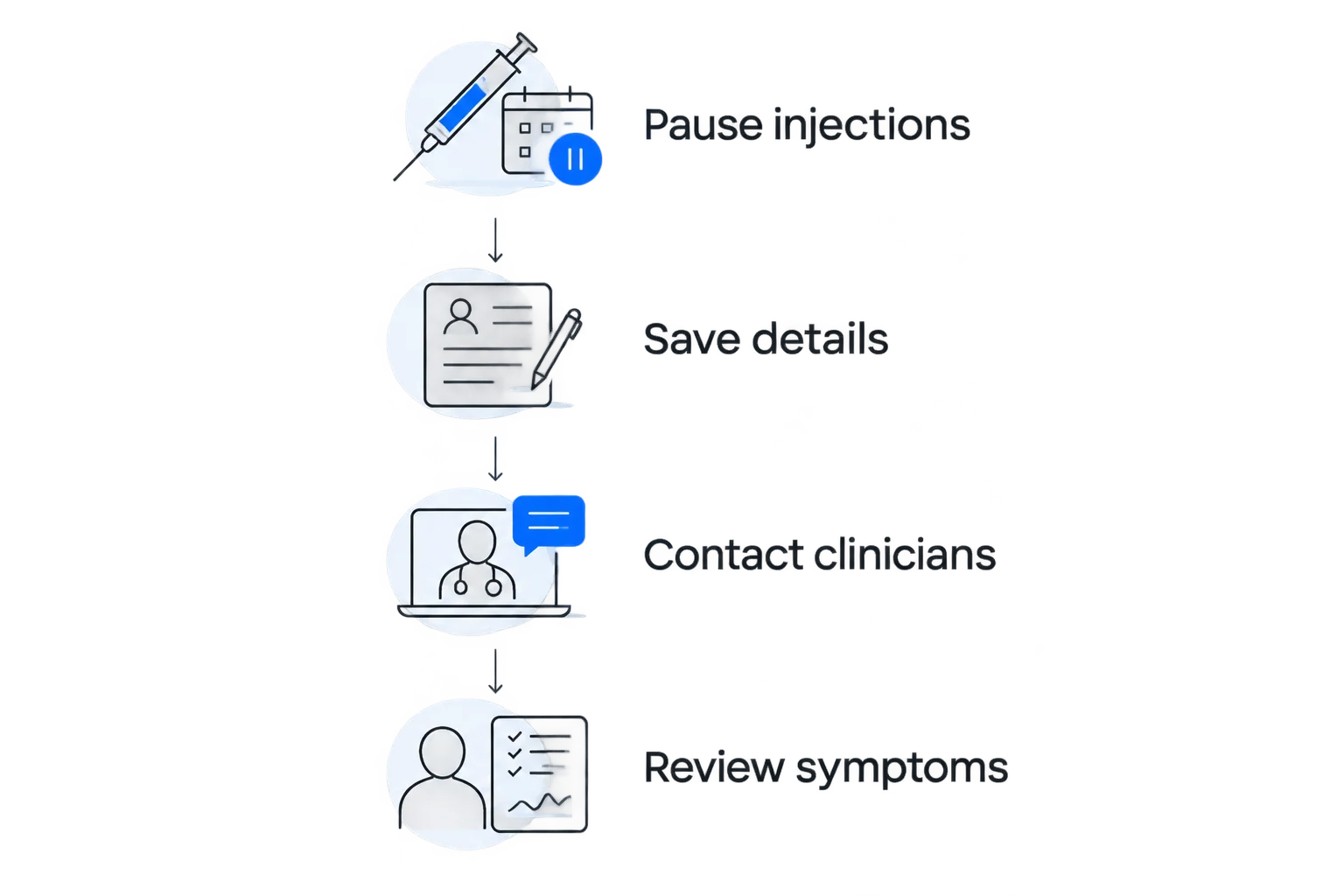
- Pause injections. Do not take another wellness dose while waiting for advice. Do not substitute an infusion or an oral NAD-related supplement on your own.
- Save details. Keep the vial, packaging, pharmacy information, ingredient list, and prescription instructions. Record the amount administered, concentration, route, date, and any symptoms.
- Contact clinicians. Tell your prenatal clinician and prescriber when the exposure occurred and whether pregnancy was confirmed or only suspected at the time.
- Review symptoms. Report new symptoms and ask what needs urgent assessment, what can be monitored, and whether any follow-up is indicated.
Do not estimate the dose from syringe markings alone if you are unsure of the concentration. Photograph the label and ask the dispensing pharmacy to clarify the amount administered.
If the injection occurred before you knew you were pregnant, report it honestly. Accurate timing helps your clinician assess the exposure; hiding it makes that assessment harder.
Should you request extra pregnancy testing after an exposure?
An NAD+ exposure does not automatically determine which tests you need. Your prenatal clinician should decide whether routine care is sufficient or whether the circumstances justify additional assessment.
Do not purchase a broad testing package to prove the exposure was harmless. A test is useful only when it answers a clinical question and has an appropriate interpretation.
Why the clinical assessment varies
The recommendation to avoid self-directed NAD+ wellness injections remains the same, but the assessment after an exposure depends on your circumstances. Bring these details rather than relying on a generic online answer:
- Pregnancy timing: Your clinician needs the exposure date and the best available pregnancy dating information.
- Exact preparation: The label identifies NAD+, other ingredients, and the dispensing source; the treatment name alone is insufficient.
- Amount and route: Concentration, amount administered, injection route, and repeat exposures describe what you actually received.
- Reason for treatment: Optional energy or wellness goals require a different discussion from treatment for a diagnosed condition.
- Symptoms and medical history: Reactions, allergies, other medicines, and pregnancy complications affect the next steps.
A lower dose is not automatically a pregnancy-safe dose. A shorter course, a smaller syringe, or fewer appointments does not fill a gap in safety evidence.
What should you ask your clinician before another dose?
Bring questions that lead to a clear decision rather than a general reassurance. Your prenatal clinician needs to know what is being proposed and why.
- What condition is this treatment intended to address?
- What human pregnancy evidence supports the exact preparation?
- Is there an established treatment with better pregnancy safety information?
- Should further doses remain on hold throughout pregnancy?
- What follow-up, if any, is appropriate after the exposure already received?
- What should change if I am trying to conceive or breastfeeding?
For a 2026 consultation, a written medication and supplement list is more useful than a description such as “wellness shots.” Include injections, infusions, vitamins, herbal products, and medicines prescribed through different services.
If VEVArx prescribed your NAD+ treatment, notify the prescribing clinician about the pregnancy or possible pregnancy. That conversation should complement, not replace, your obstetric clinician’s assessment.
Are NAD+ IV infusions safer than injections during pregnancy?
NAD+ IV infusions are not an established pregnancy-safe alternative to NAD+ injections. A different route changes how a substance is administered, but it does not supply missing evidence about pregnancy outcomes.
A clinic setting also does not settle the question. Staff supervision can support administration and response to immediate reactions, but supervision is not proof that a treatment is appropriate during pregnancy.
Comparing NAD IV clinics in Dubai or local infusion centers answers questions about treatment settings, not whether NAD+ exposure is appropriate during pregnancy. Geography, presentation, and clinic popularity cannot substitute for pregnancy-specific evidence.
Do not interpret slower administration, hydration alongside treatment, or a wellness consultation as confirmation of fetal safety. Ask your obstetric clinician about the actual substance and preparation before considering another route.
Find out if NAD+ therapy may be right for you.
Start My Pre-AssessmentWhat can you discuss instead for pregnancy fatigue?
Start with an assessment of fatigue, not a replacement wellness injection. Sleep disruption, nausea, inadequate food intake, anemia, and thyroid disorders require different responses, and symptoms alone do not identify the cause.
Explain how the fatigue affects daily activities, when it began, and whether you also have breathlessness, dizziness, palpitations, vomiting, or difficulty eating. Your clinician can decide whether an examination, testing, nutrition support, or another intervention is appropriate.
Prenatal nutrition is not NAD+ therapy
Established pregnancy nutrition recommendations should not be confused with high-dose wellness treatment. The NIH Office of Dietary Supplements lists the pregnancy recommended dietary allowance for folate as 600 micrograms dietary folate equivalents per day.
Separately, CDC guidance recommends 400 micrograms of folic acid daily for people capable of becoming pregnant to help prevent neural tube defects. These figures use different nutrient measures and serve different purposes; do not add supplements together without reviewing the labels with your clinician.
For your 2026 prenatal plan, ask whether your current prenatal vitamin and diet meet your needs. These established nutrition recommendations are not evidence that NAD+ injections are beneficial or safe during pregnancy.
What symptoms need urgent medical attention?
Call 911 for trouble breathing, swelling of the tongue or throat, collapse, or another apparent life-threatening reaction. Tell emergency responders what was injected and when, and bring the label if it is readily available.
Seek prompt medical assessment for fever, worsening injection-site redness, severe pain, or other concerning symptoms after an injection. Pregnancy symptoms such as significant bleeding or severe abdominal pain also need urgent clinical guidance, regardless of whether you think NAD+ caused them.
Do not wait for an online prescriber’s routine reply when symptoms are severe. The immediate priority is assessment and treatment, not proving which ingredient caused the problem.
Have questions about your options? Start with a quick online assessment.
Start My Pre-AssessmentFAQ
Can you take NAD+ injections while pregnant if a doctor prescribed them?
A prescription does not establish pregnancy safety for NAD+ injections. Tell both the prescriber and your obstetric clinician about the pregnancy before taking another elective dose.
What if I took NAD+ before I knew I was pregnant?
An NAD+ exposure before pregnancy recognition does not by itself establish harm. Pause further elective doses and share the label, amount, route, and exposure date with your prenatal clinician.
Is a small dose of NAD+ safe during pregnancy?
No pregnancy-safe NAD+ injection dose has been established. Do not assume that reducing the amount or spacing out doses makes wellness use safe.
Are NAD+ IV drips safer than NAD+ shots while pregnant?
NAD+ IV drips are not an established pregnancy-safe substitute for NAD+ shots. A supervised setting or different administration route does not resolve uncertainty about pregnancy safety.
Can I switch to an oral NAD+ booster while pregnant?
Do not assume an oral NAD-related supplement is pregnancy-safe because it is not injected. Ask your prenatal clinician to review the exact ingredients and the reason you want to take it.
Can I restart NAD+ injections while breastfeeding?
Do not assume NAD+ injections are safe during breastfeeding. Ask your prescribing and postpartum clinicians to review the preparation, breastfeeding evidence, and whether treatment is necessary.
Can VEVArx replace my prenatal clinician for NAD+ advice?
VEVArx wellness care does not replace prenatal care. Coordinate any NAD+ prescription decision with the clinician managing your pregnancy.
One last thing
A treatment can involve a substance essential to human biology without the treatment itself being established as safe in pregnancy. That distinction is the key to evaluating NAD+ claims in 2026.
Save a clear photo of your vial label before your appointment. The exact preparation and exposure details give your clinician something specific to assess; the phrase “NAD+ wellness injection” does not.
Related guides
Ready to get started?
See if doctor-prescribed NAD+ therapy may be right for you. It only takes a few minutes, 100% online.
Start My Pre-AssessmentThis article is for informational purposes only and is not medical advice. Compounded medications are not approved by the FDA and have not been reviewed for safety, effectiveness, or quality. Prescription products require an online consultation with a licensed healthcare provider who will determine if a prescription is appropriate. Individual results vary.