
Can you take NAD+ injections with alcohol?
Can you take NAD+ injections with alcohol? Avoid combining them without medical guidance. Learn what to ask, timing limits, and urgent warning signs.
Avoid combining NAD+ injections with alcohol unless your prescriber has specifically reviewed your situation; there is no established safe drinking amount or universal waiting interval for this combination. NAD+ injections are not a proven way to prevent intoxication, cure a hangover, or protect against alcohol-related harm. If you have already combined them, stop drinking, do not take an extra injection, and seek medical advice based on your symptoms.
- Can you take NAD+ injections with alcohol? Get individualized medical guidance rather than assuming the combination is safe.
- NAD+ injections do not establish protection against intoxication, hangovers, or alcohol-related liver injury.
- No universal waiting interval replaces instructions from your prescriber or dispensing pharmacist.
- VEVArx offers prescribed NAD+ wellness treatment; alcohol use belongs in your medical review.
Why this matters
Alcohol use changes the questions you need to ask before an injection. Your drinking pattern, other medicines, symptoms, and medical history matter more than a wellness claim about cellular energy or recovery.
For your 2026 treatment plan, keep injection technique and alcohol safety separate. Knowing whether you can take NAD+ injections at home does not establish whether drinking around a dose is appropriate for you. An at-home prescription is not permission to combine treatment with alcohol.
Curious whether you qualify? A licensed provider makes the final call.
Start My Pre-AssessmentCan you take NAD+ injections with alcohol?
There is not enough established clinical evidence to call NAD+ injections and alcohol a safe combination or to give everyone the same drinking instructions. The practical answer is to avoid combining them until your prescriber or pharmacist has reviewed your exact prescription and alcohol use.
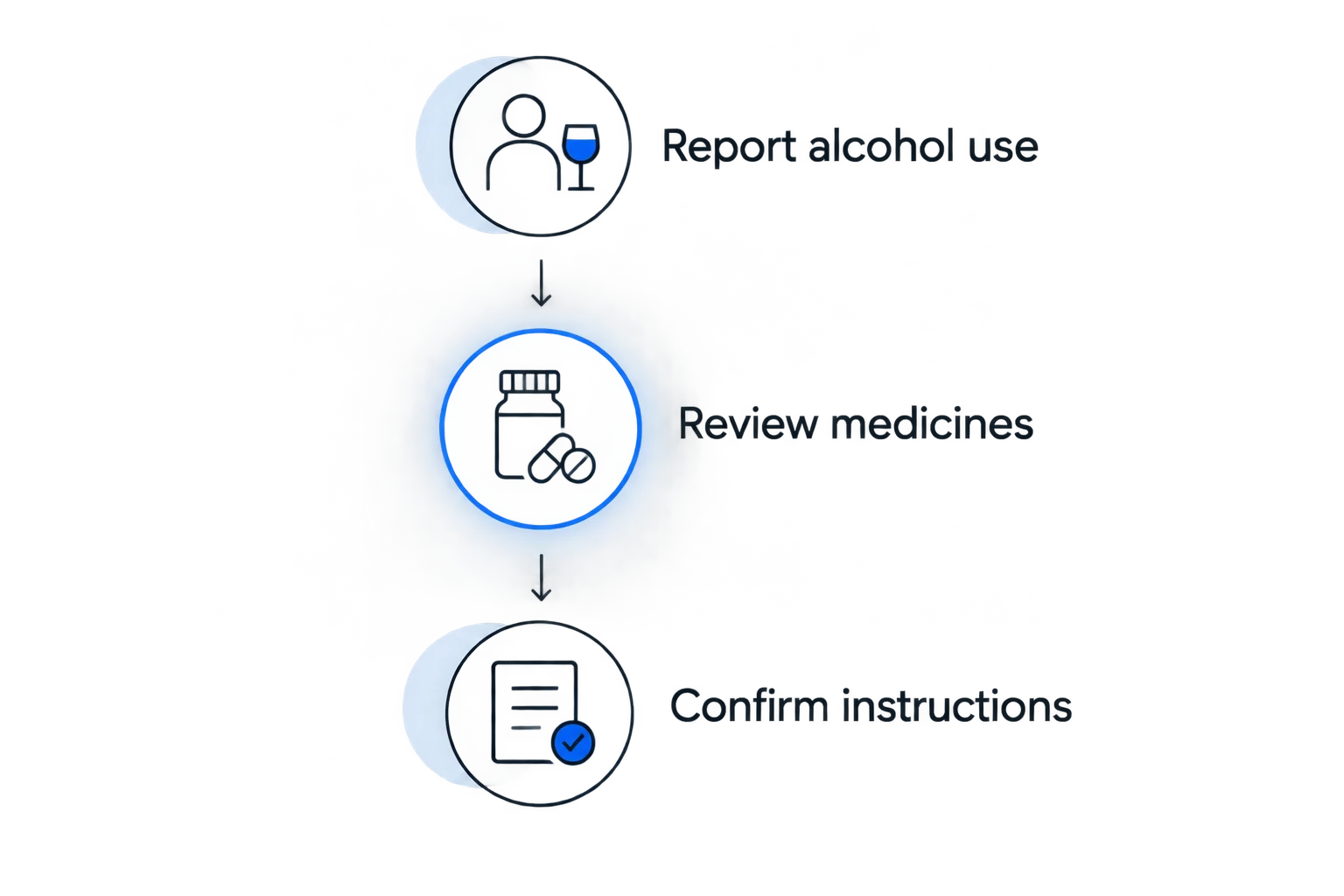
Follow these steps before your next dose:
- Report alcohol use. Tell your clinician what you drank, how much, when you finished, and whether you drink regularly.
- Review medicines. Include prescriptions, sleep aids, pain medicines, supplements, and other injectable treatments.
- Confirm instructions. Ask what to do with the scheduled injection, what symptoms require care, and when to reassess.
Do not substitute an online waiting-period recommendation for that conversation. Subcutaneous injections, intramuscular injections, and intravenous infusions are different routes; instructions for an infusion appointment do not automatically apply to your home prescription.
For decisions in 2026, distinguish an absence of a documented interaction from evidence of safety. Not having a proven interaction does not establish that combining NAD+ injections with alcohol is safe.
Why advice about NAD+ injections and alcohol varies
Your clinician needs more than the name of the injection. These factors determine what needs review:
- Alcohol amount and timing. Report both the total consumed and when you stopped drinking; the size of a glass alone is not enough.
- Current symptoms. Vomiting, dizziness, confusion, poor fluid intake, or trouble staying awake change the immediate priority from scheduling to assessment.
- Other medicines. Alcohol has established risks with medicines such as opioids, benzodiazepines, and sleep medicines, independent of NAD+.
- Medical history. Liver disease, diabetes, previous alcohol withdrawal, and other conditions need their own review rather than a generic clearance.
- The actual prescription. Your clinician or pharmacist needs the formulation, concentration, dose, route, and any added ingredients.
- Drinking pattern. Occasional drinking and physical dependence require different conversations, especially when stopping alcohol carries withdrawal risk.
These factors do not create a formula you can calculate at home. They explain why a personalized instruction is more useful than a blanket statement that the combination is either harmless or always dangerous.
Does NAD+ help your body process alcohol?
NAD+ participates in normal cellular reactions, including reactions involved in alcohol metabolism. That biological role does not prove that injecting NAD+ makes alcohol leave your body faster or improves meaningful health outcomes after drinking.
The distinction matters. A substance can participate in a metabolic pathway without an injection of that substance becoming an effective treatment for intoxication, hangovers, or liver injury.
Do not use an NAD+ prescription to justify extra drinks or to decide that you are safe to drive. Feeling more alert is not a reliable measure of sobriety, and NAD+ treatment does not establish that your judgment or coordination has recovered.
For 2026, treat claims about alcohol recovery as treatment claims that need clinical evidence—not as a consequence of how a molecule works. Ask what outcome was studied, in whom, and by which administration route before applying a claim to your prescription.
How long should you wait after drinking before an NAD+ injection?
There is no established universal waiting interval for taking an NAD+ injection after alcohol. Your prescriber should give instructions based on your drinking, symptoms, medical history, and prescription rather than an unsupported countdown.
If a dose is due after drinking, contact the prescriber or dispensing pharmacist before administering it. Describe whether you are still intoxicated, have vomited, have eaten, and can keep fluids down; do not simply say you feel “mostly fine.”
Do not take an extra dose later to compensate for a delayed injection unless your prescriber specifically instructs you to do so. A dosing decision should follow your prescription, not an attempt to recover faster from alcohol.
Can you drink alcohol after an NAD+ injection?
There is no established universal waiting interval that makes drinking after an NAD+ injection safe. Ask before drinking, particularly if the injection was recent or you have symptoms that need assessment.
If you already drank, do not panic or assume a serious reaction is inevitable. Stop drinking, avoid driving, and get advice about the next dose and any symptoms you develop.
Can NAD+ injections prevent a hangover?
NAD+ injections are not a proven hangover-prevention treatment. Taking an injection before drinking does not establish protection against alcohol poisoning, impaired judgment, or alcohol-related injury.
Do not add doses, change the injection route, or combine wellness products to try to offset drinking. More treatment is not evidence of more protection.
How much alcohol should you report to your clinician?
Report actual serving sizes and alcohol strength, not just the number of glasses. A large wine pour or strong mixed drink can contain more alcohol than you realize.
The National Institute on Alcohol Abuse and Alcoholism defines a US standard drink as about 14 grams of pure alcohol. Its standard-drink examples include:
- 12 fluid ounces of beer at 5% alcohol by volume.
- 5 fluid ounces of wine at 12% alcohol by volume.
- 1.5 fluid ounces of distilled spirits at 40% alcohol by volume.
These are measurement examples, not amounts approved for combining with NAD+ injections. Use them to describe your intake accurately during a 2026 medication review, including pours that were larger or stronger than these examples.
If you are unsure how much you drank, say so. Give the beverage type, container size, strength if known, and approximate timing rather than turning an uncertain amount into a precise estimate.
What should you do if you already combined them?
Start with your symptoms, not the assumption that NAD+ will counteract alcohol. The next action depends on whether you have warning signs, feel unwell without emergency symptoms, or have no symptoms but need dosing advice.
| Situation | Best next action | Benefit | Limitation |
|---|---|---|---|
| Trouble waking, slow or irregular breathing, seizure, or collapse | Call 911 | Gets emergency assessment started | A portal message is not an emergency response |
| Persistent vomiting, marked dizziness, or worsening symptoms | Seek prompt medical assessment | Allows assessment of symptoms and dehydration | Symptoms alone cannot identify the cause |
| No symptoms, but uncertainty about the next injection | Contact your prescriber or pharmacist | Gets prescription-specific instructions | Feeling well does not prove the combination is safe |
Do not give an injection to someone who is intoxicated, unconscious, or unable to consent and follow instructions. Do not leave someone with suspected alcohol poisoning alone or assume they can sleep it off.
If you are vomiting, do not force food, drinks, or medicines when you cannot swallow safely. Emergency symptoms take priority over questions about whether the scheduled NAD+ dose should be delayed.
Find out if NAD+ therapy may be right for you.
Start My Pre-AssessmentWhen alcohol withdrawal changes the advice
If you drink heavily or regularly and have had withdrawal symptoms, do not attempt an unsupervised detox based on advice to avoid alcohol around an injection. Alcohol withdrawal can be dangerous and needs a separate medical plan.
Tell your clinician about shaking, sweating, anxiety, or nausea after reducing alcohol, and disclose any previous withdrawal seizures. Hallucinations, seizures, or severe confusion require emergency care.
NAD+ injections are not a substitute for established alcohol-withdrawal treatment or treatment for alcohol use disorder. Your 2026 wellness plan should not delay evaluation of dependence, withdrawal risk, or alcohol-related illness.
What should you ask a telehealth prescriber?
Bring the injection label and your medication list to the conversation. Ask direct questions that produce usable instructions:
- Should you delay the scheduled dose after the drinking you reported?
- Do any ingredients or other medicines create additional concerns?
- Which symptoms require urgent care rather than a portal message?
- What should you do if you miss or postpone a dose?
- Does your drinking pattern need a separate assessment?
VEVArx is a telehealth option for US adults seeking clinician-prescribed NAD+ wellness treatment. The online format supports access to a prescription review; it does not replace emergency care or establish that NAD+ is appropriate for every adult.
When considering VEVArx, make alcohol use part of the medical conversation, not an afterthought. The relevant benefit is access to medically supervised treatment; the limitation is that no platform can turn uncertain evidence into a guaranteed safe combination.
Have questions about your options? Start with a quick online assessment.
Start My Pre-AssessmentFAQ
Can you take NAD+ injections with alcohol on the same day?
Do not assume same-day use is safe; ask your prescriber or pharmacist before combining NAD+ injections with alcohol. There is no established universal waiting interval that applies to every prescription and patient.
Is one drink safe after an NAD+ injection?
No established drinking amount can be recommended as universally safe after an NAD+ injection. Tell your clinician the serving size, alcohol strength, timing, and other medicines you take.
Should I skip my NAD+ injection if I drank last night?
Ask your prescriber or dispensing pharmacist what to do before taking the scheduled injection. Report how much you drank and any ongoing symptoms, and do not double a later dose unless instructed.
Do NAD+ injections sober you up faster?
NAD+ injections are not a proven treatment for intoxication. Do not use an injection or a feeling of increased alertness to decide that you can drive safely.
Can NAD+ injections protect my liver from alcohol?
NAD+ injections are not proven to protect your liver from alcohol-related harm. Liver disease or abnormal liver tests need medical evaluation rather than a wellness injection used as protection.
What symptoms after drinking and an injection need emergency help?
Trouble waking, slow or irregular breathing, seizures, or collapse require emergency help. Call 911 and do not assume NAD+ will reverse alcohol poisoning or another serious reaction.
Can I use NAD+ injections to manage alcohol withdrawal?
Do not use NAD+ injections as a substitute for medical alcohol-withdrawal treatment. If you have dependence or a history of withdrawal, get a clinician-directed plan before abruptly reducing alcohol.
One last thing
The most useful detail to save is a photo of your prescription label—not a screenshot of a suggested waiting period. Your clinician or pharmacist needs to know exactly what you are injecting before giving instructions about alcohol and the next dose.
Keep alcohol decisions separate from promises about energy, recovery, or longevity. A wellness goal does not change the need for prescription-specific advice or urgent assessment when symptoms are serious.
Related guides
Ready to get started?
See if doctor-prescribed NAD+ therapy may be right for you. It only takes a few minutes, 100% online.
Start My Pre-AssessmentThis article is for informational purposes only and is not medical advice. Compounded medications are not approved by the FDA and have not been reviewed for safety, effectiveness, or quality. Prescription products require an online consultation with a licensed healthcare provider who will determine if a prescription is appropriate. Individual results vary.