
Can you take tirzepatide long term safely?
Can you take tirzepatide long term safely? Yes, with medical oversight. Learn what studies show, which risks matter, and when to review your treatment.

Yes—tirzepatide can be taken long term when you have an appropriate medical indication, tolerate treatment, and continue follow-up with a prescribing clinician. In 2026, evidence supports treatment lasting several years in studied populations, but it does not establish lifelong safety or remove the need to reassess side effects, nutrition, and other medications.
- Can you take tirzepatide long term safely? Yes, with appropriate prescribing, ongoing monitoring, and regular benefit-risk reviews.
- Tirzepatide research includes 176 weeks of treatment in adults with obesity and prediabetes—not proof of lifelong safety.
- Persistent vomiting, severe abdominal pain, or dehydration require medical attention, not another routine refill.
- VEVArx offers medically supervised weight-loss care online; individual eligibility and treatment decisions require a clinician.
Can you take tirzepatide long term safely?
Long-term tirzepatide treatment is reasonable when its benefits continue to outweigh its risks for you. There is no single treatment deadline that applies to everyone. Reaching a target weight also does not automatically mean treatment should end.
The strongest answer comes from clinical studies and prescribing information, not a promise that the medication is harmless. For the duration question specifically, see how long you can stay on tirzepatide.
| Treatment decision | Best for | Potential benefit | Limitation or concern |
|---|---|---|---|
| Continue prescribed treatment | People benefiting without unacceptable adverse effects | Maintains medication-supported weight management or glucose control | Requires continued monitoring and reassessment |
| Review or adjust treatment | People with troublesome symptoms or changing medical needs | Addresses tolerability, interactions, or nutrition concerns | Changes need individualized prescribing guidance |
| Stop or switch under medical guidance | People with contraindications, pregnancy, serious reactions, or an unfavorable benefit-risk balance | Removes exposure to an unsuitable treatment | Appetite, weight, or blood glucose can rise after stopping |
These are clinical decisions, not interchangeable self-management options. A serious reaction needs prompt medical assessment rather than waiting for your next scheduled review.
Curious whether you qualify? A licensed provider makes the final call.
Start My Pre-AssessmentWhy this matters
Long-term safety is not just about how many months you have used tirzepatide. It also depends on what happens while you take it: whether you can eat adequately, stay hydrated, maintain function, and manage other conditions safely.
A 2026 safety review should distinguish expected digestive effects from symptoms that need investigation. Persistent nausea is not proof that treatment is working better. Likewise, an unchanged scale does not establish that the medication has stopped providing benefit.
The goal is a sustainable health benefit—not the highest dose or the fastest weight loss. Your treatment plan should explain how that benefit will be judged and what would trigger a change.
What does the long-term research actually show?
The SURMOUNT-1 extension studied tirzepatide treatment for 176 weeks in participants with obesity and prediabetes. That provides evidence across several years in that specific population; it does not establish the same safety profile for every patient or formulation.
The original SURMOUNT-1 trial evaluated weight management over 72 weeks. Across the trial program, gastrointestinal effects such as nausea, diarrhea, constipation, and vomiting were important tolerability issues, often occurring during dose escalation.
The 2026 takeaway is specific: tirzepatide has multiyear clinical evidence, but continued surveillance still matters. Trials cannot rule out every rare event or predict an individual's experience over decades.
The SURMOUNT-4 randomized withdrawal trial also helps explain why treatment often continues after initial weight loss. Participants switched to placebo after an initial tirzepatide treatment period regained weight on average, while those continuing treatment maintained and extended their weight reduction.
Evidence basis: the peer-reviewed SURMOUNT-1 trial and its obesity-with-prediabetes extension, the SURMOUNT-4 randomized withdrawal trial, and FDA-approved tirzepatide prescribing information. Study findings apply to the populations and products studied.
Why long-term tirzepatide safety varies
Your clinician needs more than your current weight to judge whether continuing treatment makes sense. These factors directly affect the benefit-risk assessment:
- Medical history: Pancreatitis, gallbladder problems, severe gastrointestinal disease, and relevant thyroid cancer history affect prescribing decisions.
- Medication combinations: Insulin and sulfonylureas increase the concern for low blood sugar when used with tirzepatide.
- Dose tolerability: Ongoing vomiting, constipation, or difficulty eating requires reassessment, even after initial adjustment.
- Hydration and kidney risk: Fluid loss from vomiting or diarrhea can contribute to acute kidney injury.
- Pregnancy and contraception: Pregnancy changes treatment suitability, and oral contraceptive precautions apply after starting or increasing treatment.
- Medication source: Evidence for an FDA-approved product does not establish equivalent safety for an unapproved compounded preparation.
A change in any of these factors deserves a fresh review. A prescription that was appropriate at the start is not a permanent clearance for unchanged treatment.
Who should not take tirzepatide?
FDA-approved tirzepatide products are contraindicated in people with a personal or family history of medullary thyroid carcinoma, or multiple endocrine neoplasia syndrome type 2. A previous serious allergic reaction to tirzepatide or its ingredients is also a contraindication.
The boxed thyroid warning is based on thyroid C-cell tumors in rats; whether tirzepatide causes these tumors in humans is unknown. That distinction matters. The warning is neither proof of human thyroid cancer nor permission to ignore the contraindications.
An underactive thyroid alone is not the same diagnosis as medullary thyroid carcinoma. Give your prescriber the specific diagnosis rather than describing every thyroid problem as one category.
Tirzepatide is not recommended for people with severe gastroparesis. A history of pancreatitis or gallbladder disease also calls for an individualized discussion, rather than an automatic online approval.
Which symptoms need medical attention?
Do not treat severe or persistent symptoms as the normal price of staying on treatment. Contact your clinician promptly when digestive effects prevent adequate food or fluid intake, or when symptoms worsen instead of settling.
Seek urgent medical evaluation for warning signs such as:
- Severe, persistent abdominal pain: Especially pain that spreads to the back, with or without vomiting, because pancreatitis needs assessment.
- Possible gallbladder symptoms: Upper abdominal pain, fever, jaundice, or pale stools need evaluation.
- Significant dehydration: Inability to keep fluids down, markedly reduced urination, or substantial dizziness warrants prompt care.
- Severe allergic symptoms: Swelling of the face, lips, tongue, or throat, or difficulty breathing, requires emergency help.
- Severe low blood sugar: Confusion, fainting, or inability to treat yourself requires emergency assistance.
If pancreatitis is suspected, prescribing information directs discontinuation and appropriate evaluation. If a serious allergic reaction occurs, stop the medication and seek immediate medical help. Your clinician should guide any later treatment decision.
What should your clinician monitor over time?
For your 2026 follow-up, bring a short record of symptoms, weight changes, medications, and any difficulty eating or drinking. The right review looks beyond whether you want another prescription.
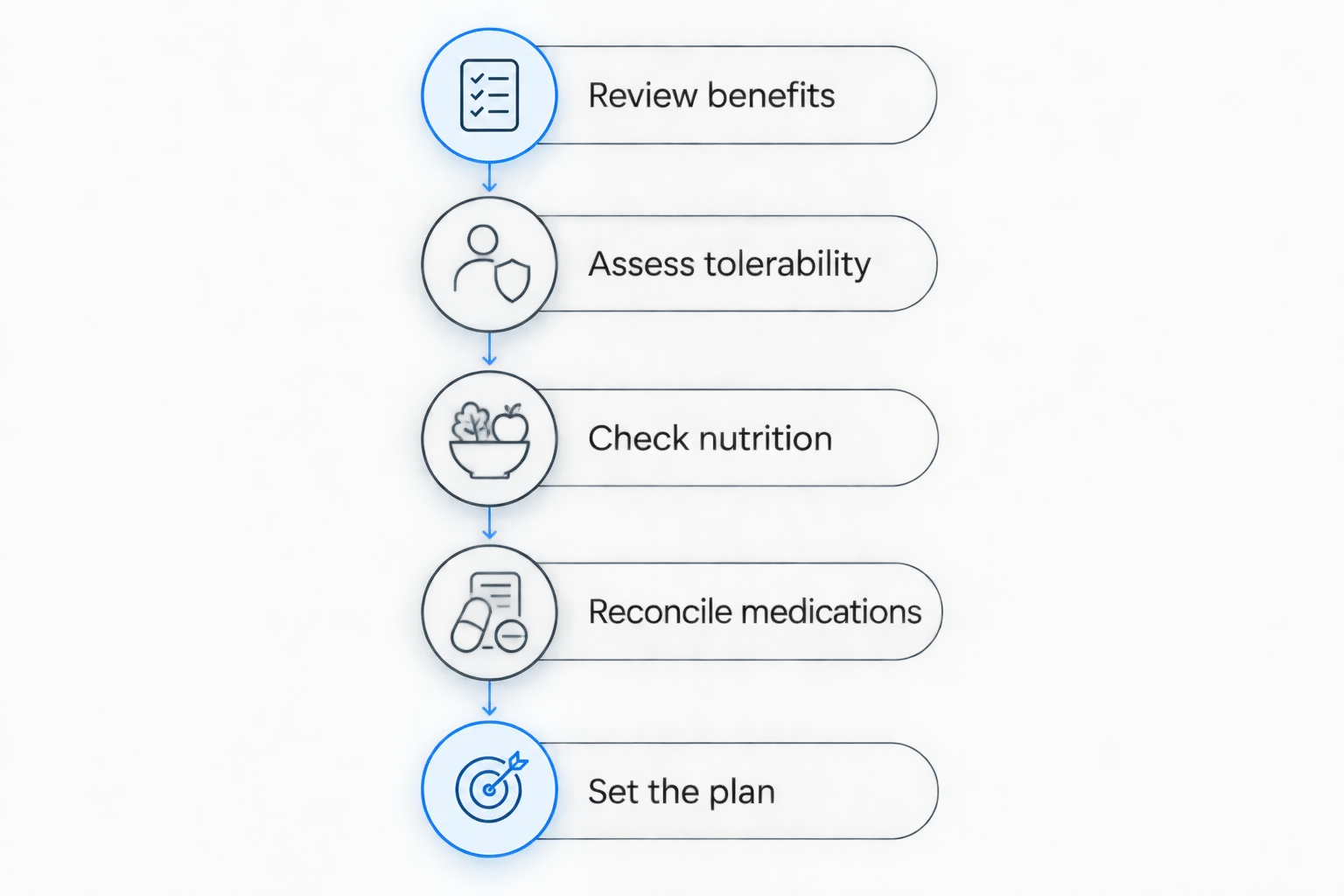
A practical follow-up sequence is:
- Review benefits. Discuss weight trajectory, relevant health measures, function, and treatment goals. For diabetes treatment, glucose control is part of that review.
- Assess tolerability. Describe nausea, vomiting, bowel changes, abdominal discomfort, hydration, and whether symptoms interfere with daily life.
- Check nutrition. Review whether appetite suppression is preventing adequate meals and protein intake. Include changes in strength or physical function.
- Reconcile medications. Report new prescriptions, supplements, contraception, and changes to insulin, sulfonylureas, or blood pressure treatment.
- Set the plan. Agree on whether to continue, adjust, investigate symptoms, or stop, and establish when to make contact again.
Laboratory testing should match your medical situation. Kidney function testing is particularly relevant when adverse effects cause dehydration; glucose monitoring matters when diabetes or hypoglycemia-producing medications are involved.
There is no universal panel that proves tirzepatide is safe indefinitely. Normal results also do not cancel out persistent symptoms. Discuss how often you need to see a doctor during GLP-1 treatment when setting your follow-up schedule.
Do you need to keep increasing the dose?
No. Long-term treatment does not mean continuous dose increases, and a higher dose is not automatically a better maintenance plan. Your prescriber should select an appropriate dose based on the indication, response, and tolerability.
Do not increase your dose to chase a temporary weight plateau. First review missed doses, symptoms, eating patterns, and whether your original goals still fit your health needs.
If you have stopped treatment for an extended period, ask for restart instructions rather than automatically resuming your previous dose. The appropriate restart plan depends on the interruption and your clinical circumstances.
Find out if GLP-1 treatment may be right for you.
Start My Pre-AssessmentDoes the product or formulation change the safety answer?
Yes. In 2026, evidence about an FDA-approved tirzepatide product should not be treated as proof that every preparation sold under the ingredient name has equivalent quality, dosing accuracy, or safety.
The distinction between tirzepatide and Mounjaro is an ingredient-versus-brand distinction: Mounjaro contains tirzepatide, but the ingredient name alone does not identify a product's approval status, formulation, or indication.
Compounded drugs are not FDA-approved. FDA does not review them for safety, effectiveness, and quality before marketing in the same way it reviews approved medications. A compounded preparation should not be assumed to share an approved product's clinical trial evidence.
Before using an injectable medication, confirm the prescribed product, concentration, dosing instructions, dispensing pharmacy, and storage requirements. If the label and your instructions conflict, ask the prescriber or pharmacist before injecting.
Can pregnancy or birth control change the plan?
Yes. Weight-loss treatment is not appropriate during pregnancy, and prescribing information warns of potential fetal harm. If pregnancy occurs or you are planning to conceive, contact your prescriber promptly for a medication review.
Tirzepatide can reduce the effectiveness of oral hormonal contraceptives because it delays gastric emptying. FDA prescribing information advises switching to a nonoral contraceptive method or adding a barrier method for 4 weeks after starting tirzepatide and for 4 weeks after each dose increase.
Those precautions are easy to miss when you have been on treatment for months. A dose change can make them relevant again, even if the rest of your routine is unchanged.
Also tell your surgical or anesthesia team that you take tirzepatide before a procedure requiring general anesthesia or deep sedation. Delayed stomach emptying can affect aspiration risk, and the procedural team should give individualized instructions.
Will you regain weight if you stop tirzepatide?
Weight regain is common after stopping tirzepatide, but individual outcomes differ. The SURMOUNT-4 withdrawal trial supports planning for maintenance rather than assuming the effect will persist unchanged without treatment.
Regain does not mean you failed or became addicted to the medication. It reflects, in part, the return of appetite and weight-regulating pressures after treatment ends.
If stopping is appropriate, ask how you will monitor weight, nutrition, and relevant medical conditions afterward. People taking tirzepatide for diabetes also need a plan for blood glucose management; stopping without replacement treatment can leave diabetes undertreated.
Where does online care fit into long-term treatment?
VEVArx is best suited to US adults seeking online, medically supervised weight-loss care. VEVArx offers doctor-prescribed weight-loss medications, including tirzepatide, but individual eligibility and the treatment plan require clinical assessment.
The benefit of telehealth is access to care without an in-person appointment for every interaction. Its limitation is that some symptoms, examinations, tests, and emergencies require local or in-person care.
Choose a care arrangement that makes it clear whom to contact about adverse effects and when urgent evaluation is necessary. Convenience should support clinical follow-up, not replace it.
Have questions about your options? Start with a quick online assessment.
Start My Pre-AssessmentFAQ
Can you take tirzepatide long term safely?
Yes, tirzepatide can be used long term when it remains medically appropriate, effective, and tolerable under clinician supervision. Multiyear studies support continued treatment in studied populations, but do not establish lifelong safety.
How many years has tirzepatide been studied for weight management?
Tirzepatide has been studied for 176 weeks in the SURMOUNT-1 extension involving people with obesity and prediabetes. That duration does not establish safety over decades or for every patient population.
Do I have to stop tirzepatide when I reach my goal weight?
No, reaching your goal weight does not automatically mean you should stop tirzepatide. Your clinician should reassess maintenance benefits, side effects, nutrition, and your overall medical needs.
Does taking tirzepatide for years damage your kidneys?
Kidney damage is not an inevitable consequence of long-term tirzepatide treatment. Vomiting and diarrhea can cause dehydration and acute kidney injury, so persistent fluid loss needs prompt medical attention.
Can I take tirzepatide if thyroid disease runs in my family?
The specific thyroid diagnosis matters: tirzepatide is contraindicated with a personal or family history of medullary thyroid carcinoma or multiple endocrine neoplasia syndrome type 2. Other thyroid conditions require their own clinical assessment.
How long do I need backup birth control with tirzepatide?
Use a nonoral contraceptive method or add a barrier method for 4 weeks after starting tirzepatide and 4 weeks after each dose increase if you use oral hormonal contraception. Discuss the appropriate method with your prescribing clinician.
Can VEVArx decide whether long-term tirzepatide is right for me?
VEVArx offers doctor-prescribed weight-loss care through telehealth. A clinician must assess your medical history, treatment response, and risks before deciding whether tirzepatide is appropriate; some evaluations require in-person care.
One last thing
Before your next refill, ask what would make your clinician change or stop your treatment. A clear answer should cover symptoms, nutrition, pregnancy, medication interactions, and whether the medication still serves your health goals.
Successful maintenance is not simply continuing the same prescription. It is continuing a treatment whose benefits remain worth its risks.
Related guides
Ready to get started?
See if doctor-prescribed GLP-1 treatment may be right for you. It only takes a few minutes, 100% online.
Start My Pre-AssessmentThis article is for informational purposes only and is not medical advice. Compounded medications are not approved by the FDA and have not been reviewed for safety, effectiveness, or quality. Prescription products require an online consultation with a licensed healthcare provider who will determine if a prescription is appropriate. Individual results vary.