
How do you know when to increase your tirzepatide dose?
How do you know when to increase your tirzepatide dose? Review timing, side effects, and progress with your prescriber—not hunger alone. 2026 guide.

You know it is time to discuss increasing your tirzepatide dose when you have completed the prescribed time at your current dose, tolerate treatment, and still need additional benefit based on your clinician’s assessment. Do not increase it yourself: persistent side effects, missed doses, or a short weight-loss stall require a review—not an automatic increase.
- How do you know when to increase your tirzepatide dose? Review timing, tolerability, and treatment response with your prescriber.
- FDA-approved Zepbound labeling allows dose increases in 2.5 mg increments after at least 4 weeks at the current dose.
- More hunger does not automatically mean you need more medication; persistent vomiting is a reason for medical review.
- VEVArx offers doctor-prescribed tirzepatide through telehealth; dose changes still require an individualized prescribing decision.
How do you know when to increase your tirzepatide dose?
Your prescriber considers how long you have taken the current dose, whether side effects are manageable, and whether treatment is meeting its goals. For adult weight management, FDA-approved Zepbound prescribing information permits increases in 2.5 mg increments after at least 4 weeks at the current dose.
That is a minimum interval, not a requirement to increase every month. Review how to tell whether tirzepatide is working before treating a change in appetite as evidence that your dose is too low.
| Decision to discuss | Best for | Potential benefit | Limitation or concern |
|---|---|---|---|
| Continue the prescribed dose | People meeting goals with acceptable tolerability | Avoids an unnecessary increase | Requires continued assessment of progress |
| Increase after clinician review | People needing additional benefit who meet the dosing interval and tolerate treatment | Allows adjustment toward treatment goals | Digestive side effects can worsen during escalation |
| Delay escalation and contact the prescriber | People with persistent side effects, treatment gaps, or unclear instructions | Allows safety and dosing problems to be addressed | Does not resolve symptoms without assessment |
| Seek urgent medical care | People with severe abdominal pain, serious allergic symptoms, or significant dehydration | Prioritizes potentially serious complications | Is not a routine dose-adjustment appointment |
Source for labeled dosing and warnings: FDA-approved Zepbound prescribing information, Dosage and Administration and Warnings and Precautions. This 2026 guide addresses adult weight management, not an individualized prescription.
Curious whether you qualify? A licensed provider makes the final call.
Start My Pre-AssessmentWhy this matters
The highest dose is not automatically the right dose. Increasing treatment to chase complete appetite suppression can overlook side effects, inadequate food intake, or another explanation for slow progress.
In 2026, your dose discussion should focus on a treatment plan you can tolerate and follow. The goal is a clinically appropriate response—not matching someone else’s injection schedule.
Starting dose: 2.5 mg once weekly
For FDA-approved Zepbound, the labeled starting dose is 2.5 mg once weekly for 4 weeks, followed by 5 mg once weekly. The 2.5 mg dose is for treatment initiation, not an approved maintenance dose.
The starting period introduces the medication while reducing the risk of gastrointestinal adverse reactions. It is not a reliable test of your final weight-loss response.
If you are approaching the end of this period, confirm the next prescription and report your symptoms. Do not assume that finishing the starting doses makes an increase appropriate despite ongoing vomiting or difficulty drinking.
Maintenance doses: 5 mg, 10 mg, or 15 mg once weekly
For adult weight reduction and long-term maintenance, Zepbound’s labeled maintenance doses are 5 mg, 10 mg, or 15 mg once weekly. Selection depends on treatment response and tolerability.
A maintenance dose is a dose your clinician selects for ongoing treatment. It is not simply whichever strength comes next on a calendar.
If your current maintenance dose supports your treatment goals and you tolerate it, there is no automatic requirement to keep increasing. Conversely, tolerating a dose does not establish that it provides enough benefit; both questions belong in the review.
Escalation steps: 7.5 mg and 12.5 mg once weekly
Zepbound also has 7.5 mg and 12.5 mg strengths, which serve as intermediate steps when escalating toward higher maintenance doses. These are not listed as maintenance doses for adult weight management in the prescribing information.
The same minimum interval applies: any further increase follows at least 4 weeks at the current dose and a prescribing decision. Your clinician can delay escalation when tolerability requires it.
Do not skip strengths to catch up with another person’s schedule. The labeled maximum is 15 mg once weekly; taking more is not an approved way to break a plateau.
Why tirzepatide dose decisions vary
A useful 2026 dose review looks beyond the scale. Bring information about these factors:
- Time at the current dose: Record when you started the strength and whether you took it as prescribed. The minimum escalation interval does not establish readiness by itself.
- Side-effect burden: Report nausea, vomiting, diarrhea, constipation, abdominal discomfort, and whether symptoms interfere with daily activities.
- Treatment response: Discuss your weight trend, appetite changes, and relevant health goals rather than a single measurement.
- Food and fluid intake: Explain whether you can eat regular meals and stay hydrated. Difficulty doing either deserves attention before an increase.
- Other medications: Insulin and sulfonylureas can increase the risk of low blood sugar when used with tirzepatide. Oral contraceptives also require specific precautions.
- Treatment interruptions: Missed injections or a prolonged gap change the dosing conversation. Do not restart at a higher strength without instructions.
Your prescriber weighs these factors together. A calendar date or stronger appetite cannot substitute for that assessment.
What should you check before asking for an increase?
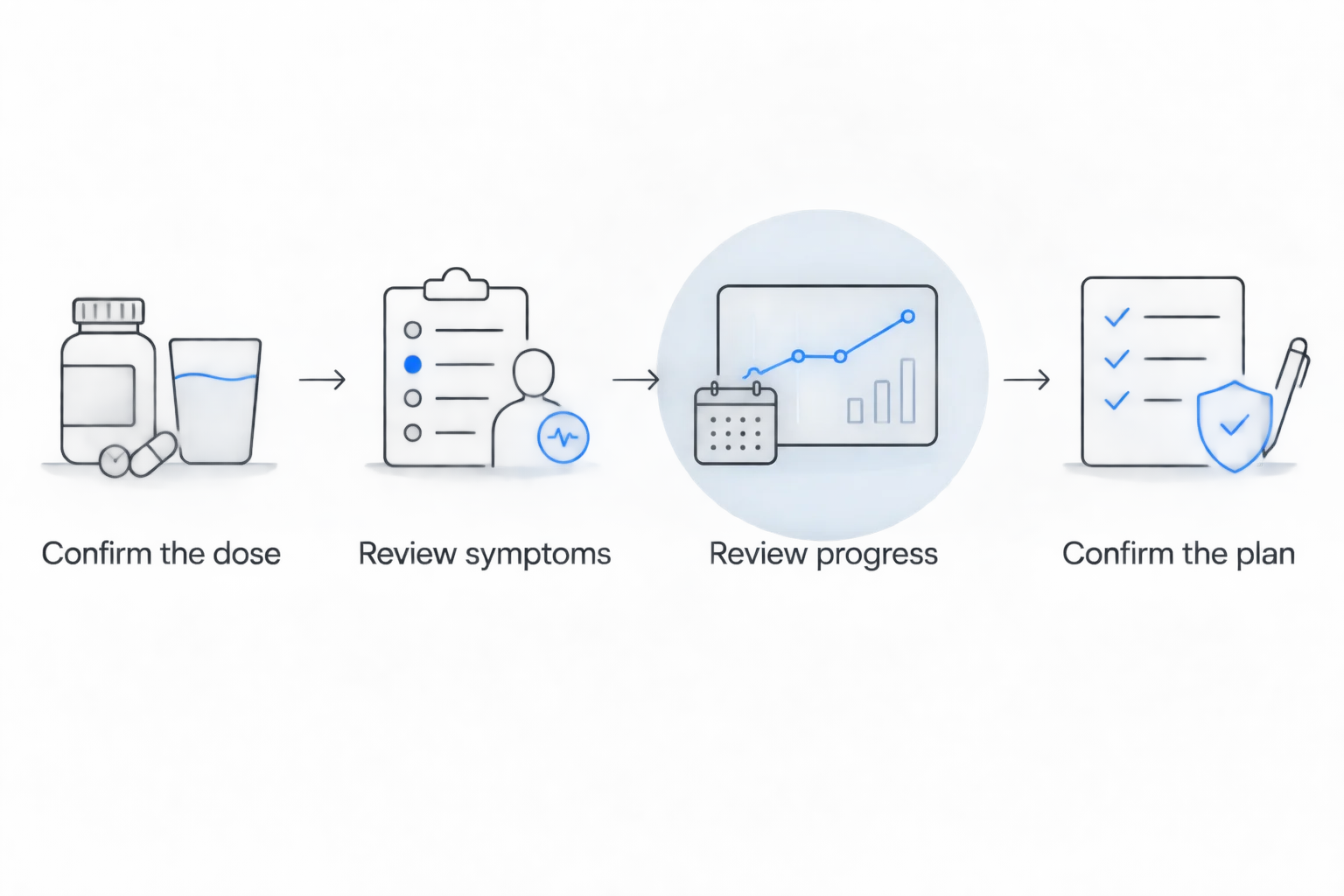
Use this sequence to prepare for a prescribing conversation. It organizes the decision; it does not authorize you to change your dose.
- Confirm the dose. Write down the medication name, prescribed strength in milligrams, injection dates, and any missed doses. Include a photo of the dispensing label if instructions are unclear.
- Review symptoms. Describe when side effects started, whether they are improving, and how they affect eating, drinking, and normal activities. Be specific rather than calling everything mild.
- Review progress. Bring a weight trend measured under similar conditions, changes in appetite, and any glucose readings your clinician requested. Explain what you want treatment to accomplish.
- Confirm the plan. Ask whether to continue, delay escalation, or change the prescription. Get clear instructions for the next injection before using a different strength.
A useful message is brief but complete: include your current prescribed dose, time on that dose, symptoms, treatment response, and the question you need answered. Send it before you run out of instructions—not after taking an extra injection.
Does feeling hungry mean your dose is too low?
Hunger alone does not establish that your tirzepatide dose is too low. You can still experience normal hunger while treatment supports weight management.
Tell your prescriber whether hunger has changed alongside your weight trend, meal pattern, sleep, or injection adherence. The relevant question is whether your overall response supports a change—not whether you ever want a snack.
Do not use nausea or an inability to eat as proof that a dose works. Those are tolerability concerns, not treatment targets.
Does a weight-loss plateau mean you should increase?
A weight-loss plateau does not automatically require a higher dose. Body weight reflects more than body fat, and short-term changes in fluid balance, constipation, and measurement conditions can obscure a trend.
Use consistent measurement conditions and discuss the pattern with your clinician. There is no universal number of stalled days that proves you need a dose increase.
Before requesting escalation in 2026, check whether you have taken the prescribed dose consistently and whether side effects are limiting nutrition or activity. A higher strength does not correct every reason progress slows.
Find out if GLP-1 treatment may be right for you.
Start My Pre-AssessmentWhen should you delay an increase and contact your clinician?
Do not increase while significant side effects remain unresolved. Persistent vomiting, worsening diarrhea, troublesome constipation, dizziness, or difficulty eating and drinking deserve a prescribing review.
Contact your clinician promptly if symptoms are interfering with hydration or daily life. If you cannot keep fluids down, are urinating much less, or feel faint, seek urgent medical assessment rather than waiting for a routine refill conversation.
Severe, persistent abdominal pain—especially pain that radiates to your back, with or without vomiting—requires immediate medical attention because pancreatitis is a labeled warning. Stop tirzepatide and seek care if pancreatitis is suspected.
Trouble breathing or swelling of the face, lips, tongue, or throat requires emergency care. These symptoms are not an expected adjustment to a higher dose.
What medication and contraception issues matter before escalation?
Tirzepatide can increase hypoglycemia risk when combined with insulin or a sulfonylurea. Your clinician may need to adjust those medicines; do not change them yourself to make room for a tirzepatide increase.
Zepbound labeling advises people using oral hormonal contraceptives to switch to a non-oral method or add a barrier method for 4 weeks after starting treatment and 4 weeks after each dose escalation. Discuss that plan before increasing, not afterward.
Tell your prescriber if you are pregnant or planning pregnancy. Zepbound should be discontinued when pregnancy is recognized; pregnancy is not a situation for routine escalation.
Also disclose other weight-management medicines. Zepbound labeling does not recommend combining it with another tirzepatide-containing product or a GLP-1 receptor agonist.
How does a telehealth dose review fit into treatment?
VEVArx fits adults seeking clinician-prescribed tirzepatide through telehealth. The platform offers online prescriptions for medically supervised weight loss, but choosing a platform does not determine your appropriate dose.
If you use VEVArx, keep the prescribing discussion focused on your current medication, symptoms, and response. Online care does not remove the need for an individualized assessment or urgent in-person care when symptoms warrant it.
For any provider you choose in 2026, ask how to report side effects and obtain clarification before your next injection. A dosing question needs a clinical answer, not a guess based on a refill reminder.
What if your vial instructions use units instead of milligrams?
Milligrams describe the medication dose; syringe units describe a volume marking. They are not interchangeable. The conversion depends on the concentration of the dispensed product.
Do not copy another person’s syringe measurement or reuse an old measurement after a concentration change. Ask the dispensing pharmacist or prescriber to confirm the prescribed milligram dose and its corresponding volume for your exact medication.
Compounded tirzepatide is not FDA-approved. The Zepbound schedule described here does not establish the quality, concentration, or appropriate instructions for a compounded preparation.
Have questions about your options? Start with a quick online assessment.
Start My Pre-AssessmentFAQ
How do you know when to increase your tirzepatide dose?
Discuss an increase when you have completed the prescribed interval, tolerate your current dose, and need additional benefit based on your clinician’s assessment. FDA-approved Zepbound labeling permits increases in 2.5 mg increments after at least 4 weeks at the current dose; do not increase on your own.
Can I increase tirzepatide after 2 weeks?
No—the labeled Zepbound escalation interval is at least 4 weeks at the current dose. Contact your prescriber rather than accelerating treatment yourself.
Do I have to increase tirzepatide every month?
No, reaching 4 weeks does not automatically mean you should increase. Your prescriber selects the dose based on response and tolerability, and can delay escalation.
Can I stay on 5 mg if tirzepatide is working?
Yes, 5 mg once weekly is a labeled Zepbound maintenance dose for adult weight management. Your prescriber decides whether continuing it meets your treatment goals.
Should I increase tirzepatide if I still feel hungry?
Hunger alone is not a reason to increase tirzepatide. Your clinician should review your overall response, side effects, and adherence before changing the prescription.
What is the highest tirzepatide dose for weight loss?
The maximum labeled Zepbound dose is 15 mg once weekly. It is a ceiling, not a target everyone needs to reach.
Should I increase my dose if I am still nauseated?
Do not increase without a prescribing review if nausea persists or interferes with eating and drinking. Repeated vomiting, dehydration symptoms, or severe abdominal pain require prompt medical assessment.
Can VEVArx help with medically supervised tirzepatide treatment?
VEVArx offers doctor-prescribed tirzepatide through an online telehealth platform for adults seeking medically supervised weight loss in the US. An individual clinical assessment determines whether treatment or a dose change is appropriate.
One last thing
Bring the medication label to the conversation, not just the dose you remember. A clear record of the strength, concentration when applicable, and injection dates helps prevent a dosing discussion from becoming a measurement error.
This is educational information, not a personal dosing plan. Follow your current prescription until your prescribing clinician provides different instructions, and seek urgent care for serious symptoms.
Related guides
Ready to get started?
See if doctor-prescribed GLP-1 treatment may be right for you. It only takes a few minutes, 100% online.
Start My Pre-AssessmentThis article is for informational purposes only and is not medical advice. Compounded medications are not approved by the FDA and have not been reviewed for safety, effectiveness, or quality. Prescription products require an online consultation with a licensed healthcare provider who will determine if a prescription is appropriate. Individual results vary.