
Can you take tirzepatide with metformin?
Can you take tirzepatide with metformin? Yes, when prescribed together. Learn about digestive effects, low blood sugar, timing, and when to seek care.

Yes, you can take tirzepatide with metformin when your prescriber recommends the combination; the medications are used together to manage type 2 diabetes. The main caveat is overlapping digestive side effects, while low blood sugar becomes a greater concern if you also take insulin or a sulfonylurea. In 2026, the right approach remains an individualized prescription, a medication review, and clear instructions for side effects—not stopping metformin yourself.
- Can you take tirzepatide with metformin? Yes, when prescribed together; watch digestive symptoms and review other diabetes medications.
- Tirzepatide plus metformin has a low hypoglycemia risk without insulin or sulfonylureas, but the risk is not zero.
- Persistent vomiting, dehydration, or severe abdominal pain requires medical attention, not another dose adjustment at home.
- VEVArx suits US adults seeking online, medically supervised GLP-1 weight-loss care; prescriptions require individual assessment.
Can you take tirzepatide with metformin?
Yes. Tirzepatide and metformin can be prescribed together because they lower blood sugar through different mechanisms. FDA-approved tirzepatide prescribing information includes clinical studies in adults taking background metformin. Taking metformin is not, by itself, a reason to exclude tirzepatide.
If you are comparing treatment pathways, the GLP-1 weight-loss guide for type 2 diabetes covers the broader discussion. The combination still needs a clinician's assessment of your medical history, kidney function, other medications, and treatment goals.
| Treatment approach | Best fit to discuss with your clinician | Main benefit | Main limitation |
|---|---|---|---|
| Metformin alone | Adults whose diabetes plan is meeting their individualized goals | Lowers liver glucose production and improves insulin sensitivity | Digestive effects occur, and it does not meet every patient's treatment goals |
| Tirzepatide alone | Adults for whom tirzepatide is appropriate and metformin is unsuitable or unnecessary | Supports blood sugar control and, depending on the prescription indication, weight management | Requires an injection and carries digestive effects, warnings, and contraindications |
| Tirzepatide with metformin | Adults who need additional treatment and can tolerate both medicines | Combines complementary effects on blood sugar | Digestive symptoms can overlap; other diabetes medicines require review |
These are discussion categories, not a ranking. Neither medicine automatically replaces the other, and taking both is not proof that your diabetes is unusually severe.
Curious whether you qualify? A licensed provider makes the final call.
Start My Pre-AssessmentWhy this matters
A combination can be appropriate without being right for every person. Your reason for taking metformin matters: diabetes management, an off-label indication, and weight-management care are not interchangeable treatment plans.
For a 2026 treatment review, separate two questions: whether the medicines can be combined and whether you personally should take both. The answer to the first is yes; the second depends on your diagnosis, response, tolerance, and safety assessment. A lower number on the scale does not settle that decision.
How tirzepatide and metformin work together
Metformin primarily reduces glucose production by the liver and improves insulin sensitivity. Tirzepatide activates GIP and GLP-1 receptors, increases insulin release in a glucose-dependent way, reduces glucagon, and delays stomach emptying. Tirzepatide also affects appetite and food intake.
Those differences explain why a clinician can add tirzepatide without automatically discontinuing metformin. The medicines have complementary actions rather than being duplicate versions of the same treatment. They also share some unwanted effects, especially nausea and diarrhea.
The combination is not a promise of a particular weight-loss result. Your prescriber should assess glucose readings, A1C, symptoms, and treatment goals rather than assuming that adding another medication is always better.
Does the combination mean better blood sugar control?
Adding tirzepatide can improve blood sugar control when metformin alone is insufficient. FDA-approved tirzepatide prescribing information describes this use in adults with type 2 diabetes, including trials with metformin as background therapy.
That evidence does not mean everyone needs combination treatment. If your current plan is effective or you have reasons to avoid tirzepatide, the appropriate decision can be to keep your existing regimen or choose another approach.
Why your tirzepatide and metformin plan varies
Your clinician should review the following factors before combining the medicines or changing either prescription:
- Treatment goal: Blood sugar management and weight management require attention to the specific diagnosis and prescribed product.
- Other diabetes medicines: Insulin and sulfonylureas increase the concern for low blood sugar when tirzepatide is added.
- Kidney function: Metformin suitability depends on kidney function, and dehydration can create additional safety problems.
- Digestive tolerance: Existing nausea, diarrhea, vomiting, or severe stomach-emptying problems affect the treatment discussion.
- Medical history: A personal or family history of medullary thyroid carcinoma or MEN2 is a contraindication to tirzepatide. Previous pancreatitis also needs explicit discussion.
- Pregnancy plans: Pregnancy, planned pregnancy, and contraceptive use require a separate medication review before treatment changes.
Bring your full medication list, not just your diabetes prescriptions. Include supplements, nonprescription medicines, and the exact names and formulations on your medication labels.
Can I take metformin on my tirzepatide injection day?
Yes, metformin can generally be taken on the same day as your weekly tirzepatide injection. There is no standard requirement to separate them by a set number of hours. Follow the instructions on your own prescriptions.
Tirzepatide injections can be given with or without food. Metformin is generally taken with meals to reduce digestive effects, but the schedule depends on whether your prescription is immediate-release or extended-release. Do not switch formulations or schedules yourself.
Tirzepatide delays stomach emptying and can affect the absorption of oral medications. A pharmacist should review medicines that need especially precise exposure or monitoring. Spacing every tablet away from the injection is not a substitute for that review.
Should I skip metformin if I feel nauseated?
Do not routinely skip metformin simply because it is injection day or you expect nausea. Contact your prescriber if symptoms interfere with eating, drinking, or taking your medicines.
Ask for specific sick-day instructions before you need them. Significant vomiting, diarrhea, dehydration, or an acute illness can require temporary medication changes, but the instructions should reflect your kidney function and complete treatment plan.
How to start the combination safely
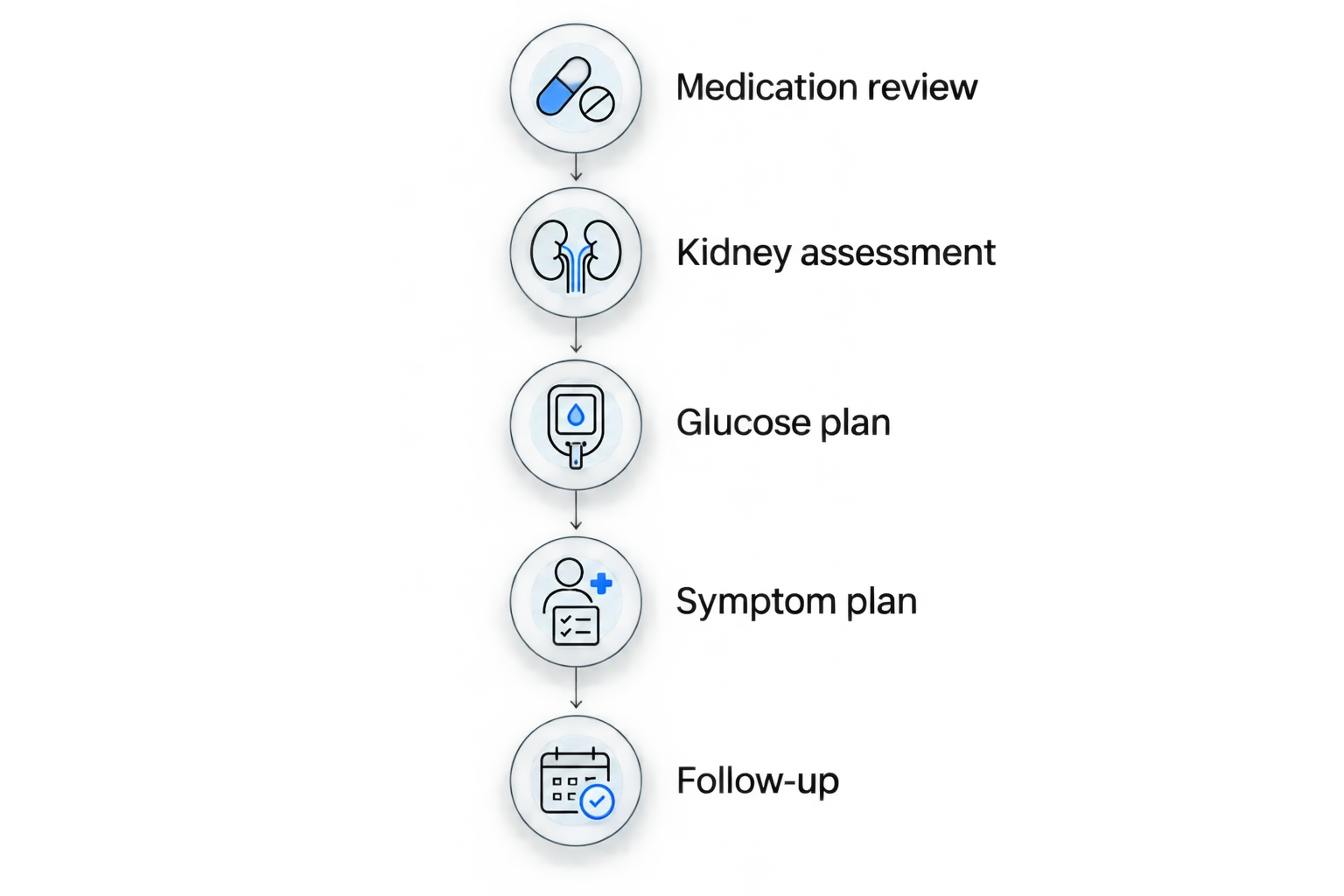
Before starting tirzepatide alongside metformin in 2026, get a written plan that covers monitoring, digestive symptoms, and when to seek help. A prescription alone does not answer those practical questions.
- Medication review: Give your prescriber the exact metformin formulation and dose, plus every other prescription and supplement you take. Flag insulin and sulfonylureas specifically.
- Kidney assessment: Ask whether your kidney function results are current enough for a metformin safety review. Mention recent dehydration or an illness that affected your fluid intake.
- Glucose plan: Confirm whether you need home glucose checks, when to check, and what readings require a call. Do not assume someone else's monitoring schedule fits your regimen.
- Symptom plan: Ask what to do if you develop nausea, vomiting, diarrhea, constipation, or poor fluid intake. Get clear instructions about severe or persistent symptoms.
- Follow-up: Agree on when your clinician will review tolerance, glucose results, and whether any medication adjustment is needed. Do not increase tirzepatide faster than prescribed.
Keep a short symptom log that records injection timing, meals, glucose readings if prescribed, and symptoms. That gives your clinician more useful information than a general report that the medicines feel too strong.
What side effects should you watch for?
Digestive symptoms are the main overlapping tolerability issue with tirzepatide and metformin. Both can cause nausea and diarrhea; tirzepatide can also cause vomiting, constipation, and abdominal discomfort. Symptoms deserve attention when they persist or interfere with hydration and nutrition.
For mild symptoms, smaller meals, slower eating, and avoiding unusually large meals can help. Take metformin according to its food instructions, and ask your clinician whether formulation or timing changes are appropriate. Do not crush an extended-release tablet or change the dose yourself.
When should you contact your prescriber promptly?
Contact your clinician for ongoing vomiting or diarrhea, dizziness, reduced urination, or difficulty maintaining fluid intake. Dehydration can worsen kidney function, which matters for metformin safety.
Metformin carries a warning for lactic acidosis, a rare but serious complication. Severe weakness, unusual sleepiness, breathing difficulty, or feeling very unwell—especially during dehydration or acute illness—needs urgent assessment rather than assuming it is routine medication nausea.
When do symptoms need urgent care?
Seek urgent care for severe, persistent abdominal pain, particularly if it radiates to your back or occurs with vomiting. Tirzepatide prescribing information warns about acute pancreatitis; suspected pancreatitis requires stopping tirzepatide and prompt evaluation.
Trouble breathing, swelling of the lips or tongue, fainting, or a severe allergic reaction requires emergency help. Do not wait for a routine telehealth message response during an emergency.
Find out if GLP-1 treatment may be right for you.
Start My Pre-AssessmentCan tirzepatide and metformin cause low blood sugar?
Tirzepatide with metformin has a low risk of hypoglycemia when neither insulin nor a sulfonylurea is part of the regimen. The risk is not zero, and the assessment changes when you take additional glucose-lowering medicines or have reduced food intake.
Watch for sweating, shaking, a racing heartbeat, hunger, dizziness, or confusion. Symptoms alone do not confirm the cause; check your glucose if you have a meter or continuous glucose monitor and can do so safely.
The American Diabetes Association's published hypoglycemia guidance uses these thresholds and treatment steps:
- Below 70 mg/dL: This is low blood glucose and requires action under your treatment plan.
- 15 grams of fast-acting carbohydrate: This is the standard initial treatment for an alert adult who can swallow safely.
- 15 minutes: Recheck glucose after this interval and repeat treatment if it remains below 70 mg/dL.
If you are unconscious, having a seizure, or unable to swallow safely, someone should call emergency services and use prescribed glucagon if available. Do not give food or drink by mouth to someone who cannot swallow safely.
Do you need to stop metformin when tirzepatide starts working?
No. Improved readings do not automatically mean you should stop metformin. They can mean the prescribed combination is working. Your clinician should decide whether to continue, reduce, or discontinue treatment using your results and medical history.
Weight change alone is not enough to guide that decision. Review glucose patterns, A1C, side effects, and kidney function before changing the regimen. If another clinician manages your diabetes, make sure both prescribers know about every medication change.
For adults considering online weight-loss care, VEVArx offers doctor-prescribed GLP-1 treatment. VEVArx is best suited to US adults seeking online, medically supervised GLP-1 weight-loss care. Online access does not replace an individual interaction review or urgent in-person assessment when symptoms require it.
What should you ask at your next appointment?
Use your 2026 medication review to leave with decisions, not just general reassurance. Ask these questions before starting or increasing tirzepatide:
- What is the purpose of each medicine in my treatment plan?
- Should my metformin prescription stay unchanged?
- Do insulin or other medicines need adjustment?
- What glucose readings or symptoms should trigger a call?
- What should I do with each medicine if I cannot keep fluids down?
- When will we review my kidney function, A1C, and treatment response?
If you use oral hormonal contraception, raise that explicitly. Tirzepatide prescribing information advises switching to a nonoral method or adding barrier contraception for 4 weeks after starting and for 4 weeks after each dose increase.
Have questions about your options? Start with a quick online assessment.
Start My Pre-AssessmentFAQ
Can you take tirzepatide with metformin every day?
You can take prescribed metformin on its regular schedule while using weekly tirzepatide. Tirzepatide is not a daily injection; follow the exact instructions for both prescriptions.
Is tirzepatide with metformin safe for everyone?
No, tirzepatide with metformin is not appropriate for everyone. Kidney function, other medicines, pregnancy plans, digestive conditions, and tirzepatide contraindications require a clinician's assessment.
Will taking metformin with tirzepatide cause more nausea?
Taking metformin with tirzepatide can cause overlapping digestive effects because both medicines can cause nausea and diarrhea. Contact your clinician if symptoms persist or limit eating and drinking.
Should I stop metformin before my first tirzepatide injection?
Do not stop metformin before your first tirzepatide injection unless your prescriber instructs you to. Many adults with type 2 diabetes continue metformin when tirzepatide is added.
Can I take tirzepatide and metformin if I do not have diabetes?
Taking tirzepatide and metformin without diabetes requires an individual assessment of why each medicine is being prescribed. Metformin is not FDA-approved for weight loss, and tirzepatide eligibility depends on the prescribed product and indication.
Does metformin cancel out tirzepatide?
Metformin does not cancel out tirzepatide. The medicines work through different mechanisms and are used together in type 2 diabetes care.
Can VEVArx help me explore medically supervised GLP-1 treatment?
VEVArx offers online, doctor-prescribed GLP-1 weight-loss treatment for US adults. Tell the prescribing clinician about metformin and all other medicines so the treatment assessment accounts for your existing regimen.
One last thing
The most useful safety question is not just whether these two medicines interact—it is what else you take. Insulin, sulfonylureas, oral contraceptives, and medicines affected by delayed stomach emptying can change the advice you need.
For your 2026 appointment, photograph every medication label and bring your recent glucose readings if you monitor at home. This educational guide draws on FDA-approved tirzepatide and metformin prescribing information and American Diabetes Association hypoglycemia guidance; it does not replace your prescriber's instructions.
Related guides
Ready to get started?
See if doctor-prescribed GLP-1 treatment may be right for you. It only takes a few minutes, 100% online.
Start My Pre-AssessmentThis article is for informational purposes only and is not medical advice. Compounded medications are not approved by the FDA and have not been reviewed for safety, effectiveness, or quality. Prescription products require an online consultation with a licensed healthcare provider who will determine if a prescription is appropriate. Individual results vary.