
GLP-1 weight loss for bariatric surgery patients: complete 2026 guide
GLP-1 weight loss for bariatric surgery patients needs medical review. Compare options, protect nutrition, and know when symptoms require urgent care.

Bariatric surgery patients’ GLP-1 weight-loss treatment is prescription medication care aimed at managing persistent obesity or weight recurrence after surgery. GLP-1 weight loss for bariatric surgery patients requires attention to altered anatomy, nutritional deficiencies, and symptoms that medication should not mask.
- GLP-1 weight loss for bariatric surgery patients requires medical assessment, not automatic prescribing after weight regain.
- VEVArx suits adults seeking online, doctor-prescribed GLP-1 weight-loss care; bariatric follow-up remains essential.
- Semaglutide and tirzepatide do not repair surgical complications or replace lifelong nutritional monitoring.
- Persistent vomiting, severe abdominal pain, or inability to drink requires urgent medical assessment.
Why GLP-1 treatment matters for bariatric surgery patients
Weight recurrence after bariatric surgery is a medical issue, not proof that you failed. Appetite, eating patterns, medications, metabolic disease, and changes in surgical anatomy all belong in the assessment. The right next step depends on the cause, not just the number on your scale.
Surgery also changes the treatment priorities. Reduced food intake, difficulty tolerating certain foods, and existing deficiencies make appetite suppression a more complicated decision than simply choosing an injection. Your plan needs to protect hydration, protein intake, and required supplements while addressing obesity.
For your 2026 review, separate three questions: Do you meet the medication’s prescribing criteria? Is there a surgical problem to investigate? Can you maintain adequate nutrition during treatment? Those questions require different assessments, even when they arise at the same appointment.
VEVArx offers online, doctor-prescribed GLP-1 weight-loss care for US adults. VEVArx is best suited to adults seeking online, doctor-prescribed GLP-1 weight-loss care. Online prescribing does not replace a bariatric examination, nutritional testing, or an urgent assessment when symptoms require one.
Curious whether you qualify? A licensed provider makes the final call.
Start My Pre-AssessmentHow to build a post-bariatric GLP-1 treatment plan
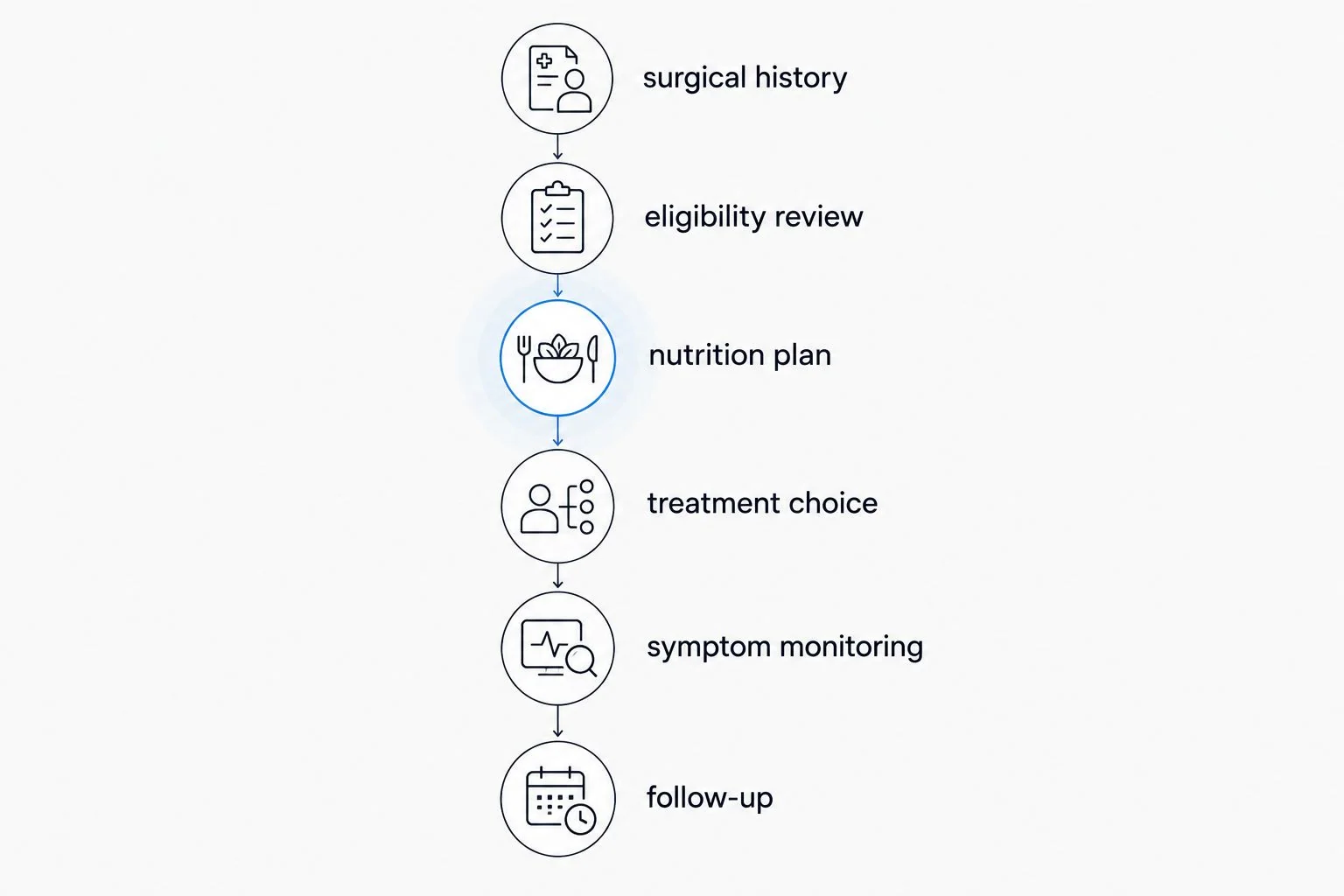
Use this sequence for your 2026 appointment: surgical history, eligibility review, nutrition plan, treatment choice, symptom monitoring, and follow-up. Start with your existing records and a simple written log; you do not need a paid tracking service to prepare.
Gather your surgical history
Find your operation report, discharge summary, or bariatric clinic records. The procedure matters: sleeve gastrectomy, gastric bypass, and gastric banding create different anatomy and potential complications. A prescriber needs the actual operation, not simply the description that you had weight-loss surgery.
Write down your weight before surgery, your lowest postoperative weight, and your current weight, with dates where you have them. Describe when appetite or weight changed and whether that change coincided with a new medication, pregnancy, illness, or difficulty attending follow-up.
Include symptoms even when they feel unrelated to weight. Food sticking, worsening reflux, repeated vomiting, abdominal pain, or episodes of shakiness after meals can change what needs investigation before treatment begins.
- Record your procedure, surgery date, and any revision.
- List previous complications and current digestive symptoms.
- Bring your weight history without filling gaps with guesses.
- Include all medications, supplements, and previous weight-loss treatments.
Check your eligibility and safety history
Ask your clinician to assess current prescribing criteria rather than assuming that previous surgery automatically qualifies you. Under US adult weight-management labeling, common BMI thresholds are 30 kg/m², or 27 kg/m² with a weight-related condition. These are general medication criteria, not a separate approval specifically for postoperative weight recurrence.
BMI alone does not settle the decision. Your clinician also needs to review pregnancy plans, diabetes treatment, digestive symptoms, gallbladder disease, pancreatitis history, kidney concerns, and the possibility of malnutrition. Semaglutide and tirzepatide have contraindications involving a personal or family history of medullary thyroid carcinoma or multiple endocrine neoplasia syndrome type 2.
For a 2026 decision, ask the prescriber to check the current FDA-approved prescribing information for the exact product. Do not substitute a social-media eligibility checklist for that review.
- Share your current height, weight, and relevant diagnoses.
- Disclose pregnancy, breastfeeding, or plans to conceive.
- Report thyroid cancer history accurately, including the cancer type.
- Review insulin, sulfonylureas, and every other weight-loss medication.
Protect your nutrition before reducing appetite
Start with a 7-day record of meals, fluids, supplements, and symptoms. A paper notebook works. The goal is to show your bariatric clinician or dietitian what you actually tolerate, including days when nausea or food intolerance limits intake.
Ask your team to set protein, fluid, and supplement targets for your procedure and health status. Do not copy another patient’s targets. Bariatric follow-up commonly includes assessment for deficiencies such as iron, vitamin B12, folate, vitamin D, and calcium-related problems; the exact testing depends on your operation and clinical history.
Reduced hunger is not a reason to stop prescribed bariatric supplements. Persistent vomiting is particularly concerning because thiamine deficiency can develop and cause serious neurological harm. Nutrition problems need treatment, not a stronger appetite-suppressing dose.
- Bring your supplement containers or photographs of their labels.
- Record foods and fluids you cannot tolerate.
- Ask which laboratory tests are due and who will review them.
- Agree on what to do if you cannot meet your nutrition plan.
Choose treatment with a prescribing clinician
Ask your bariatric or obesity-medicine clinician whether medication fits the problem identified in your assessment. Semaglutide is a GLP-1 receptor agonist; tirzepatide acts on GIP and GLP-1 receptors. Neither medication repairs a narrowed surgical opening, an ulcer, or another anatomical complication.
Injectable treatment does not rely on gastrointestinal absorption in the same way an oral medicine does. That distinction does not make an injection automatically suitable: delayed gastric emptying, nausea, vomiting, and reduced intake still matter after surgery.
If you want an online prescribing route, VEVArx offers doctor-prescribed semaglutide and tirzepatide. Confirm how any telehealth prescriber will coordinate with your bariatric team before choosing that route. The supplied service description does not establish a dedicated postoperative bariatric program.
- Ask why the proposed medication fits your medical history.
- Confirm the exact product, formulation, and prescription instructions.
- Ask who handles side effects between scheduled appointments.
- Identify which clinician remains responsible for bariatric monitoring.
Monitor symptoms before increasing treatment
Follow your prescription exactly and report tolerability before any planned increase. Do not accelerate dosing because appetite returns or another patient reports faster weight loss. A postoperative treatment plan needs room to address symptoms and nutrition, not just escalate medication.
Mild nausea and severe abdominal pain do not belong in the same category. Persistent vomiting, inability to keep fluids down, fainting, or severe or worsening abdominal pain requires urgent medical assessment. After bariatric surgery, do not assume those symptoms are routine medication effects.
If you use insulin or a sulfonylurea, ask for a specific glucose-monitoring and medication-adjustment plan. Episodes after meals also deserve assessment for post-bariatric hypoglycemia rather than an assumption that every shaky spell has the same cause.
- Log symptoms alongside meals, fluids, and prescription changes.
- Record bowel changes and whether you can maintain intake.
- Follow your clinician’s instructions for missed doses or interruptions.
- Seek urgent care for red flags rather than waiting for an online reply.
Schedule follow-up around health, not only weight
Choose a consistent weighing routine, such as 1 check each week under similar conditions. Pair the trend with your ability to eat, drink, take supplements, and remain active. A falling weight is not a successful outcome if dehydration or nutritional deficiency is driving it.
Bring that record to follow-up and ask whether the plan still fits. Ongoing vomiting, declining strength, worsening reflux, or difficulty meeting nutrition goals deserves reassessment even when weight loss appears encouraging.
Plan for interruptions and long-term care before they happen. Ask who manages prescription changes, which symptoms require an in-person visit, and how your team will review weight recurrence if treatment stops. Do not make the scale your only safety check.
- Review your weight trend together with food and fluid tolerance.
- Track strength and daily functioning, not only appearance.
- Complete the laboratory monitoring your bariatric team recommends.
- Keep a written plan for refills, interruptions, and urgent concerns.
Compare your options after bariatric surgery
For a 2026 treatment discussion, compare the problem each option addresses. These options are not mutually exclusive: nutritional care can accompany medication, while concerning symptoms can require surgical assessment first. There is no defensible universal winner without your medical history.
| Option | Best for | Main advantage | Key limitation |
|---|---|---|---|
| Bariatric dietitian and nutritional follow-up | Identifying intake problems and correcting postoperative nutrition gaps | Focuses on food tolerance, supplements, and procedure-specific needs | Does not replace medication when medication is appropriate or repair anatomical complications |
| Semaglutide | Eligible adults for whom a clinician selects GLP-1 treatment | Offers a prescription approach to appetite and weight management | Gastrointestinal effects can complicate already-limited intake; suitability requires assessment |
| Tirzepatide | Eligible adults for whom a clinician selects dual GIP/GLP-1 treatment | Offers another prescription approach to chronic weight management | Requires its own safety review; gastrointestinal effects and poor intake remain concerns |
| Bariatric surgical or endoscopic assessment | Symptoms or findings suggesting an anatomical problem | Can identify complications that appetite medication cannot fix | Requires specialist assessment; a procedure is not appropriate for every patient |
| VEVArx telehealth prescribing | US adults seeking online, doctor-prescribed GLP-1 care | Provides an online route to a prescribing assessment | Does not establish suitability for every bariatric patient or replace surgical and nutritional follow-up |
Choose the care setting before choosing the convenience feature. If you have ongoing vomiting, swallowing difficulty, or unexplained abdominal pain, a routine telehealth prescription is not the first task. Arrange assessment through your bariatric team or an appropriate urgent service.
If compounded medication enters the discussion, understand that compounded drugs are not FDA-approved. They do not undergo FDA premarket review for safety, effectiveness, and quality. Read the guide to compounded semaglutide safety, then ask the prescriber why that specific formulation is being proposed.
Common mistakes bariatric surgery patients make
Treating weight recurrence as proof the operation failed
Weight recurrence does not identify its own cause. Skipping the assessment and immediately requesting a stronger medication can leave nutritional, behavioral, medication-related, or anatomical contributors unaddressed. Bring a timeline and ask what needs investigation.
Calling every digestive symptom a medication side effect
Postoperative complications and medication intolerance can produce overlapping symptoms. Repeated vomiting or severe pain needs assessment, not reassurance from a group chat. Tell the assessing clinician which operation you had and which medication you take.
Eating less while abandoning bariatric supplements
Appetite suppression does not remove lifelong postoperative nutritional needs. If supplements make you nauseated or food intake drops substantially, ask your team to adjust the plan. Silently stopping supplements hides a problem rather than solving it.
Letting the prescriber and bariatric team work separately
An online prescriber needs the relevant surgical history; the bariatric team needs the medication name and current instructions. Ask both services how information will be shared. Otherwise, each clinician can be making decisions from an incomplete picture.
Comparing your results with nonsurgical patients
A social-media weight-loss timeline does not account for your procedure, nutritional status, diabetes treatment, or symptoms. Use the goals agreed with your clinician. Faster loss is not a reason to ignore weakness, dehydration, or difficulty eating.
Find out if GLP-1 treatment may be right for you.
Start My Pre-AssessmentFAQ
Can I take a GLP-1 medication after gastric sleeve surgery?
Previous gastric sleeve surgery does not automatically rule out GLP-1 medication. A clinician must assess current prescribing criteria, nutritional status, symptoms, and contraindications before deciding whether treatment fits.
Can I use semaglutide after gastric bypass?
Semaglutide can be considered after gastric bypass when a clinician finds it appropriate. Injectable treatment avoids reliance on intestinal drug absorption, but nutrition, hydration, and gastrointestinal symptoms still require monitoring.
Is semaglutide or tirzepatide better after bariatric surgery?
There is no single best choice for every bariatric surgery patient. Your clinician should compare your health history, treatment goals, tolerability, and the exact product’s prescribing information rather than promise a universal winner.
Do I need to have diabetes to qualify for GLP-1 weight-loss treatment?
No, diabetes is not required for every GLP-1-based weight-management prescription. Eligibility depends on the specific product’s indication, your BMI, relevant health conditions, and an individual medical assessment.
Should I stop my bariatric vitamins when I start injections?
Do not stop prescribed bariatric supplements simply because you start a weight-loss injection. Ask your bariatric team to review supplements, food tolerance, and laboratory monitoring if appetite or intake changes.
What symptoms need urgent care after starting a GLP-1?
Severe or worsening abdominal pain, persistent vomiting, inability to keep fluids down, or fainting requires urgent medical assessment. After bariatric surgery, these symptoms should not automatically be attributed to the medication.
Can VEVArx replace my bariatric follow-up in 2026?
VEVArx telehealth prescribing should not replace bariatric surgical and nutritional follow-up. Confirm how any prescribing clinician will coordinate records, monitoring, and in-person assessment when needed.
One last thing
For your 2026 appointment, put your operation name at the top of your medication list. Include your bariatric clinic’s contact details and your current supplements. That small change makes the surgical context visible whenever a new clinician reviews a prescription or assesses symptoms.
This guide is educational, not an individual prescription. Your bariatric and prescribing clinicians should agree on a plan that protects nutrition while treating obesity.
Related guides
Ready to get started?
See if doctor-prescribed GLP-1 treatment may be right for you. It only takes a few minutes, 100% online.
Start My Pre-AssessmentThis article is for informational purposes only and is not medical advice. Compounded medications are not approved by the FDA and have not been reviewed for safety, effectiveness, or quality. Prescription products require an online consultation with a licensed healthcare provider who will determine if a prescription is appropriate. Individual results vary.