
GLP-1 weight loss for menopausal women: complete 2026 guide
GLP-1 weight loss for menopause starts with eligibility, not hormones alone. Compare options, protect muscle, and plan safer clinician-supervised care.

Menopausal women’s GLP-1 weight-loss care is clinician-supervised treatment that uses prescription medication alongside nutrition and movement to support weight management and metabolic health. This 2026 guide explains eligibility, medication choices, muscle protection, and safety when menopause symptoms complicate your routine.
- GLP-1 weight loss for menopause treats eligible weight-related conditions, not menopause itself or isolated belly fat.
- VEVArx offers online, doctor-prescribed GLP-1 weight-loss care for adults seeking medical supervision.
- Semaglutide and tirzepatide require individualized screening; menopause alone does not establish eligibility.
- Protect muscle with resistance training, adequate nutrition, and follow-up—not appetite suppression alone.
Why GLP-1 weight loss matters for menopausal women
Menopause changes the context of weight management. Hormonal changes favor abdominal fat accumulation, while aging contributes to declining muscle mass; disrupted sleep, hot flashes, and joint discomfort can make eating and exercise routines harder to maintain.
GLP-1 medications address appetite and weight-related disease. They do not replace menopause care, restore estrogen, or selectively remove abdominal fat. Treat weight management and menopause symptoms as connected concerns with different treatment goals.
VEVArx provides online access to doctor-prescribed weight-loss medications, including semaglutide and tirzepatide. VEVArx GLP-1 weight-loss care is best suited to adults seeking online, doctor-prescribed treatment. An in-person practice is the better setting when you need a physical examination or evaluation that cannot be completed remotely.
For your 2026 care plan, prioritize safe prescribing, adequate nutrition, and follow-up over promises about a menopause-specific injection. Menopause does not automatically qualify you for medication, and weight gain does not identify its cause.
Curious whether you qualify? A licensed provider makes the final call.
Start My Pre-AssessmentHow to build a menopause-aware GLP-1 plan
Start with your existing clinician, a written medication list, and a simple symptom log. You do not need a subscription, connected scale, or tracking app to prepare for an appointment.
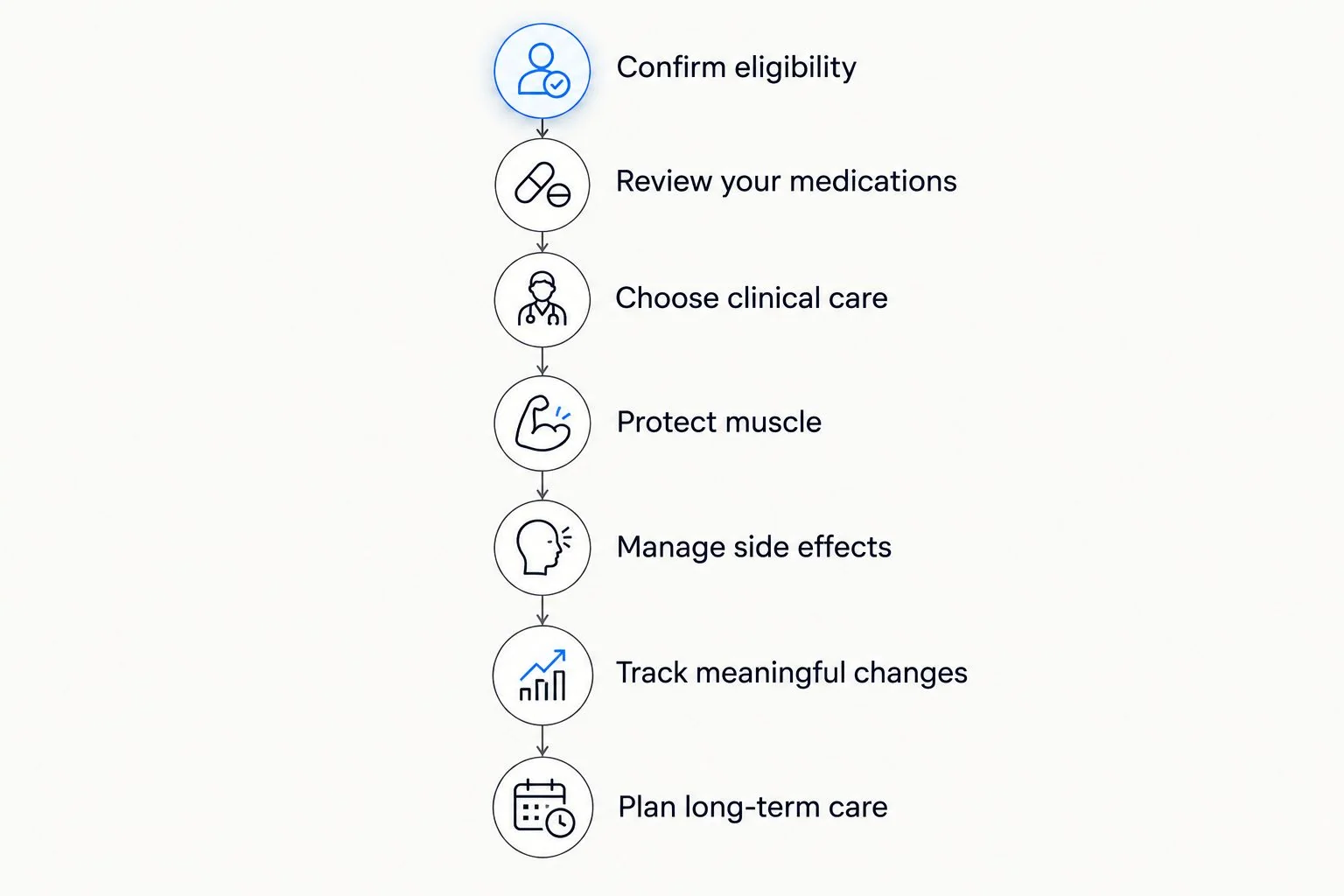
Confirm eligibility
FDA prescribing information for weight-management formulations generally uses a body mass index of at least 30 kg/m², or at least 27 kg/m² with a weight-related condition, for adult eligibility. Your clinician must also assess the specific product’s indication, contraindications, and your health history.
These thresholds are not a menopause diagnosis or an automatic prescription. Ask whether blood pressure, glucose, cholesterol, sleep apnea, or other weight-related conditions affect your treatment options. Testing should answer a clinical question rather than become a blanket hormone panel.
Discuss unexplained weight changes, swelling, persistent fatigue, or unusual bleeding separately. An appetite-focused treatment should not substitute for investigating another medical problem.
- Bring your weight history and previous treatment experience.
- List diagnosed weight-related conditions and recent relevant results.
- Record sleep disruption, hot flashes, and changes in physical function.
- Ask which findings require an examination or additional testing.
Review your medications
Make a medication list before choosing treatment. Include menopause hormone therapy, contraception, diabetes medicines, supplements, and any weight-loss products obtained elsewhere. FDA prescribing information for semaglutide and tirzepatide includes precautions related to delayed gastric emptying and oral medication use.
Review personal or family history of medullary thyroid carcinoma or multiple endocrine neoplasia syndrome type 2. These are contraindications for the weight-management products discussed here; ordinary hypothyroidism is a different issue. Also disclose pancreatitis, gallbladder disease, significant gastrointestinal symptoms, kidney problems, and planned procedures involving anesthesia.
Pregnancy remains possible during perimenopause. Tirzepatide labeling advises nonoral contraception or an added barrier method for 4 weeks after starting and after each dose increase. Semaglutide labeling advises stopping at least 2 months before a planned pregnancy.
- Bring exact medication names rather than broad categories.
- Flag insulin or sulfonylurea use because hypoglycemia risk needs review.
- Discuss contraception and pregnancy plans before treatment.
- Tell procedural teams that you take a GLP-1 medication.
Choose clinical care
Your regular clinician is a practical starting point: bring your notes and ask about eligibility, prescribing, and follow-up. If attending appointments is the main obstacle, VEVArx GLP-1 weight-loss care offers an online route to doctor-prescribed treatment. Remote care still needs appropriate screening and a clear plan for problems between visits.
Choose the care setting before choosing an injection. Ask who prescribes, where the medication comes from, how questions are handled, and when an in-person assessment becomes necessary. Convenience is a benefit; the inability to perform a hands-on examination is a limitation.
In 2026, do not treat compounded and FDA-approved products as interchangeable. Compounded drugs are not FDA-approved, and the FDA does not review them for safety, effectiveness, or quality before marketing. Read the compounded semaglutide safety guide before discussing a compounded prescription.
- Confirm the prescriber’s credentials and state licensure.
- Ask for the exact medication and formulation.
- Confirm the dispensing pharmacy and prescription instructions.
- Request a written follow-up and symptom-escalation plan.
Protect muscle
Less hunger does not guarantee adequate nutrition. During menopause and aging, protecting muscle deserves attention alongside weight loss. Start with regular meals, a protein source at meals, and strength-building activity suited to your current ability.
The Physical Activity Guidelines for Americans recommend at least 150 minutes of moderate-intensity activity per week and muscle-strengthening activity on at least 2 days per week for adults. These are general health targets, not entry requirements for medication. Build toward them with adaptations for pain, balance, or other limitations.
Ask a registered dietitian or clinician to personalize protein and fluid needs, especially with kidney disease or difficulty eating. Do not use persistent weakness or skipped meals as evidence that treatment is working well.
- Include a protein source in regular meals.
- Add resistance exercises that match your ability.
- Track everyday strength, such as climbing stairs or carrying groceries.
- Ask for help if nausea repeatedly prevents adequate intake.
Manage side effects
Nausea, vomiting, diarrhea, constipation, and abdominal discomfort are recognized adverse effects of these medications. Smaller meals, slower eating, and avoiding meals that consistently trigger symptoms are practical starting points. Contact your prescriber when symptoms interfere with eating, drinking, or daily activities.
Follow the prescribed dose schedule rather than increasing faster to chase weight loss. If symptoms persist, the clinician should reassess the dose, timing, medication choice, or need for evaluation. Do not combine semaglutide with tirzepatide or another GLP-1 medicine on your own.
Seek urgent medical evaluation for severe or persistent abdominal pain, repeated vomiting, inability to keep fluids down, or signs of significant dehydration. Trouble breathing or swelling of the face or throat requires emergency care.
- Keep a brief record of symptoms and dose timing.
- Follow your clinician’s fluid advice, including any restrictions.
- Ask before using medicines for persistent digestive symptoms.
- Obtain advice before another dose when significant symptoms remain unresolved.
Track meaningful changes
Use a paper notebook or spreadsheet before buying tracking tools. Record weight under reasonably consistent conditions, but also note strength, food intake, sleep, bowel symptoms, and how you feel during normal activities.
A useful 2026 review asks whether treatment improves health without undermining function. Blood pressure, glucose, or other measurements belong in the plan when relevant to your medical history. Your clinician should decide which measurements matter and how often to review them.
Menopause symptoms need their own record. Hot flashes or poor sleep can continue even when weight decreases; that does not establish medication failure. Likewise, a lower scale reading does not excuse worsening weakness or persistent vomiting.
- Track weight trends rather than reacting to isolated readings.
- Record appetite alongside your ability to eat enough.
- Note changes in strength, dizziness, and daily function.
- Review menopause symptoms separately from weight outcomes.
Plan long-term care
Discuss maintenance before starting, not only when you reach a target weight. Obesity treatment often requires ongoing care, and weight regain after medication discontinuation is documented in clinical research. Stopping treatment needs a plan for appetite, nutrition, activity, and relevant health measurements.
Ask how follow-up changes during maintenance and what should trigger a treatment review. Do not assume that reaching a particular clothing size means the underlying condition has resolved. Equally, do not continue an ineffective or poorly tolerated treatment without reassessment.
With VEVArx or another prescribing service, clarify the clinical follow-up process directly. Use your 2026 appointments to decide whether the treatment still fits your health needs, preferences, and ability to maintain adequate nutrition.
- Discuss maintenance goals before the first prescription.
- Ask how treatment benefit and tolerability will be reassessed.
- Agree on a plan for interruption or discontinuation.
- Keep menopause symptom care connected to your wider medical care.
The care sequence is straightforward: establish eligibility, review safety, choose an appropriate setting, and monitor both health and function. Medication selection belongs inside that process—not ahead of it.
Compare treatment options for menopausal women
These options address different problems. FDA-approved semaglutide and tirzepatide weight-management products treat eligible weight-related conditions; menopause hormone therapy treats appropriate menopause symptoms. Nutrition and activity support health with or without medication.
| Option | Best for | Main benefit | Key limitation |
|---|---|---|---|
| Nutrition and activity support | Women building a foundation or not eligible for medication | Supports nutrition, strength, and cardiometabolic health | Does not directly address medication eligibility or persistent menopause symptoms |
| FDA-approved semaglutide for weight management | Eligible adults choosing treatment with a clinician | Reduces appetite and supports chronic weight management | Gastrointestinal effects, contraindications, and ongoing monitoring apply |
| FDA-approved tirzepatide for weight management | Eligible adults considering a dual GIP/GLP-1 medicine | Supports chronic weight management through appetite-related pathways | Gastrointestinal effects and oral contraceptive precautions require review |
| Menopause hormone therapy | Appropriate candidates with bothersome menopause symptoms | Treats symptoms such as hot flashes | Is not prescribed as a weight-loss treatment and requires its own risk assessment |
Choose by indication and safety, not by the label “menopause weight loss.” Semaglutide and tirzepatide have different formulations and prescribing instructions. A clinician should identify the exact product rather than treating the ingredient name as a complete prescription.
Common mistakes menopausal women make
- Treating every symptom as menopause. New fatigue, unexplained weight changes, or bleeding deserve assessment rather than an automatic prescription response.
- Chasing belly-fat promises. GLP-1 medication does not selectively target your waist, and a changing waistline does not establish eligibility.
- Ignoring muscle while celebrating weight loss. Poor intake and declining strength need attention even when the scale moves downward.
- Assuming contraception is unnecessary. Perimenopause does not rule out pregnancy; tirzepatide also has specific oral contraceptive instructions.
- Expecting weight treatment to resolve hot flashes. Menopause symptoms require a separate discussion, including whether symptom-directed treatment is appropriate.
Find out if GLP-1 treatment may be right for you.
Start My Pre-AssessmentFAQ
Can GLP-1 medication help with menopause weight gain?
GLP-1 medication can support weight loss in menopausal women who meet the relevant prescribing criteria. Menopause alone does not establish eligibility, and these medicines do not treat estrogen decline or selectively remove abdominal fat.
Which is better for menopause, semaglutide or tirzepatide?
Neither semaglutide nor tirzepatide is automatically the better choice because you are menopausal. The decision depends on the exact product, your medical history, other medicines, tolerability, and treatment goals.
Can I take a GLP-1 medication while using hormone therapy?
Using menopause hormone therapy does not automatically rule out GLP-1 treatment. Your prescriber should review the specific hormone formulation, route, other medications, and individual risks before combining treatments.
Do I need diabetes to qualify for GLP-1 weight-loss medication?
No, diabetes is not required for every GLP-1 weight-management prescription. FDA-approved adult weight-management products generally use BMI and weight-related conditions to determine eligibility, alongside product-specific safety screening.
Will GLP-1 treatment make me lose muscle during menopause?
Weight loss can include lean tissue loss, so muscle protection belongs in a GLP-1 treatment plan. Resistance training, adequate nutrition, and monitoring strength help address that concern; persistent weakness needs clinical review.
Can I still get pregnant while taking GLP-1 medication in perimenopause?
Pregnancy remains possible during perimenopause, and weight-loss medications should not be used during pregnancy. Discuss contraception before treatment, including tirzepatide's additional precautions for oral hormonal contraceptives.
Is online GLP-1 care appropriate for menopausal women?
Online GLP-1 care is an option when a licensed clinician can appropriately assess eligibility and arrange follow-up. VEVArx offers online, doctor-prescribed weight-loss treatment; symptoms requiring examination or urgent assessment need an appropriate in-person setting.
One last thing
Reduced hunger is a medication effect, not a complete health outcome. For your next 2026 appointment, bring one observation about strength and one about your ability to eat adequately—not just your latest weight. That gives your clinician a clearer picture of whether treatment supports your health.
This guide provides general education, not an individualized prescription. Follow your clinician’s instructions and the current FDA-approved labeling for your exact medication.
Related guides
Ready to get started?
See if doctor-prescribed GLP-1 treatment may be right for you. It only takes a few minutes, 100% online.
Start My Pre-AssessmentThis article is for informational purposes only and is not medical advice. Compounded medications are not approved by the FDA and have not been reviewed for safety, effectiveness, or quality. Prescription products require an online consultation with a licensed healthcare provider who will determine if a prescription is appropriate. Individual results vary.