
How do you know if your tirzepatide dose is too high?
How do you know if your tirzepatide dose is too high? Persistent symptoms need review. Learn warning signs, emergency symptoms, and what to do next.

Your tirzepatide dose needs medical review if nausea, vomiting, diarrhea, constipation, or appetite suppression prevents you from eating, staying hydrated, or functioning normally—especially after a dose increase. These symptoms do not prove the dose is too high; severe abdominal pain, fainting, trouble breathing, or confusion needs urgent assessment rather than another dose adjustment at home.
- How do you know if your tirzepatide dose is too high? Persistent symptoms affecting eating, drinking, or daily activities need review.
- Mild nausea alone does not prove excessive dosing; symptom severity and hydration matter more.
- Severe abdominal pain, breathing problems, fainting, or confusion require urgent medical assessment.
- VEVArx offers medically supervised telehealth weight loss for US adults; emergency symptoms need emergency care.
Why this matters
Feeling too sick to eat is not the treatment goal. Tirzepatide reduces appetite and delays stomach emptying, but being unable to maintain fluids or nutrition calls for a prescribing review—not a determination to push through.
For your 2026 treatment plan, separate the decision to increase medication from the decision to investigate side effects. The guide to when to increase your tirzepatide dose covers the escalation question; this page focuses on recognizing when symptoms need attention.
Curious whether you qualify? A licensed provider makes the final call.
Start My Pre-AssessmentHow do you know if your tirzepatide dose is too high?
Look at what symptoms stop you from doing, when they started, and whether they are improving. New or worsening symptoms after an increase deserve attention, but timing alone cannot distinguish medication intolerance from dehydration, infection, gallbladder disease, or another medical problem.
| What you notice | What it means | What to do |
|---|---|---|
| Mild nausea or fullness while you can still eat, drink, and function | A recognized side effect, not proof of excessive dosing | Monitor symptoms; report persistent or worsening symptoms |
| Repeated vomiting, ongoing diarrhea, or difficulty maintaining food and fluids | Possible intolerance with dehydration risk | Contact prescriber promptly; seek urgent care if fluids will not stay down |
| Persistent constipation, painful bloating, or worsening abdominal discomfort | Symptoms need assessment, especially if bowel function changes | Contact prescriber; severe pain, vomiting, or inability to pass gas needs urgent evaluation |
| Severe, persistent abdominal pain, sometimes spreading to the back | Possible pancreatitis or another urgent abdominal condition | Stop tirzepatide and seek urgent medical assessment |
| Trouble breathing, swelling of the face or throat, collapse, or severe confusion | Possible emergency | Emergency care; call 911 |
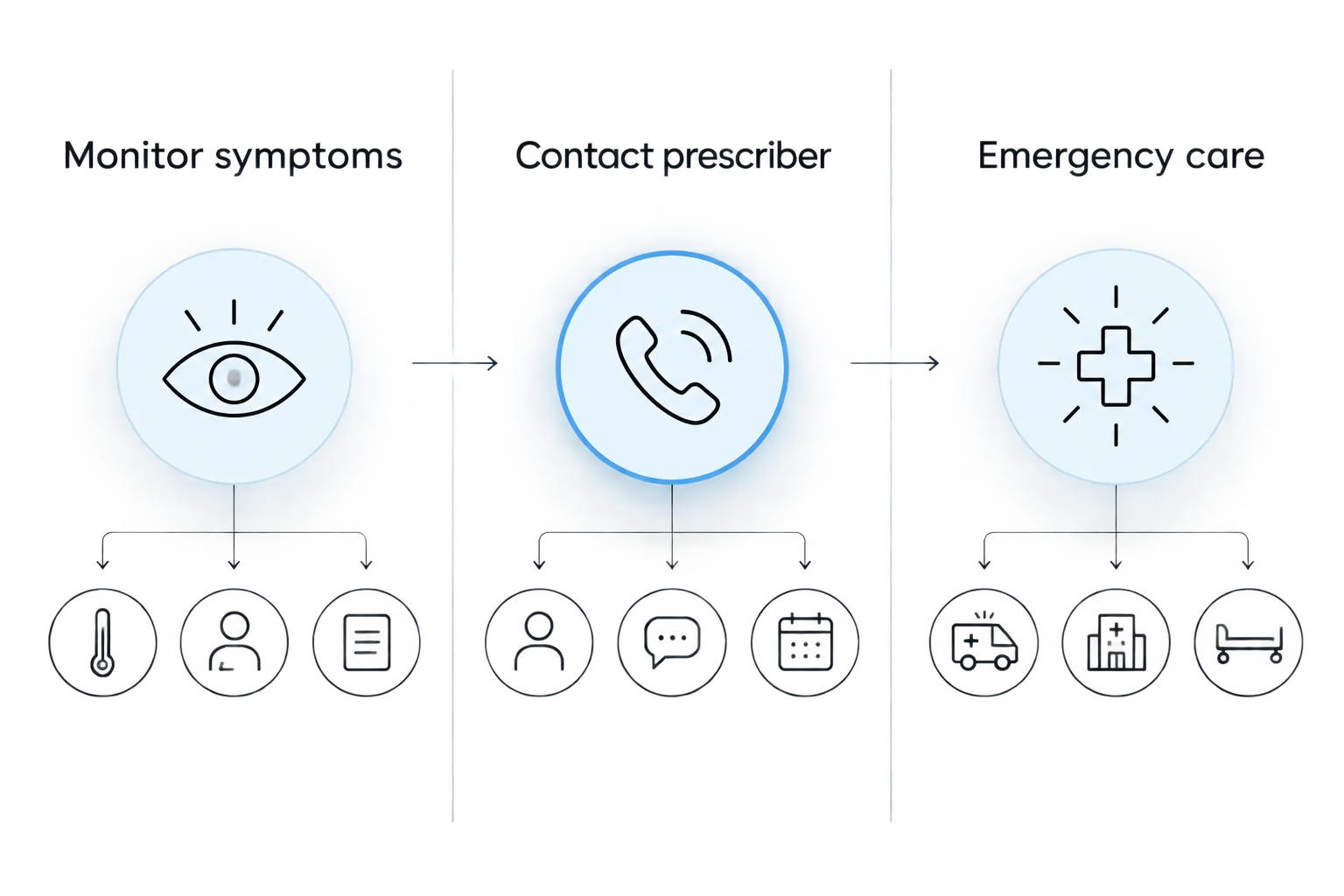
A symptom diary helps your clinician assess the pattern. Record your prescribed dose, injection time, symptoms, fluid intake, and whether you can keep meals down; do not wait to complete the diary before seeking urgent care.
Which symptoms suggest poor dose tolerance?
Persistent symptoms that interfere with hydration, nutrition, or normal activity are more concerning than brief, mild discomfort. Nausea, vomiting, diarrhea, constipation, and abdominal discomfort are recognized tirzepatide adverse effects in FDA-approved prescribing information.
Report patterns such as:
- Vomiting that recurs or prevents you from keeping liquids down.
- Nausea that repeatedly stops you from eating adequate meals.
- Diarrhea accompanied by dizziness, unusual weakness, or reduced urination.
- Constipation that persists despite your clinician's recommended measures.
- Appetite suppression so strong that you routinely cannot eat enough.
These symptoms warrant review even if you followed the prescription exactly. A correctly measured dose can still be poorly tolerated, and a symptom caused by another condition still needs treatment.
Do not use the scale as the safety check. Weight loss does not cancel out dehydration, inadequate nutrition, or a serious medication reaction.
Which symptoms need urgent or emergency care?
Severe symptoms are not something to troubleshoot by changing your next injection. Get medical help first.
Seek urgent assessment for severe or persistent abdominal pain, especially with vomiting or pain extending to your back. Tirzepatide prescribing information warns about acute pancreatitis; suspected pancreatitis requires stopping the medication and prompt evaluation.
Upper abdominal pain with fever, yellowing skin or eyes, or pale stools also needs prompt assessment for possible gallbladder disease. Repeated vomiting, very little urine, or dizziness when standing can indicate significant dehydration and possible kidney complications.
Call 911 for breathing difficulty, swelling of your tongue or throat, collapse, seizures, or severe confusion. Do not drive yourself if you feel faint or confused, and do not wait for a portal message in an emergency.
Does low blood sugar mean your tirzepatide dose is too high?
Low blood sugar does not automatically identify tirzepatide as the sole cause. The risk is higher when tirzepatide is used with insulin or an insulin-releasing medicine such as a sulfonylurea, according to FDA-approved prescribing information.
Watch for sweating, shaking, sudden hunger, a racing heartbeat, dizziness, or confusion. Check your glucose if you have a meter or continuous glucose monitor, and follow your prescribed hypoglycemia plan.
For many adults with diabetes, the American Diabetes Association defines low glucose as below 70 mg/dL. Standard guidance for someone awake and able to swallow is 15 grams of fast-acting carbohydrate, followed by another glucose check after 15 minutes; follow your clinician's individualized instructions.
A person who cannot swallow safely should not receive food or drink by mouth. Use prescribed glucagon if available and call emergency services for unconsciousness, seizures, or inability to treat the low safely.
What does the prescribed dose schedule tell you?
For a 2026 prescription check, FDA-approved Zepbound labeling provides a useful reference: treatment starts at 2.5 mg once weekly for 4 weeks, followed by 5 mg once weekly. Further increases are in 2.5 mg increments, after at least 4 weeks on the current dose; the maximum recommended dose is 15 mg once weekly.
Those figures describe the labeled schedule, not a personal dosing recommendation. The starting dose is for treatment initiation, and your prescriber selects an appropriate maintenance dose based on treatment response, tolerability, and the condition being treated.
Reaching the maximum is not the goal. Completing the minimum time at a dose does not make an increase automatic, particularly when you have ongoing side effects.
Do not use this schedule to convert a vial into syringe units. Milligrams describe the drug amount; milliliters describe liquid volume, and syringe markings require interpretation using the exact product concentration and instructions.
Why tirzepatide tolerance varies
The same prescribed dose does not produce the same experience for everyone. These factors belong in a dose review:
- Recent escalation. Gastrointestinal symptoms often appear or worsen during dose increases.
- Other medications. Insulin and sulfonylureas increase hypoglycemia risk; your clinician needs your complete medication list.
- Food and fluid intake. Reduced intake, vomiting, or diarrhea can contribute to dehydration and weakness.
- Digestive conditions. A history of significant stomach-emptying problems changes the safety discussion; tirzepatide is not recommended for severe gastroparesis in prescribing information.
- Dose measurement. Confusing milligrams, milliliters, or syringe units can result in taking more medication than prescribed.
- Treatment interruptions. Restarting after a gap requires instructions specific to your situation rather than assumptions about your previous dose.
These factors help explain symptoms, but they do not establish a diagnosis. Your clinician still needs to assess severity, timing, other illnesses, and whether testing or an examination is necessary.
What should you do before your next injection?
If symptoms are persistent or significant, contact your prescriber before the next scheduled injection. Ask for an explicit plan rather than deciding independently to increase, decrease, split, or repeat a dose.
Prepare this information for your 2026 medication review:
- Confirm the prescription. Share the medication name, prescribed milligrams, formulation, and pharmacy label.
- Describe the timing. Give your last injection date, any recent increase, missed doses, or possible extra dose.
- Describe the impact. Explain whether you can drink, eat, urinate normally, work, and manage everyday activities.
- List other medicines. Include diabetes medicines, blood-pressure medicines, supplements, and nonprescription products.
- Request next-dose instructions. Ask what to do about the upcoming injection and which symptoms require in-person care.
A telehealth review offers access to prescribing advice, but it cannot replace an examination when severe symptoms require one. VEVArx is a fit for US adults seeking medically supervised telehealth weight loss.
VEVArx offers doctor-prescribed tirzepatide and other weight-loss treatments; your actual symptoms should determine whether you contact your prescriber, seek urgent care, or call emergency services.
Find out if GLP-1 treatment may be right for you.
Start My Pre-AssessmentWhat if you injected more tirzepatide than prescribed?
Treat a suspected extra dose or measurement error as a poison-exposure question, even before symptoms start. In the US, call Poison Control at 1-800-222-1222 for individualized instructions; call 911 for severe symptoms.
Keep the packaging, vial or pen, syringe information, concentration, and injection time available. Tell the specialist the prescribed amount and the amount you believe you injected, without guessing at conversions.
Do not induce vomiting or take another injection to correct a scheduling mistake. Tirzepatide's effects can persist, so follow the monitoring and treatment instructions you receive rather than assuming that feeling well initially rules out a problem.
Can your dose be too high without nausea?
Yes—nausea is not required for poor tolerance or a dosing error. Inability to eat adequately, troublesome constipation, dehydration, or low glucose with interacting medicines still warrants assessment.
Conversely, having no side effects does not mean your dose needs increasing. Your prescriber should consider the treatment goal and response, not whether you feel the medication after each injection.
Should you lower the dose or stay on it longer?
Your prescriber should make that decision after reviewing the symptoms and excluding urgent causes. Possible approaches include delaying escalation, changing the prescribed dose, addressing side effects, or selecting a different treatment.
Each approach has limits. Staying at the current dose avoids an immediate increase but does not solve severe intolerance; reducing a dose does not treat pancreatitis, gallbladder disease, or another underlying illness.
For 2026 treatment decisions, use a clear rule: do not increase while significant side effects remain unresolved without your prescriber's direction. Do not improvise partial pen doses or borrow another person's dosing instructions.
Have questions about your options? Start with a quick online assessment.
Start My Pre-AssessmentFAQ
How do you know if your tirzepatide dose is too high?
Persistent symptoms that prevent normal eating, drinking, or daily activities mean your tirzepatide dose needs medical review. Symptoms alone cannot prove excessive dosing, and severe abdominal pain, fainting, or breathing problems require urgent assessment.
Is nausea normal after increasing tirzepatide?
Nausea is a recognized tirzepatide side effect and can occur during dose escalation. Repeated vomiting, inability to keep fluids down, or symptoms that disrupt normal eating need prompt medical advice.
Should I take my next tirzepatide shot if I am still vomiting?
Contact your prescriber before your next injection if you are still vomiting. Seek urgent care if you cannot keep fluids down, have severe abdominal pain, or show signs of significant dehydration.
Can tirzepatide cause low blood sugar?
Tirzepatide can cause low blood sugar, particularly when combined with insulin or sulfonylureas. Follow your prescribed hypoglycemia plan, and get emergency help for seizures, unconsciousness, or inability to swallow safely.
What should I do if I accidentally took too much tirzepatide?
Call US Poison Control at 1-800-222-1222 immediately for a suspected extra dose or measurement error. Call 911 for severe symptoms, and keep the medication label and injection details available.
Do I have to reach the highest tirzepatide dose?
No—the highest tirzepatide dose is not a target everyone must reach. Your prescriber selects a dose based on the treatment indication, response, tolerability, and applicable prescribing information.
Can VEVArx help me decide whether to change my dose?
VEVArx offers medically supervised telehealth weight-loss prescriptions, so dose concerns belong in a discussion with your prescribing clinician. Severe or emergency symptoms require urgent in-person care rather than waiting for a routine online response.
One last thing
A dose can be within the labeled range and still be wrong for your current tolerance. The strongest question for your 2026 follow-up is not whether you can handle more medication—it is whether your current treatment lets you eat, hydrate, function, and meet your medical goals safely.
This article provides general education, not a diagnosis or an individualized dosing plan. Use your prescriber's instructions and seek urgent care for warning signs.
Related guides
Ready to get started?
See if doctor-prescribed GLP-1 treatment may be right for you. It only takes a few minutes, 100% online.
Start My Pre-AssessmentThis article is for informational purposes only and is not medical advice. Compounded medications are not approved by the FDA and have not been reviewed for safety, effectiveness, or quality. Prescription products require an online consultation with a licensed healthcare provider who will determine if a prescription is appropriate. Individual results vary.