
How long does it take to see results from glutathione injections?
How long does it take to see results from glutathione injections? No reliable timeline exists. Learn what to track and when to review your treatment.

There is no established, evidence-based timeline for seeing results from glutathione injections used for skin lightening, increased energy, or general wellness. A promised number of days or sessions is not a reliable treatment expectation in 2026. Feeling different after an injection does not prove that the treatment worked, and visible results are not guaranteed.
- How long does it take to see results from glutathione injections? No evidence-based timeline establishes when wellness benefits appear.
- Skin brightening and energy changes need separate assessment; neither has a dependable injection countdown.
- Vevarx offers doctor-prescribed glutathione; medical supervision does not guarantee results or establish a treatment timeline.
- Do not increase your dose or injection frequency to chase faster results.
Why this matters
A treatment schedule is not a results guarantee. Instructions about when to inject tell you how a clinician intends you to use a prescription. They do not establish when your skin, energy, or health will improve.
Vevarx offers doctor-prescribed glutathione through an online telehealth platform. Before considering treatment, ask what specific benefit the prescriber expects, what evidence supports that use, and how you will decide whether continuing makes sense.
For a 2026 treatment decision, separate the proposed benefit from the delivery method. Getting a substance by injection does not, by itself, establish that it improves the outcome you want.
Curious whether you qualify? A licensed provider makes the final call.
Start My Pre-AssessmentHow long does it take to see results from glutathione injections?
There is no dependable countdown for cosmetic or general-wellness results. Research does not establish a standard injectable-glutathione schedule that reliably produces skin lightening, better energy, or a measurable general-wellness benefit.
The main evidence problem is matching the treatment to the claim. A study of oral glutathione cannot establish how quickly injections work. A change in a laboratory measurement also does not automatically establish a visible or meaningful health improvement.
| Your goal | What counts as a meaningful result | What the timeline cannot establish | Best next step |
|---|---|---|---|
| Skin brightening | A consistently documented change in pigmentation | That injections will lighten your skin or maintain a change | Get a diagnosis for uneven pigmentation before selecting treatment |
| More energy | Improvement in a defined symptom and daily functioning | That a temporary feeling proves a glutathione benefit | Discuss persistent fatigue and its possible causes with a clinician |
| General wellness | A specific, clinically relevant outcome agreed with your clinician | That an undefined detox or antioxidant claim represents better health | Ask the prescriber to define the intended benefit |
These goals are not interchangeable. A person reporting more energy has not demonstrated a skin benefit, and a brighter photograph has not demonstrated improved health.
A useful answer from a clinician includes the evidence limitations, not just a proposed schedule. Ask whether the expected outcome comes from research on the same route of administration and the same reason for treatment.
Skin brightening: no established injection timeline
Injectable glutathione does not have an established, reliable timeline for skin lightening. The FDA has not approved injectable products for skin lightening, and cosmetic claims should not be treated as proof of safety or effectiveness.
Best next step for uneven pigmentation: get the cause assessed first. Melasma, post-inflammatory hyperpigmentation, and other pigment changes need an appropriate diagnosis. An injection schedule does not replace that assessment.
The potential appeal is a more even-looking complexion. The limitation is that an appealing outcome is not the same as a demonstrated benefit from injections, and any possible benefit must be weighed against treatment risks.
If you document your skin, use consistent lighting, camera settings, and positioning. Avoid filters. Photos taken under different conditions cannot reliably show whether a treatment changed pigmentation.
For skin concerns in 2026, ask about treatments supported for your specific diagnosis rather than choosing an injection because someone else's photos look convincing. Sun protection also belongs in a pigmentation discussion; it does not prove that glutathione is effective.
Energy: no established time to improvement
There is no validated timetable showing when glutathione injections improve nonspecific fatigue. Energy is a subjective experience, and a better day after an injection cannot identify the cause of that improvement.
Best next step for persistent fatigue: investigate the symptom. Sleep problems, anemia, thyroid conditions, medication effects, and other health issues belong in a clinical assessment. Do not assume fatigue means you need an antioxidant injection.
Tracking energy can still help your clinician understand the problem. Record what you cannot comfortably do, when fatigue occurs, and whether it affects work, exercise, or ordinary activities. That is more useful than describing a treatment as giving you a glow or a boost.
The practical advantage of symptom tracking is a clearer conversation. Its limitation is attribution: a diary can show that you felt better, but it cannot establish that glutathione caused the change.
General wellness: define the outcome before the schedule
General wellness is too broad to support a meaningful results timeline. Claims about detoxification, antioxidant support, or anti-aging need to identify a specific outcome before you can judge whether treatment achieved anything.
Glutathione has a normal biological role as an antioxidant. That fact alone does not demonstrate that supplemental injections improve health in someone seeking a wellness treatment.
Ask what success would change in your life or medical care. If the answer is a laboratory result, ask why that measurement matters and whether changing it improves a meaningful health outcome. A test result is not automatically a treatment benefit.
For your 2026 wellness plan, do not accept an undefined benefit paired with a precise deadline. The more vague the goal, the easier it becomes to keep treating without a clear reason to continue.
Why reports of glutathione results vary
Different reports do not establish a predictable response curve. They often describe different goals, treatments, and ways of measuring change.
- Treatment goal: Skin pigmentation, fatigue, and general wellness are different outcomes. Evidence for one does not establish another.
- Administration route: Oral, topical, and injectable treatments are not interchangeable sources of evidence.
- Underlying condition: A symptom or skin change needs a diagnosis before you can interpret whether treatment helped.
- Other changes: Sleep, skincare, sun exposure, and other treatments complicate attributing a change to an injection.
- Measurement method: A filtered photo, a subjective impression, and a clinically relevant outcome do not carry the same weight.
None of these factors supplies a formula for predicting your results. They explain why an online testimonial cannot tell you what will happen after your prescription.
How should you evaluate a proposed treatment plan?
Use the consultation to establish what the prescription is intended to accomplish. Do this before focusing on injection frequency or planning repeat treatment.
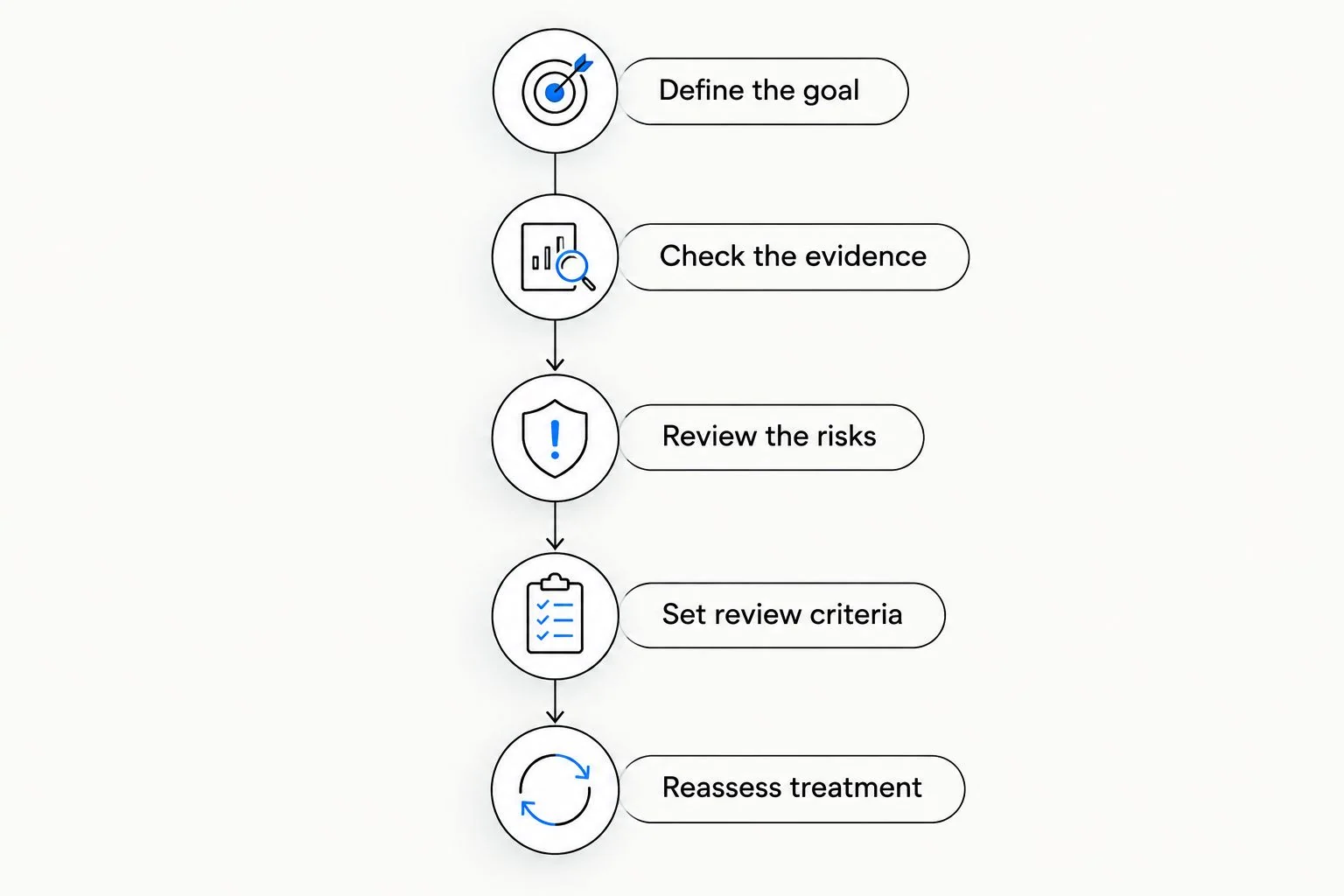
- Define the goal. State the problem you want addressed in concrete terms. Uneven facial pigmentation is more specific than looking healthier; fatigue during ordinary activities is more useful than wanting extra energy.
- Check the evidence. Ask whether research supports injectable glutathione for that exact goal. Ask the clinician to distinguish a plausible biological mechanism from demonstrated patient benefit.
- Review the risks. Discuss your medical history, medications, allergies, and pregnancy or breastfeeding status. Ask what reactions require stopping treatment or seeking urgent help.
- Set review criteria. Agree on what you will monitor and when the clinician will reassess the plan. A review appointment is a decision point, not a promise that results will appear by then.
- Reassess treatment. Report benefits, lack of benefit, and adverse effects honestly. Continuing because you have already started is not a medical reason to continue.
Keep a copy of the instructions and the questions you want answered. If the proposed plan changes, ask what clinical reason supports that change rather than assuming a higher dose means a better chance of success.
Does taking more glutathione make results appear faster?
Do not increase your dose or frequency to accelerate results. There is no established cosmetic or wellness timeline that makes self-directed escalation a sound strategy.
A prescription schedule should reflect a clinician's assessment, not an influencer's routine. If you miss an injection, follow the prescription instructions or contact the prescriber; do not improvise a catch-up schedule.
For a closer look at frequency, read can you take glutathione injections every day?. The decision still belongs with the prescribing clinician, including when the current plan is producing no clear benefit.
Find out if glutathione therapy may be right for you.
Start My Pre-AssessmentWhat if you notice nothing after starting treatment?
No noticeable change is a reason to review the treatment goal and evidence with your prescriber, not proof that you need more injections. Ask whether continuing has a defensible clinical purpose.
Describe what you actually observed. No improvement in fatigue, no consistent pigmentation change, and an injection-site reaction are separate findings that deserve separate discussion.
Does feeling better after an injection prove it worked?
Feeling better after an injection does not prove that glutathione caused the improvement. Timing alone cannot separate a treatment effect from normal variation, expectations, or other changes in your routine.
Report the improvement without overstating what it means. Your clinician can assess whether it is meaningful, sustained, and relevant to the original treatment goal.
Safety matters before speed
Injection treatment carries risks, including injection-site reactions, infection, and allergic reactions. A prescription and an online consultation do not remove those risks.
Seek emergency care for trouble breathing, swelling of the tongue or throat, or fainting after an injection. Do not wait for a routine follow-up to discuss symptoms that suggest a severe reaction.
Contact your clinician promptly about increasing redness, warmth, swelling, drainage, fever, or worsening pain around an injection site. Ask for instructions before using another dose when you suspect a reaction or a product problem.
If a prescription is compounded, understand the distinction: compounded drugs are not FDA-approved, and the FDA does not review them for safety, effectiveness, or quality before marketing. Prescribing does not turn a cosmetic claim into an approved indication.
For a 2026 provider comparison, prioritize clear prescribing information and access to clinical follow-up over promises of rapid results. Vevarx is for US adults seeking clinician-prescribed glutathione through telehealth, not a guaranteed cosmetic outcome. Its online model does not replace an in-person assessment when your symptoms require one.
Have questions about your options? Start with a quick online assessment.
Start My Pre-AssessmentFAQ
How long does it take to see results from glutathione injections?
There is no established, evidence-based timeline for skin lightening, energy, or general-wellness results from glutathione injections. Ask your prescriber what specific benefit is expected and what evidence supports that use.
Will I see results after my first glutathione injection?
A first injection does not come with a reliable expectation of visible or noticeable benefit. Feeling different afterward does not prove that glutathione caused the change.
How many glutathione injections do I need for brighter skin?
There is no established number of injections that reliably produces brighter skin. The FDA has not approved injectable products for skin lightening.
Can I take glutathione injections more often for faster results?
Do not increase injection frequency without instructions from your prescriber. More frequent use is not an established way to obtain faster cosmetic or wellness results.
Should I keep taking glutathione if I don't notice anything?
Ask your prescriber to reassess treatment rather than automatically continuing or increasing the dose. Review the original goal, any adverse effects, and the clinical reason for further treatment.
Does a glutathione injection detox my body right away?
An immediate detox benefit is not an established outcome of glutathione injections. Glutathione's biological antioxidant role does not demonstrate a rapid health benefit from supplemental injections.
Does Vevarx guarantee results from glutathione injections?
A doctor-prescribed glutathione treatment does not establish a guaranteed result or timeline. Vevarx offers prescription-based telehealth care; discuss the expected benefit, limitations, and follow-up plan with the clinician.
One last thing
Ask for a stopping rule, not just a starting schedule. Before treatment, establish what lack of benefit, adverse effect, or change in your health should trigger a reassessment.
That question is useful precisely because there is no dependable results countdown. A responsible plan explains how to make the next decision even when the hoped-for improvement never appears. For your 2026 treatment decision, clarity about when to reconsider matters more than a confident promise about when you will see a glow.
Related guides
Ready to get started?
See if doctor-prescribed glutathione therapy may be right for you. It only takes a few minutes, 100% online.
Start My Pre-AssessmentThis article is for informational purposes only and is not medical advice. Compounded medications are not approved by the FDA and have not been reviewed for safety, effectiveness, or quality. Prescription products require an online consultation with a licensed healthcare provider who will determine if a prescription is appropriate. Individual results vary.