
Is it safe to stop tirzepatide cold turkey?
Is it safe to stop tirzepatide cold turkey? Not always. Learn why tapering isn't routinely required, what to monitor, and when to call your doctor.

Tirzepatide does not require tapering to prevent a recognized withdrawal syndrome, but stopping cold turkey is not automatically safe for everyone. Appetite and blood sugar can rise after treatment stops, so arrange a plan with your prescriber—especially if you have diabetes—and seek urgent care rather than waiting for a routine appointment if you have severe symptoms.
- Is it safe to stop tirzepatide cold turkey? No withdrawal taper is required, but stopping needs a medical plan.
- Tirzepatide’s approximately 5-day half-life means its effects fade gradually, not immediately after your last injection.
- Returning hunger and weight regain are treatment-discontinuation concerns, not proof of addiction.
- FDA-approved tirzepatide instructions cover one missed dose; they do not establish a restart schedule after a prolonged break.
Why this matters
Stopping an injection and stopping its effects are different events. Tirzepatide remains in your body after the last dose, while its effects on appetite and glucose regulation gradually diminish.
For your 2026 treatment decisions, separate three questions: whether you need a withdrawal taper, whether your underlying condition still needs treatment, and whether symptoms require immediate assessment. A “no” to the first question does not answer the other two. For the longer-term decision, read how long you can stay on tirzepatide.
Curious whether you qualify? A licensed provider makes the final call.
Start My Pre-AssessmentIs it safe to stop tirzepatide cold turkey?
There is no standard requirement to taper tirzepatide to prevent withdrawal. FDA-approved tirzepatide prescribing information does not provide a routine discontinuation taper. However, stopping removes an active treatment for weight management, diabetes, or another prescribed indication.
Use this sequence before a planned stop:
- Explain the reason. Tell your prescriber whether you are stopping because of side effects, pregnancy, treatment preferences, or an interruption in care.
- Review diabetes treatment. Ask whether your glucose-monitoring plan or other diabetes medicines need adjustment. Do not change insulin independently.
- Agree on follow-up. Decide what symptoms, glucose readings, appetite changes, or weight trends should trigger contact.
- Clarify any restart. Get instructions before resuming treatment after a prolonged break. Your previous dose is not automatically the appropriate restart dose.
Stopping and tapering are not interchangeable guarantees of safety:
| Approach | Best suited to | Potential benefit | Limitation |
|---|---|---|---|
| Prescriber-directed stopping | People whose clinician decides treatment should end | Avoids unnecessary additional doses | Appetite or blood sugar can rise afterward |
| Individualized dose reduction | People whose clinician identifies a specific reason for gradual adjustment | Allows supervised reassessment during the change | No established taper reliably prevents weight regain |
| Unsupervised stopping or dose spacing | Not recommended | Avoids taking another dose | Leaves monitoring, replacement treatment, and restart questions unresolved |
A clinician-directed plan can involve stopping without tapering. The safety comes from matching that decision to your medical situation—not from assuming every medicine needs gradual dose reduction.
What happens after your last tirzepatide injection?
Tirzepatide has an elimination half-life of approximately 5 days, according to FDA-approved prescribing information. That means the amount in your body falls by about half over that interval; it does not disappear when you skip the next injection.
The gradual decline explains why stopping cold turkey does not create an immediate medication-free state. It also explains why an unwanted effect does not necessarily resolve as soon as you stop.
As exposure falls, you can notice more hunger or less fullness. If tirzepatide helps control your diabetes, glucose readings can rise. The timing and extent differ between people, so a calendar alone cannot tell you when monitoring is no longer necessary.
Returning hunger is not a withdrawal diagnosis. It can reflect the loss of an appetite-regulating treatment effect. Likewise, weight regain after stopping does not establish that the medicine caused addiction.
What does the evidence say about weight regain?
The SURMOUNT-4 randomized withdrawal trial studied adults with obesity or overweight, without diabetes. Participants first received tirzepatide for 36 weeks, then continued tirzepatide or switched to placebo for another 52 weeks.
Participants switched to placebo regained weight on average, while participants continuing tirzepatide lost additional weight on average. The trial supports a practical point: removing treatment can reverse part of its benefit.
The trial does not establish that everyone regains the same amount, that tapering prevents regain, or that every patient should remain on treatment indefinitely. It also does not answer how someone with diabetes should adjust other glucose-lowering medicines.
For a 2026 stopping decision, use this evidence to plan maintenance—not to predict your exact outcome. A follow-up plan should address appetite, nutrition, activity, weight trends, and whether another treatment is appropriate.
Why stopping tirzepatide affects people differently
Your stopping plan depends on more than the dose printed on the prescription. These factors change what your clinician needs to address:
- Reason for treatment. Stopping diabetes treatment raises glucose-management questions that differ from stopping treatment prescribed only for weight management.
- Other medicines. Insulin and sulfonylureas require particular attention because glucose needs can change as tirzepatide’s effects diminish.
- Reason for stopping. A planned treatment review is different from suspected pancreatitis, a serious allergic reaction, or recognized pregnancy.
- Current symptoms. Persistent vomiting, dehydration, or severe abdominal pain need assessment rather than an improvised taper.
- Treatment interruption. A single missed injection and a prolonged break require different conversations, particularly before restarting.
Give your prescriber your actual last injection date and dose. If you use a compounded formulation, include its concentration and dispensing instructions; syringe units alone do not identify the amount of medication.
How should you prepare to stop tirzepatide?
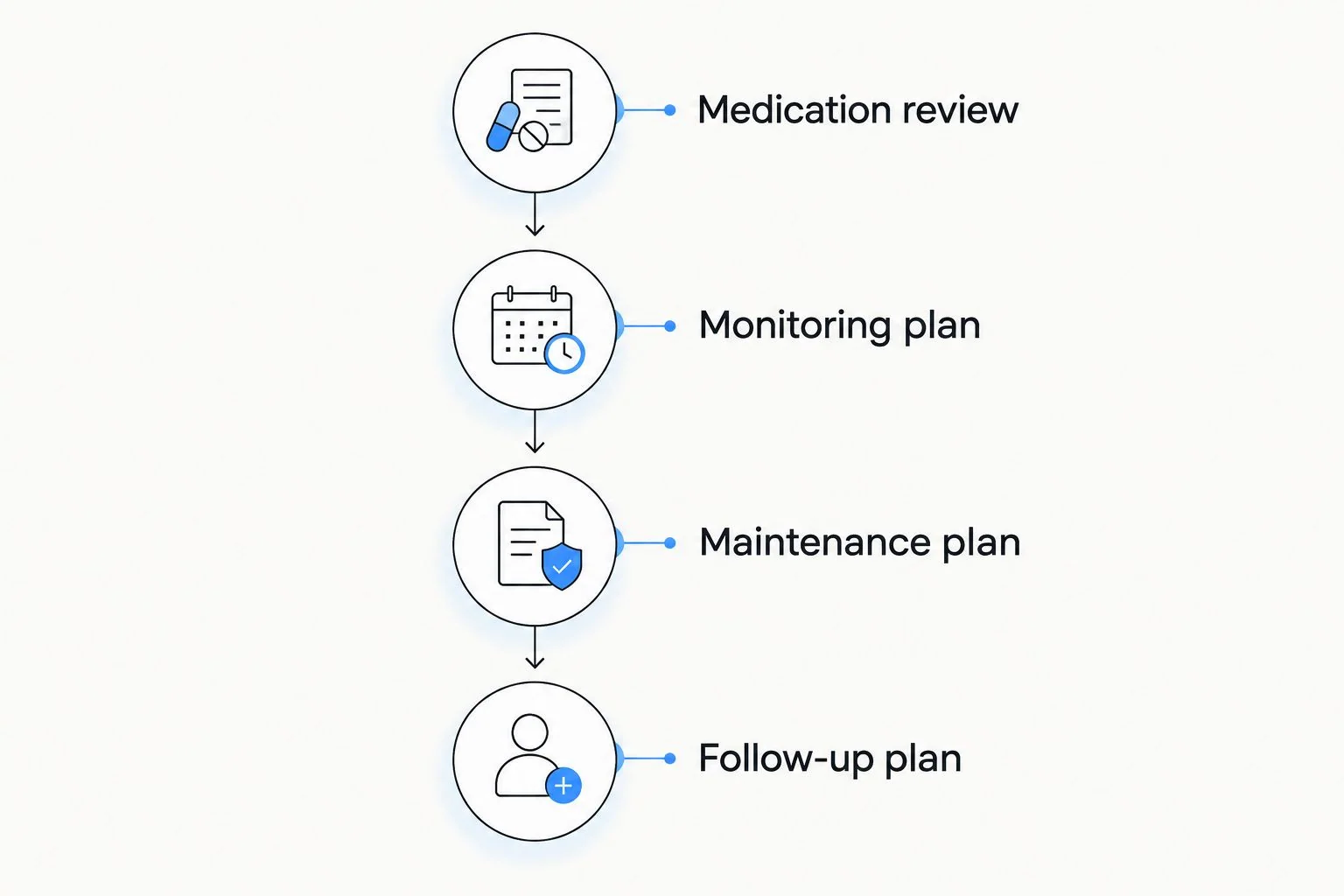
Build a short written plan with your treating clinician. Keep it specific enough that you know what to do when hunger changes, glucose rises, or symptoms appear.
- Medication review: List prescription medicines, supplements, your last tirzepatide dose, and why you want to stop.
- Monitoring plan: Agree on what to track and which results require a call. Diabetes glucose targets must be individualized.
- Maintenance plan: Discuss regular meals, adequate nutrition, physical activity, and support for returning appetite.
- Follow-up plan: Confirm who handles questions and how a future restart would be assessed.
For your 2026 medication review, bring actual readings and symptoms rather than a general impression that treatment “isn't working.” Explain whether the problem is nausea, difficulty eating, a weight plateau, or something else. Those concerns do not all require the same response.
Avoid replacing tirzepatide with another prescription medicine, an unprescribed peptide, or a supplement on your own. Stopping one treatment does not establish that a substitute is safe or appropriate.
When should you seek urgent medical care?
Severe symptoms change the priority from planning discontinuation to getting assessed. Do not wait for a routine telehealth response if you have signs of a serious reaction.
- Trouble breathing, fainting, or swelling of the face, tongue, or throat: Seek emergency care for a possible serious allergic reaction.
- Severe, persistent abdominal pain, especially with vomiting or pain extending to the back: Seek urgent assessment for possible pancreatitis. FDA-approved labeling directs discontinuation when pancreatitis is suspected.
- Repeated vomiting or inability to keep fluids down: Seek prompt care for dehydration and possible kidney complications.
- Confusion, deep or rapid breathing, or vomiting with markedly elevated glucose: Seek emergency assessment for a possible hyperglycemic emergency.
If you become pregnant, contact your prescriber promptly. Tirzepatide used for weight reduction should be discontinued when pregnancy is recognized; people with diabetes also need a pregnancy-appropriate glucose-management plan.
Do not keep taking doses solely because you believe tapering is mandatory. A suspected serious adverse reaction requires medical direction, not additional exposure to complete a self-designed schedule.
Find out if GLP-1 treatment may be right for you.
Start My Pre-AssessmentCan I restart tirzepatide after stopping?
A prolonged break requires a restart discussion, not an automatic return to your old dose. Tell your prescriber how long you have been off treatment, why you stopped, and whether you had side effects.
For a single missed dose, FDA-approved tirzepatide labeling says to take it within 4 days of the missed dose. If more than that interval has passed, skip the missed dose and resume the regular schedule; doses must be at least 72 hours apart.
Those instructions do not establish a universal restart schedule after multiple missed doses. Do not double up to compensate. If you use a compounded formulation, ask your prescriber or dispensing pharmacist for instructions specific to that prescription.
Will tapering tirzepatide prevent weight regain?
No established tirzepatide taper reliably prevents weight regain. Gradually changing a dose is not the same as proving that weight will remain stable after treatment ends.
Your clinician can discuss whether continued treatment, another appropriate therapy, or a nonmedication maintenance plan fits your situation. Any plan still needs follow-up. If hunger or weight trends become difficult to manage, report the change rather than waiting until you feel you have failed.
Where does online medical supervision fit?
VEVArx is best suited to US adults seeking online, doctor-prescribed weight-loss care rather than self-directed medication use. VEVArx offers medically supervised weight-loss treatment that includes tirzepatide; prescribing still requires an individual clinical decision.
The benefit of involving a prescriber is the opportunity to review treatment rather than inventing a stopping schedule yourself. The limitation is equally clear: an online platform is not a substitute for emergency assessment, and this article cannot determine your personal stopping or restart instructions.
If you receive weight-loss care through VEVArx, discuss medication changes with your treating clinician. Bring your medication details and specific concerns to that conversation.
Have questions about your options? Start with a quick online assessment.
Start My Pre-AssessmentFAQ
Is it safe to stop tirzepatide cold turkey in 2026?
Tirzepatide does not require tapering to prevent a recognized withdrawal syndrome, but stopping without a medical plan is not safe for every patient. Blood sugar and appetite can rise, so discuss monitoring and ongoing treatment with your prescriber.
Will I get withdrawal symptoms if I stop tirzepatide?
Tirzepatide does not have an established withdrawal syndrome requiring a routine taper. Returning hunger or rising blood sugar can reflect the loss of treatment effects rather than withdrawal.
How long does tirzepatide keep working after the last shot?
Tirzepatide has an approximately 5-day half-life, so medication exposure declines gradually after the last injection. That figure does not predict exactly when appetite, side effects, or blood sugar will change for you.
Can stopping tirzepatide make my blood sugar go up?
Yes, stopping tirzepatide can raise blood sugar because its glucose-lowering effect diminishes. If you have diabetes, agree on monitoring and any replacement treatment with your prescriber; do not independently change insulin.
Should I stop tirzepatide if it makes me nauseated?
Nausea needs a severity-based assessment, not an automatic decision to continue or stop. Contact your prescriber, and seek urgent care for severe abdominal pain, repeated vomiting, or inability to keep fluids down.
Can I restart my previous tirzepatide dose after a long break?
Do not automatically restart your previous tirzepatide dose after a prolonged break. Your prescriber needs to review the interruption, prior side effects, and current health before giving restart instructions.
Can VEVArx tell me whether I should stop tirzepatide?
If you receive treatment through VEVArx, ask your treating clinician to assess whether stopping is appropriate. A general article cannot replace that assessment or provide a personalized taper or restart schedule.
One last thing
Your last injection date is useful medical information. Record it alongside the dose, medication formulation, symptoms, and any glucose readings before you contact your prescriber.
For a 2026 medication review, that record is more useful than simply saying you stopped “a while ago.” It helps separate a missed dose from a longer interruption and gives your clinician a clearer basis for the next decision.
Related guides
Ready to get started?
See if doctor-prescribed GLP-1 treatment may be right for you. It only takes a few minutes, 100% online.
Start My Pre-AssessmentThis article is for informational purposes only and is not medical advice. Compounded medications are not approved by the FDA and have not been reviewed for safety, effectiveness, or quality. Prescription products require an online consultation with a licensed healthcare provider who will determine if a prescription is appropriate. Individual results vary.