
Can you take semaglutide with metformin?
Can you take semaglutide with metformin? Yes, when prescribed together. Review blood sugar risks, stomach side effects, kidney checks, and timing.

Yes, you can take semaglutide with metformin when your prescriber recommends both; this is an established combination for treating type 2 diabetes. The main concerns are overlapping stomach side effects, dehydration, and low blood sugar when other glucose-lowering medicines are involved. Your medication list, kidney function, and semaglutide formulation determine the monitoring and timing you need.
- Can you take semaglutide with metformin? Yes, when prescribed together; the combination is established in type 2 diabetes care.
- Semaglutide and metformin can both cause stomach symptoms; persistent vomiting or dehydration needs medical attention.
- Insulin and sulfonylureas increase low-blood-sugar concerns when added to this combination.
- VEVArx offers medically supervised weight loss online; medication combinations require an individual prescribing decision.
Can you take semaglutide with metformin?
Semaglutide and metformin can be prescribed together because they lower blood glucose through different mechanisms. Metformin mainly reduces glucose production by the liver. Semaglutide increases glucose-dependent insulin release, reduces glucagon secretion, and slows gastric emptying.
The combination is not automatically appropriate for everyone seeking weight loss. If you have diabetes, the treatment decision belongs within your broader GLP-1 weight-loss plan for type 2 diabetes, including glucose monitoring and coordination with your diabetes clinician.
| Treatment approach | Best for | Main benefit | Main limitation |
|---|---|---|---|
| Metformin alone | People whose prescribed diabetes plan is adequately controlled with metformin | Lowers blood glucose without usually causing hypoglycemia by itself | Stomach side effects and kidney-function restrictions |
| Semaglutide alone | People with an appropriate diabetes or weight-management indication, depending on the product | Supports glucose control, weight management, or both, according to its indication | Gastrointestinal effects and product-specific contraindications |
| Semaglutide with metformin | People whose clinician identifies a reason to use both | Addresses blood glucose through complementary mechanisms | Overlapping stomach effects and a more involved medication plan |
FDA-approved semaglutide prescribing information includes use alongside metformin in clinical studies. That supports compatibility—not permission to add either medicine without a prescription review.
Curious whether you qualify? A licensed provider makes the final call.
Start My Pre-AssessmentWhy this matters
For your 2026 medication review, distinguish a compatible combination from the right combination for you. A clinician still needs to decide whether both medicines serve a treatment goal and whether you can tolerate them.
Metformin use does not automatically mean you have diabetes; clinicians also prescribe it for certain other conditions. Likewise, semaglutide products have different approved indications, so a diabetes prescription and a weight-management prescription are not interchangeable treatment plans.
Adding medication also adds decisions. You need to know which clinician manages dose changes, what symptoms to report, and what to do if illness prevents normal eating or drinking.
Injectable semaglutide with metformin: timing is usually separate
Weekly injectable semaglutide generally does not require a waiting period before or after metformin. You can usually take your prescribed metformin on the same day as your injection, following each medicine's instructions.
Metformin is commonly taken with meals to reduce gastrointestinal effects. Injectable semaglutide can generally be administered with or without food; keeping a consistent injection schedule matters more than separating it from metformin.
Do not change either dose simply because both medicines fall on the same day. If nausea repeatedly follows injection day, tell your prescriber rather than skipping metformin or advancing your semaglutide dose yourself.
Your instructions also need to match your actual formulation. A compounded preparation requires its own prescription review; instructions for an approved injection should not be assumed to cover every preparation.
Oral semaglutide with metformin: follow the tablet instructions
Oral semaglutide has administration requirements that injectable semaglutide does not. For oral tablets whose FDA labeling specifies this schedule, take the tablet on an empty stomach with no more than 4 ounces of plain water, then wait at least 30 minutes before food, drinks, or other oral medicines.
That waiting period includes metformin. Afterward, take metformin according to its own prescription, including any instruction to take it with a meal.
For a 2026 prescription check, ask your pharmacist to confirm the instructions for the exact oral product dispensed. Do not assume every semaglutide product uses an identical schedule.
A useful distinction: swallowing two medicines together is an administration question; receiving both medicines as part of one treatment plan is a prescribing question. Separating tablets does not resolve an unsuitable treatment plan.
Why safety and tolerability vary
The interaction question is only part of the assessment. These factors determine how closely your clinician needs to monitor treatment:
- Other diabetes medicines. Insulin and sulfonylureas increase hypoglycemia risk. Your clinician may need to adjust those medicines when semaglutide is added.
- Kidney function. Metformin has kidney-function restrictions, and dehydration during gastrointestinal illness can worsen kidney function.
- Formulation. Oral semaglutide has specific administration requirements; injections follow a different schedule.
- Dose changes. Starting treatment or increasing a dose can bring nausea, vomiting, diarrhea, or reduced food intake.
- Treatment purpose. Diabetes control, obesity treatment, and another reason for metformin require different assessments of benefit.
- Medical history. Severe stomach-emptying problems, pancreatitis history, and semaglutide-specific contraindications require review before prescribing.
Bring supplements and nonprescription products into that discussion, too. A medication review is incomplete if your clinician only knows about the two prescriptions named in the question.
What side effects should you watch for?
Stomach symptoms are the most obvious overlap between semaglutide and metformin. Both can cause nausea or diarrhea; semaglutide can also cause vomiting, constipation, and abdominal discomfort. Timing helps your clinician assess the cause, but symptoms alone do not reliably identify which medicine is responsible.
Smaller meals, stopping when comfortably full, and avoiding foods that clearly trigger symptoms can help with tolerability. Take metformin with food when directed, and drink fluids regularly unless your clinician has restricted your fluid intake.
Contact your prescriber if symptoms persist, interfere with eating, or make normal activities difficult. Do not keep increasing semaglutide while significant symptoms remain unresolved unless your prescriber specifically instructs you to do so.
When symptoms need urgent attention
Seek urgent medical assessment for severe or persistent abdominal pain, especially pain extending to your back, repeated vomiting, fainting, or signs of significant dehydration. These symptoms need evaluation rather than another home remedy.
If you cannot keep fluids down, ask for same-day advice about your medicines. Acute illness can require temporary medication changes, but the instructions should come from your clinician or an established sick-day plan.
Call emergency services for collapse, severe confusion, seizures, or difficulty breathing. Do not give food or drink to someone who cannot swallow safely.
Can semaglutide and metformin cause low blood sugar?
Blood glucose below 70 mg/dL is low, and the risk deserves particular attention if you also use insulin or a sulfonylurea. Semaglutide and metformin used without those medicines generally have a low risk of hypoglycemia, but symptoms still need assessment.
Warning signs include shakiness, sweating, hunger, dizziness, palpitations, and confusion. Check your glucose if you have a meter or continuous glucose monitor and follow your prescribed treatment plan.
For an awake adult who can swallow safely, standard hypoglycemia guidance uses 15 grams of fast-acting carbohydrate, followed by a glucose recheck after 15 minutes. Repeat treatment if glucose remains low, following your diabetes care instructions; severe symptoms require emergency help.
Do not assume every dizzy spell is hypoglycemia. Dehydration, reduced food intake, and other conditions can cause similar symptoms, which is why a glucose reading and clinical context matter.
Find out if GLP-1 treatment may be right for you.
Start My Pre-AssessmentDoes metformin need to stop when semaglutide starts?
Starting semaglutide does not automatically mean stopping metformin. Many diabetes treatment plans retain metformin when another medicine is added, provided it remains appropriate and tolerated.
Kidney function can change that decision. FDA metformin labeling contraindicates use when estimated glomerular filtration rate, or eGFR, is below 30 mL/min/1.73 m². Other kidney-function ranges also require prescribing review rather than a self-directed decision.
Long-term metformin use can lower vitamin B12 levels, so your clinician can assess whether testing is indicated, especially with anemia or new numbness or tingling. Semaglutide does not remove that monitoring consideration.
For your 2026 follow-up, ask whether each medicine still has a clear purpose. Better glucose readings are a reason to review the plan—not proof that you should stop one medicine yourself.
How should you prepare for a prescription review?
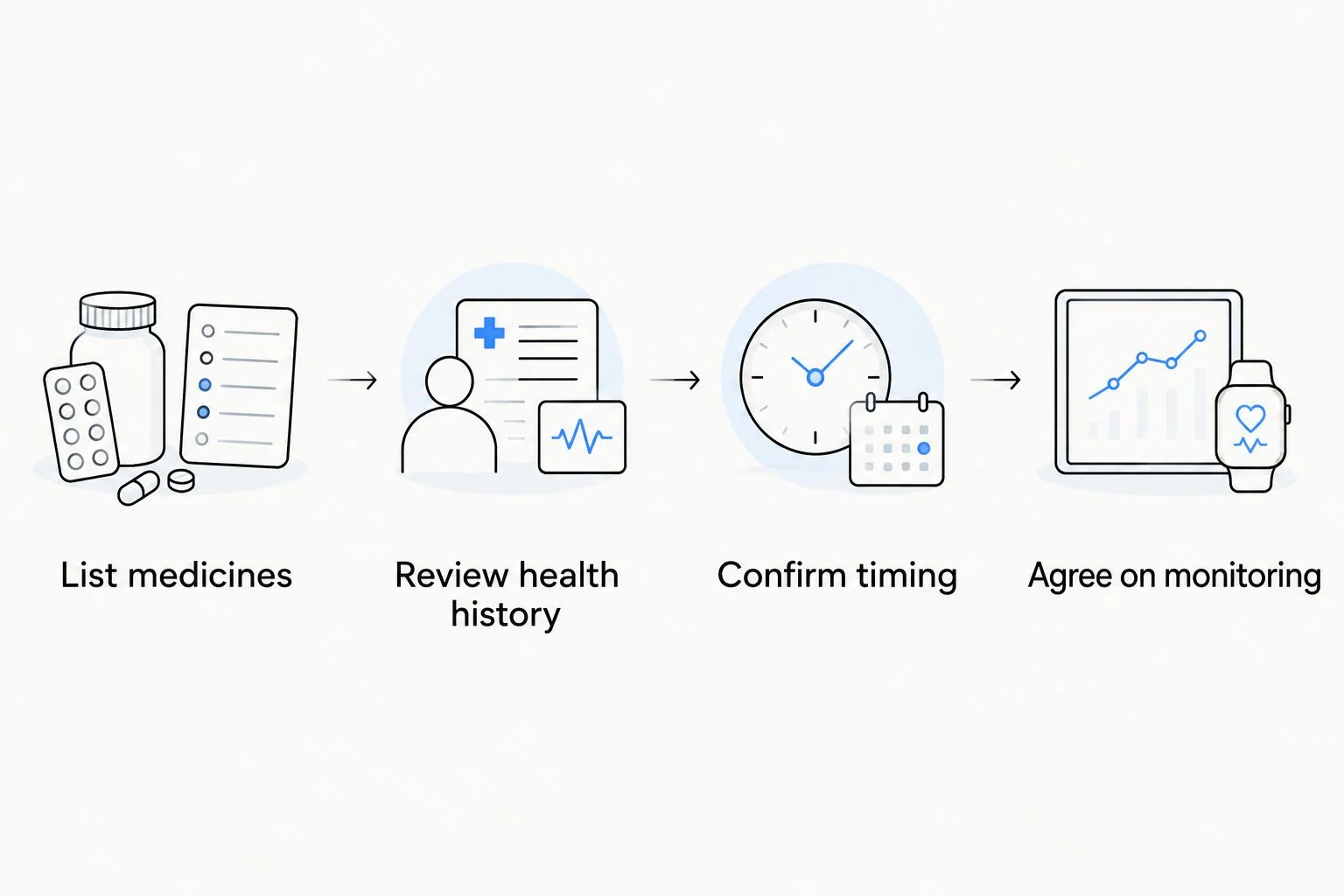
Use this sequence before adding semaglutide to metformin or changing an existing combination. It keeps the discussion focused on decisions rather than a generic interaction check.
- List medicines. Record exact names, formulations, prescribed doses, supplements, and any insulin or sulfonylurea use. Include who prescribes each medicine.
- Review health history. Bring relevant kidney results and disclose pancreatitis, severe stomach symptoms, pregnancy plans, and personal or family history of medullary thyroid carcinoma or MEN2.
- Confirm timing. Ask for instructions that distinguish oral semaglutide from injections and explain how metformin fits around meals.
- Agree on monitoring. Establish which glucose readings or symptoms require contact, who handles dose changes, and what to do during vomiting or poor fluid intake.
VEVArx is best suited to US adults seeking online, medically supervised weight loss. The platform offers doctor-prescribed GLP-1 medications, but an individual assessment must determine whether semaglutide fits alongside your existing metformin prescription; online prescribing does not replace urgent assessment of severe symptoms.
Explore medically supervised weight loss
VEVArx offers online, doctor-prescribed GLP-1 weight-loss treatment for US adults.
Can you take both medicines just for weight loss?
Combining semaglutide and metformin is not an automatic weight-loss upgrade. A clinician needs a reason to prescribe each medicine, even when weight management is your primary goal.
Metformin is not FDA-approved specifically for weight loss. Semaglutide's approved use depends on the product and the patient's eligibility; the fact that both medicines can affect weight does not establish that adding metformin will improve your result.
For a 2026 weight-management consultation, explain why metformin was originally prescribed and whether that reason still applies. Keep the focus on treatment benefit, tolerability, and follow-up—not simply having more medications in the plan.
Have questions about your options? Start with a quick online assessment.
Start My Pre-AssessmentFAQ
Can I take metformin on the same day as my semaglutide injection?
Yes, prescribed metformin can generally be taken on the same day as injectable semaglutide. Follow each medicine's directions, including taking metformin with meals when instructed.
Do I need to separate oral semaglutide and metformin?
For oral semaglutide tablets whose labeling requires it, wait at least 30 minutes before taking metformin or other oral medicines. Confirm the instructions for your exact product with your pharmacist.
Will semaglutide and metformin make my blood sugar too low?
Semaglutide and metformin generally have a low hypoglycemia risk without insulin or a sulfonylurea. Blood glucose below 70 mg/dL is low and needs treatment according to your diabetes care plan.
Should I stop metformin if semaglutide makes me nauseous?
Do not stop or change metformin on your own because of nausea. Contact your prescriber to review symptom severity, dose timing, hydration, and whether either prescription needs adjustment.
Is semaglutide with metformin safe if I have kidney disease?
Kidney disease requires an individual medication review before combining semaglutide and metformin. Metformin is contraindicated when eGFR is below 30 mL/min/1.73 m², and dehydration can create additional kidney concerns.
Can I add metformin to semaglutide to lose weight faster?
Do not add metformin solely to accelerate weight loss without a prescribing assessment. Metformin is not FDA-approved specifically for weight loss, and an added benefit is not guaranteed.
Can I discuss my current metformin prescription during an online weight-loss assessment?
Yes, disclose your metformin prescription during any online weight-loss assessment, including with VEVArx. Your clinician needs the reason for treatment, formulation, dose, other medicines, and relevant medical history before deciding on semaglutide.
One last thing
A missed instruction can matter even when there is no major direct drug interaction. Oral semaglutide taken alongside breakfast and metformin can conflict with its administration requirements; injectable semaglutide does not have that same food-timing rule.
For your 2026 medication review, bring the actual prescription labels or clear photographs of them. Ask your pharmacist to write one schedule and your clinician to provide one sick-day plan so you know what to do before nausea, illness, or a missed meal complicates treatment.
Safety references: FDA-approved semaglutide and metformin prescribing information, plus American Diabetes Association hypoglycemia guidance. This article provides general education for US adults, not an individual prescribing or emergency-care plan.
Related guides
Ready to get started?
See if doctor-prescribed GLP-1 treatment may be right for you. It only takes a few minutes, 100% online.
Start My Pre-AssessmentThis article is for informational purposes only and is not medical advice. Compounded medications are not approved by the FDA and have not been reviewed for safety, effectiveness, or quality. Prescription products require an online consultation with a licensed healthcare provider who will determine if a prescription is appropriate. Individual results vary.